
Best SaaS LinkedIn Ads Agencies for B2B Lead Generation
The best SaaS LinkedIn Ads agencies for B2B lead generation include SaaSHero, B2Linked, Directive Consulting, Remotion, Impactable, The B2B Playbook, KlientBoost, and Cleverly. These agencies specialize in targeting decision-makers on LinkedIn using Sponsored Content, Lead Gen Forms, and Account-Based Marketing (ABM) strategies. They focus on real revenue metrics like Net New ARR, pipeline value, and CAC payback — not just vanity metrics like clicks or impressions. Pricing ranges from $397/month to $7,000+/month depending on ad spend and scope of service. INTRODUCTION LinkedIn isn’t just a networking platform anymore — it’s the single most powerful paid advertising channel for B2B SaaS companies in 2026. If you’re a SaaS founder, CMO, or growth marketer struggling to generate qualified pipeline, the right SaaS LinkedIn Ads agency for B2B lead generation can completely transform your results. Here’s a number that should stop you in your tracks: 80% of all B2B social media leads come from LinkedIn, according to Foundation Inc. And yet, most SaaS companies waste their budgets on poorly targeted campaigns that generate cheap clicks but zero qualified pipeline. The secret? You need a specialized partner — one that understands SaaS buyer psychology, long sales cycles, and multi-stakeholder buying committees. In this article, we’ll cover the top agencies ranked by real-world performance, break down how LinkedIn advertising works for SaaS, explore key selection criteria, and share expert tips to maximize your ROI. Whether you’re a bootstrapped startup or a Series B company, this guide has everything you need. What Are SaaS LinkedIn Ads Agencies for B2B Lead Generation? A SaaS LinkedIn Ads agency for B2B lead generation is a specialized marketing partner that plans, launches, manages, and optimizes paid advertising campaigns on LinkedIn specifically for software-as-a-service companies targeting other businesses. Unlike generalist digital marketing agencies, these firms deeply understand the unique dynamics of B2B SaaS — including long sales cycles, high ACV deals, multiple buying stakeholders, and the need to demonstrate ROI in terms of pipeline and Annual Recurring Revenue (ARR), not just impressions or leads. LinkedIn is the world’s largest professional network with over 950 million members and 67 million companies registered on the platform (LaGrowthMachine, 2026). Its targeting capabilities are unmatched for B2B: you can reach a Head of Procurement at a 500-person enterprise, a VP of Engineering at a Series C startup, or a CFO in the fintech vertical — with razor-sharp precision. No other platform comes close for this type of targeting. These agencies matter because LinkedIn advertising is expensive and complex. The average Cost Per Click (CPC) on LinkedIn ranges from $6 to $10, and Cost Per Lead (CPL) for B2B technology companies routinely exceeds $100 (nav43.com, 2025). Without expert management, SaaS companies hemorrhage budget on the wrong audiences, the wrong ad formats, and the wrong messaging. Specialized agencies exist to eliminate that waste and convert ad spend into measurable pipeline. How Does LinkedIn Advertising Work for SaaS B2B Companies? Understanding the mechanics of LinkedIn advertising is essential before choosing an agency. The process, at a high level, works as follows: An important concept here is the LinkedIn 95-5 Rule — LinkedIn’s own research shows that 95% of your potential buyers are not in the market to buy right now. Winning SaaS brands use LinkedIn to build brand awareness with the 95% while capturing the 5% who are ready to act. Specialized agencies design full-funnel strategies to address this reality. Top 10 Best SaaS LinkedIn Ads Agencies for B2B Lead Generation (2026) Here is a comprehensive comparison of the leading agencies: Agency Best For Pricing (Monthly) Key Strength SaaSHero Revenue-first B2B SaaS From $1,250 (flat fee) 650% ROI, ARR-focused reporting B2Linked Enterprise LinkedIn budgets From $3,000 + $1,000 setup $150M+ LinkedIn ad spend managed Directive Consulting Mid-market SaaS scaling Custom (larger budgets) Customer Generation methodology Remotion Series A–E SaaS/tech Custom; $15K+ ad spend min SQL-to-closed-won tracking Impactable Venture-backed startups From $1,500 LinkedIn + Google Ads combo The B2B Playbook Pipeline-focused B2B From $1,580 5 BEs demand gen framework KlientBoost Cross-channel PPC + CRO Performance-based 63% avg ROI lift in 3 months Cleverly Top-of-funnel volume From $397 Outreach + ads combined Metadata.io RevOps-mature teams Custom Automation + CRM integration Disruptive Advertising Multi-channel paid media Custom Google + LinkedIn integrated Let’s explore the standout agencies in detail. SaaSHero leads the pack for pure-play B2B SaaS LinkedIn advertising. Their entire model is built around revenue metrics — specifically, Net New ARR and CAC payback periods. They use flat-fee retainers (starting at $1,250/month) rather than percentage-of-spend pricing, which eliminates the conflict of interest that plagues many agencies. Their case studies speak for themselves: TripMaster generated $504,758 in Net New ARR in one year, while TestGorilla achieved an 80-day payback period that supported their $70M Series A round. Their specialization spans HR Tech, Cybersecurity, Transportation, and MarTech verticals. B2Linked, founded by AJ Wilcox — one of the world’s most recognized LinkedIn Ads experts — is the original LinkedIn-only agency. They have managed over $150M in LinkedIn ad spend across 1,000+ businesses and hold official LinkedIn Marketing Partner status. Their proprietary campaign management and scheduling tools provide a genuine performance advantage. B2Linked is ideal for enterprises with established LinkedIn budgets who need maximum channel efficiency. Directive Consulting brings a data-driven “Customer Generation” methodology that prioritizes Customer Acquisition Cost (CAC) and Lifetime Value (LTV) over surface metrics. They integrate LinkedIn Ads with broader paid search and social strategy. This makes them an excellent choice for mid-market and enterprise SaaS companies that have a mature paid media infrastructure and want to scale proven acquisition models. Remotion is the specialist’s specialist for B2B SaaS. Founded in 2016 and serving companies from startup to unicorn, Remotion tracks all the way down the funnel — from click to SQL, opportunity, and closed-won. They actively collaborate with SDR/BDR teams on lead quality. Their preferred minimum ad spend is $15,000/month, making them best suited for well-funded SaaS companies. Impactable, founded by LinkedIn expert Justin Rowe, is a strong fit for high-growth, venture-backed startups. They combine LinkedIn Ads with Google Ads, covering the full lead generation and demand generation funnel. Their custom-built campaign tools and understanding of investor-driven growth metrics make them a reliable partner for companies moving fast.
Best SaaS Demand Generation Agencies for B2B Growth in 2026
The best SaaS demand generation agencies for B2B growth in 2026 include Hey Digital, Refine Labs, Directive Consulting, Powered by Search, Kalungi, Single Grain, 42 Agency, Ironpaper, Omniscient Digital, and Disruptive. These agencies specialize in full-funnel demand creation, paid media, ABM, content marketing, and pipeline-aligned measurement. They don’t just generate leads — they build systems that convert awareness into revenue. The right agency depends on your company’s stage, budget, ICP clarity, and whether you need paid, organic, or multi-channel execution. Introduction If your B2B SaaS company is generating leads but struggling to fill the pipeline, you’re not alone — and the problem might not be your product. It might be your demand generation strategy. In 2026, the B2B SaaS market is valued at over $497 billion (Fortune Business Insights), and competition for buyer attention has never been fiercer. Standing out requires more than running ads or sending email blasts. It requires a systematic, full-funnel approach to creating, capturing, and converting demand. That’s exactly where the best SaaS demand generation agencies for B2B growth make their mark. These specialist agencies understand how SaaS buyers research, evaluate, and purchase — and they build marketing programs that align with that journey from first touchpoint to closed deal. In this guide, you’ll discover the top 10 agencies, what makes each one unique, how demand generation works, the key benefits of hiring an expert agency, common mistakes to avoid, and how to choose the right partner for your growth stage. Whether you’re a Series A startup or a scaling enterprise, this guide will help you make a confident decision. What is SaaS Demand Generation? (Full Explanation) Demand generation is the process of creating awareness, interest, and desire for your SaaS product among your ideal customers — long before they’re ready to buy. Unlike lead generation, which focuses on capturing contact information, demand generation works at a higher, more strategic level. Think of lead generation as fishing with a net — you’re pulling in whatever swims by. Demand generation is like building an ecosystem where your ideal fish naturally thrive, are attracted to your pond, and trust you enough to swim toward the hook when the time is right. In the context of B2B SaaS, demand generation is particularly critical because buying journeys are long, involve multiple stakeholders, and rarely follow a straight line. Research from Forrester shows that B2B buyers complete 57–70% of their purchase journey before ever contacting a vendor. This means your marketing needs to be working hard during those unseen stages. A strong SaaS demand generation strategy typically spans three core stages: The best agencies treat all three stages as a unified system, not isolated campaigns. They align marketing directly to pipeline, CAC (Customer Acquisition Cost), and LTV (Lifetime Value) — not vanity metrics like impressions or raw lead volume. How Does B2B SaaS Demand Generation Work? Understanding the mechanics behind demand generation helps you ask the right questions when evaluating agencies. Here’s how a high-performing demand gen program typically operates, step by step: Step 1 — Define Your ICP (Ideal Customer Profile) Every effective program starts here. The agency works with your sales and marketing teams to identify exactly who you’re targeting: company size, industry, decision-maker roles, pain points, and buying triggers. Without sharp ICP clarity, campaigns waste budget on the wrong audience. Step 2 — Develop Messaging and Positioning Before a single ad is written or piece of content is published, strong agencies invest time in understanding your unique value proposition. How is your SaaS product different? What specific pain does it solve? The messaging framework becomes the backbone of all campaign creative. Step 3 — Build a Multi-Channel Strategy The best demand generation programs rarely rely on a single channel. A typical B2B SaaS program might combine LinkedIn Ads for brand awareness, Google Ads for high-intent capture, SEO content for organic pipeline, and email nurture sequences to move prospects closer to a sales conversation. Step 4 — Launch, Test, and Iterate Agencies run structured experiments — testing ad creatives, landing page headlines, CTA variations, and audience segments. This “test-and-learn” culture is what separates elite agencies from those that just “manage campaigns.” Step 5 — Measure Pipeline and Revenue Impact The agency connects marketing activity to your CRM (HubSpot, Salesforce, etc.) to track how demand programs influence opportunities, pipeline value, and closed-won revenue. MQL counts are replaced with metrics that actually matter to leadership. Step 6 — Optimize and Scale With data flowing in, the agency continuously refines what’s working. Winning channels get more budget. Underperforming tactics are paused. Over time, demand generation becomes a predictable, compounding growth engine. Top 10 Best SaaS Demand Generation Agencies for B2B Growth Here is a comprehensive overview of the leading agencies in 2026, each with distinct strengths, specialties, and ideal client profiles. Agency Primary Specialty Best For Pricing Hey Digital Paid-led full-funnel demand gen Series A–C+ SaaS companies Custom Refine Labs Demand creation & category building Mid-market & Enterprise SaaS Custom Directive Consulting CAC/LTV-focused customer generation Growth-stage SaaS Custom Powered by Search SEO + paid hybrid demand gen Series A–C companies Custom Kalungi GTM strategy + fractional CMO Early-stage SaaS Custom Single Grain Experimentation-led growth marketing B2B & B2C SaaS Custom 42 Agency Narrative + product marketing Complex-product SaaS Custom Ironpaper ABM-led demand generation Enterprise B2B SaaS Custom Omniscient Digital Content-led organic demand Organic-first SaaS teams Custom Disruptive Scalable paid demand generation Growth-stage SaaS Custom Hey Digital Hey Digital is a B2B SaaS performance marketing agency that specializes in paid-led demand generation. Their approach is uniquely built around pipeline stages, not individual channels, making them ideal for SaaS companies that want their ad spend to translate directly into qualified pipeline. They work with clients like Hotjar, Toggl, Todoist, PostHog, and UserTesting — companies that need repeatable, scalable demand systems. What sets Hey Digital apart is their emphasis on cross-channel campaign orchestration and structured creative experimentation, ensuring that messaging evolves alongside your buyers. Refine Labs Refine Labs is arguably the most recognized name in B2B SaaS demand generation. Founded by Chris Walker, the agency is famous for popularizing the “demand creation vs. demand capture” distinction and championing pipeline-focused measurement over MQL reporting. They work primarily with mid-market and enterprise SaaS companies, building category-level awareness through paid social, content distribution, and community-led strategies.
When Should SaaS Companies Invest in Paid Ads? Complete Strategy Guide
SaaS companies should invest in paid ads after achieving product-market fit (PMF), when they have paying customers actively using the product, a clearly defined user persona, basic analytics tracking in place, and a monthly budget of at least $5,000. Paid ads work best when you already know who you’re selling to and why they buy. Launching paid campaigns too early — before PMF — burns budget on a product the market hasn’t validated. Once your organic channels begin to plateau and you have a clear LTV:CAC ratio target of 3:1 or better, paid advertising becomes a powerful, scalable growth engine for your SaaS business. INTRODUCTION Paid advertising can be rocket fuel for a SaaS company — or a bonfire for your budget. The difference? Timing. Many SaaS founders make the costly mistake of launching Google Ads or LinkedIn campaigns the moment their product goes live. The result? Wasted thousands of dollars, zero conversions, and a deep frustration with paid channels. But here’s the truth: paid ads don’t fail SaaS companies — bad timing does.CONCLUSION Knowing when SaaS companies should invest in paid ads is not a question of calendar date or ARR milestone alone — it’s about strategic readiness. The clearest answer is this: invest in paid ads after you’ve achieved product-market fit, defined your user personas, set up your tracking infrastructure, and established a budget that reflects your niche’s competitive reality. Get the timing right, and paid ads become the most powerful growth lever in your SaaS arsenal — delivering immediate traffic, fast feedback loops, and scalable revenue. Get it wrong, and you’ll burn budget on a product or audience that isn’t ready. The key takeaways are simple: validate before you accelerate, track before you spend, and always tie every dollar back to your LTV:CAC ratio. Ready to make paid ads work for your SaaS? Share this guide with your marketing team, drop your biggest paid ads question in the comments below, or explore our related resources on SaaS marketing strategy. The right investment at the right time could be the decision that changes your growth trajectory forever. According to recent data, customer acquisition costs (CAC) for SaaS have risen by 60% over the past five years, and B2B SaaS deals now require an average of 266 touchpoints before closing. That means paid ads have never been more complex — or more strategic — than they are today. In this guide, you’ll learn exactly when SaaS companies should invest in paid ads, what signals to look for before launching, how to set your budget, which platforms to use, and the common pitfalls to avoid. Whether you’re a seed-stage startup or a scaling SaaS with $1M+ ARR, this article will give you a clear, actionable roadmap. What Is “Investing in Paid Ads” for SaaS Companies? Investing in paid advertising for SaaS means allocating a dedicated budget to run campaigns on platforms like Google Ads, LinkedIn Ads, Meta Ads, or YouTube — with the goal of acquiring new users, generating trial sign-ups, or booking product demos. Unlike organic strategies such as SEO or content marketing, paid ads deliver immediate visibility in front of a targeted audience. For SaaS businesses, paid acquisition is unique because the product is subscription-based. This means the lifetime value (LTV) of a single customer can stretch over months or years, which changes how you calculate ROI. A SaaS company isn’t just buying a one-time transaction — it’s buying a recurring revenue relationship. The core question isn’t whether to run paid ads. Almost every growing SaaS company eventually does. The real question is when the conditions are right to invest — and that depends on a set of very specific signals. Running paid ads too early is like pouring gasoline on a fire that hasn’t been lit yet. Running them at the right time is like hitting a turbocharger on a well-tuned engine. The global SaaS market is projected to surpass $299 billion in 2025 (Digital Silk), and competition for customer attention is fiercer than ever. That makes strategic paid ad investment not just important — it’s a competitive necessity. How Do You Know When Your SaaS Is Ready for Paid Ads? This is the most critical question every SaaS founder and marketer must answer honestly before spending a single dollar on ads. There is no universal launch date — readiness is determined by a checklist of business fundamentals. 1. You’ve Achieved Product-Market Fit (PMF) Product-market fit, a term coined by investor Marc Andreessen, means your product satisfies a genuine, strong market demand. You know you have PMF when happy paying customers are referring other paying customers. Experts and growth practitioners consistently agree: do not run paid ads before PMF. If you run ads before PMF, you’ll acquire users who churn quickly — burning your budget without building sustainable revenue. A reliable signal of PMF is what Sean Ellis calls the “40% rule” — at least 40% of your users should say they would be “very disappointed” if your product disappeared. Once you hit that benchmark, you have the foundation to scale with paid. 2. You Have Paying Users Actively Using the Product Active users validate three critical things: your product works, your market is real, and your customer personas are accurate. Without active paying users, your paid campaigns will drive sign-ups that don’t engage — inflating your CAC without building LTV. 3. Your User Personas Are Clearly Defined Before launching any paid campaign, you need detailed, research-backed customer personas. These include demographics, job titles, pain points, goals, device usage, and behavioral triggers. Paid platforms like LinkedIn and Google use this data for precise targeting. Without defined personas, your ads reach the wrong people — and money gets wasted. 4. Tracking & Analytics Infrastructure Is in Place This is a non-negotiable step that many founders skip. Before running paid ads, ensure the following are configured: Google Analytics 4 (GA4), Google Tag Manager, conversion goal tracking, UTM parameters, and CRM integration. Without this infrastructure, you’re flying blind — spending money without knowing what’s working. 5. You Have a Defined Budget According to Lever Digital, you can technically start with $500/month, but you need at least $5,000/month to generate meaningful, statistically significant results. Many
13 PPC Ad Copy Examples You Can Learn From (2025 Guide)
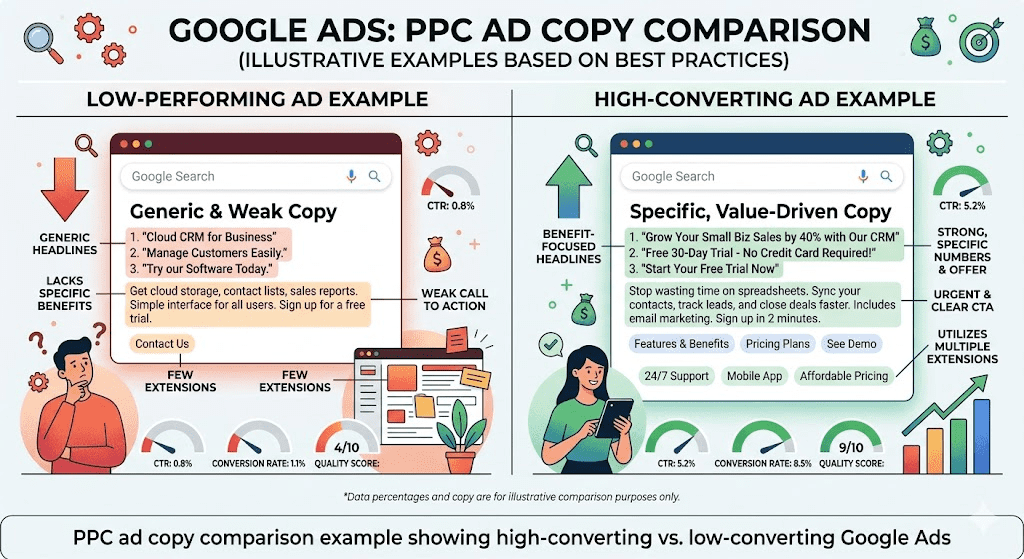
PPC ad copy examples are real-world Google Ads (and other paid ads) that demonstrate proven copywriting techniques. These include writing headlines with urgency, using social proof, addressing pain points, and adding strong calls to action. Great PPC ad copy grabs attention fast, matches the searcher’s intent, and convinces them to click. Whether you’re advertising a product, service, or brand, studying high-performing ad copy examples teaches you exactly what phrases, structures, and emotional triggers work — so you can replicate that success in your own campaigns. Introduction Your ad budget means nothing if your words don’t convert. You could be spending thousands of dollars on Google Ads, but if your copy is flat, generic, or misaligned with what users want — you’re simply burning cash. PPC ad copy is the art and science of writing paid ad text that stops scrollers, earns clicks, and drives sales. It’s one of the most high-leverage skills in digital marketing today. According to WordStream’s 2025 Google Ads Benchmarks report (analyzing over 16,000 campaigns), the average click-through rate on Google Ads is 6.66% — and the gap between mediocre and excellent ad copy is often the entire difference between being above or below that benchmark. In this guide, you’ll discover 13 real PPC ad copy examples across multiple industries and ad types. Each example comes with a breakdown of why it works and what you can steal for your own campaigns. Whether you’re a beginner or a seasoned PPC marketer, these examples will sharpen your copywriting instincts instantly. What Is PPC Ad Copy? (Full Explanation) Pay-per-click (PPC) ad copy refers to the written content within a paid advertisement — typically on Google Ads, Microsoft Ads, Facebook Ads, or LinkedIn Ads — where the advertiser pays each time a user clicks on the ad. Unlike organic content or SEO writing, PPC copy must do a very specific job within an extremely tight space. A standard Google Search Ad gives you roughly 30 characters per headline and 90 characters per description line. That’s less space than a tweet. Every word must earn its place. PPC ad copy has three core components that work together to drive results: the headline (the first thing people see), the description (the supporting message), and the call to action (the directive that tells people what to do next). When these three elements align with a user’s search intent, the results can be remarkable. The importance of PPC advertising cannot be overstated. Search ad spending in the U.S. alone is projected to reach $140.06 billion in 2025 (Digital Silk, 2026), and global digital ad spending is forecasted to surpass $740 billion the same year. With competition this fierce, excellent ad copy is no longer optional — it’s the primary weapon in your marketing arsenal. How Does PPC Ad Copy Work? Writing effective PPC ad copy is a process, not a guessing game. Here is a clear step-by-step breakdown of how it works from start to finish. Step 1 — Understand Search Intent. Before writing a single word, identify why someone is searching. Are they looking to buy (transactional), compare options (commercial), or just learn (informational)? Your ad copy must mirror that intent perfectly. Step 2 — Identify Your Unique Selling Proposition (USP). What makes your offer different? It could be a price guarantee, speed of service, number of customers served, or a specific feature competitors lack. Your USP is the core message your ad should communicate. Step 3 — Write Keyword-Rich Headlines. Use the focus keyword naturally in at least one headline. Google’s algorithm rewards relevance, and users are visually drawn to headlines that match what they just typed. Step 4 — Address a Pain Point or Desire. The best ads speak directly to a problem the user has or a goal they want to achieve. Phrases like “Tired of slow internet?” or “Get debt-free in 12 months” immediately connect emotionally. Step 5 — Add a Clear Call to Action (CTA). Every ad must tell the reader what to do next. “Get a Free Quote,” “Shop Now,” “Book a Consultation,” and “Download Free Guide” are all proven CTAs that drive action. Step 6 — Test Multiple Variations. PPC pros recommend creating 3-5 ad variations per ad group. Small changes in wording, CTA, or headline order can dramatically shift performance. A/B testing is the only way to know what truly converts for your specific audience. Step 7 — Align with Your Landing Page. The best ad copy in the world will fail if it leads to a mismatched landing page. The promise made in your ad must be fulfilled immediately when the user lands on your site. 13 PPC Ad Copy Examples You Can Learn From These 13 examples are drawn from across industries and platforms. Each illustrates a distinct copywriting strategy that you can adapt for your own campaigns. Example 1 — Competitive Ad Copy (Monday.com vs. Rivals) “monday.com — So Much Better. Objective comparison says it all. Flexible platform for teams to manage projects, their way, wherever!” Why it works: This ad attacks competitors without naming them directly, which is both bold and legally smart. It uses the phrase “objective comparison” to plant doubt about rival tools, then pivots immediately to a customer-centric benefit: flexibility. Competitive copy thrives on differentiation. What to steal: Lead with a comparison hook. Position your product as the superior alternative without being petty. Example 2 — Authority Ad Copy (Legal Services) “We’ve Helped Over 1,000,000 People. Over $10B Won For Clients. Experienced Trial Lawyers Available 24/7. Pay Nothing Unless We Win.” Why it works: This ad stacks trust signals in rapid succession — a massive number, a financial proof point, availability, and zero-risk guarantee. For high-stakes industries like legal services (where the average CPC is $8.58), users need to feel safe before clicking. What to steal: In high-trust industries, lead with credibility numbers and risk-reversal phrases like “no fee unless you win.” Example 3 — Pain Point Ad Copy (Project Management Tools) “Finally, a social media calendar tool that your team will ACTUALLY love. Sign up for free today.” Why it works: The word “actually” carries enormous emotional weight. It implies that other tools have failed this user before — and that this one is different. It speaks directly to the frustration
10 Practical Ways to Improve Your Google Ads Quality Score
Google Ads Quality Score is a 1–10 rating that measures the relevance and quality of your keywords, ads, and landing pages. To improve it, focus on these three core pillars that Google evaluates: Expected Click-Through Rate (CTR), Ad Relevance, and Landing Page Experience. Practical steps include writing tightly themed ad groups, matching your ad copy to user search intent, speeding up your landing page, using negative keywords, leveraging ad extensions, and running regular A/B tests. A higher Quality Score directly lowers your cost-per-click (CPC) and improves your ad placement — meaning you pay less and appear more prominently. INTRODUCTION Imagine paying 50% less per click while your ads appear at the very top of Google Search. That’s not a dream — that’s what a high Google Ads Quality Score can do for your campaigns. Every time your ad enters an auction, Google evaluates it against a Quality Score — a 1 to 10 diagnostic metric that reflects how relevant your ad, keywords, and landing page are to the user’s search. According to WordStream, advertisers with a Quality Score of 6 or higher enjoy a 16–50% decrease in cost-per-click (CPC), while those scoring below 4 can see their CPC skyrocket by 25–400%. That’s a massive swing in advertising efficiency. Whether you’re a small business owner running your first campaign or a seasoned PPC manager overseeing enterprise accounts, improving your Quality Score should be a top priority. In this article, you’ll learn 10 proven, practical ways to improve your Google Ads Quality Score, reduce wasted ad spend, and drive better ROI — backed by real data and expert-level strategy. What Is Google Ads Quality Score? (Full Explanation) Google Ads Quality Score is a diagnostic score from 1 to 10 assigned at the keyword level. It reflects how relevant and useful your ad experience is compared to other advertisers competing for the same keywords. Google does not use the Quality Score number directly in live auctions, but the underlying components — Expected CTR, Ad Relevance, and Landing Page Experience — are factored into every ad auction in real time. Here’s how the three components break down: Each component is rated as “Above Average,” “Average,” or “Below Average.” The combination of these three ratings produces your final 1–10 score. Why does it matter? Because Quality Score directly influences your Ad Rank — the formula Google uses to decide where your ad appears and how much you pay per click. A higher score means better position at a lower cost. A score of 7–10 is considered excellent, 5–6 is average, and anything below 4 signals serious optimization is needed. How Does Google Ads Quality Score Work? (Step-by-Step) Understanding the mechanics of Quality Score is the first step to improving it. Here’s how the process works from search query to ad display: This system rewards advertisers who create genuinely useful ad experiences. Google wants users to find what they’re looking for quickly, and it incentivizes advertisers who help make that happen. 10 Practical Ways to Improve Your Google Ads Quality Score Way #1: Tighten Your Ad Group Structure (SKAGs or Themed Groups) One of the most impactful changes you can make is restructuring your ad groups. Many advertisers stuff dozens of unrelated keywords into a single ad group, which makes it nearly impossible to write ad copy that’s relevant to all of them. The best practice is to use Single Keyword Ad Groups (SKAGs) or tightly themed ad groups with 3–5 closely related keywords. This allows you to write laser-focused ad copy that directly reflects the exact keyword a user searched for. For example, instead of one ad group containing “running shoes,” “best sneakers,” and “athletic footwear,” create separate groups for each theme. Your ad for “best running shoes for beginners” can then say exactly that — making it far more relevant and improving both your Ad Relevance and Expected CTR scores. Way #2: Write Ad Copy That Perfectly Matches Search Intent Your ad relevance score lives and dies by how well your copy mirrors what users are actually searching for. There are four main types of search intent: informational, navigational, commercial, and transactional. Each demands a different approach. Always include your focus keyword in the headline of your ad. Google bolds the keyword when it matches the search query, which visually signals relevance to the user and increases CTR. Also use Responsive Search Ads (RSAs) and pin your most relevant headlines to Positions 1 and 2 for consistent messaging. Way #3: Optimize Your Landing Page Experience Your landing page is where the Quality Score rubber meets the road. Google evaluates several factors including page relevance, content quality, mobile-friendliness, page load speed, and navigability. A landing page that takes 5 seconds to load or sends users to a generic homepage instead of a product-specific page will tank your score. Follow these landing page best practices: Way #4: Boost Your Expected Click-Through Rate (CTR) Expected CTR is one of the most heavily weighted components of Quality Score. Google estimates this based on your ad’s historical performance relative to others targeting the same keyword. Here’s how to drive it higher: Way #5: Use Negative Keywords Strategically Negative keywords are one of the most underutilized Quality Score tools. When your ad appears for irrelevant searches, it gets impressions but no clicks — which drags down your Expected CTR and signals poor relevance to Google. For example, if you’re selling premium accounting software and your ad appears for the search “free accounting software,” users who are looking for a free product won’t click your paid ad. That wasted impression hurts your CTR ratio. Regularly review your Search Terms Report in Google Ads to identify queries that are triggering your ads but not converting. Add these as negative keywords at the campaign or ad group level. Common negative keyword categories include “free,” “DIY,” “jobs,” “how to,” and competitor brand names (unless you’re running intentional competitor campaigns). Way #6: Leverage Ad Extensions (Now Called Assets) Ad extensions — rebranded as “Assets” in Google Ads — do not directly calculate into your Quality Score formula, but they significantly increase your Expected CTR, which does. Extensions give your ad more real estate on the search results page and provide users with
12 PPC Landing Page Tweaks to Increase Conversion Rate (Proven Strategies for 2026)

What are the best PPC landing page tweaks to increase conversion rate? The most impactful PPC landing page tweaks to increase conversion rate include matching your ad copy to your landing page headline, removing navigation menus, adding a transparent pricing table, using customer testimonials, improving page load speed, and creating mobile-friendly designs. Other key tactics include A/B testing individual elements, using exit-intent pop-ups, adding live chat, simplifying lead forms, using social proof pop-ups, and reinforcing search intent through targeted keywords. Together, these tweaks reduce friction, build trust, and guide visitors toward taking action — directly boosting your ROI. INTRODUCTION You’re spending real money on every single click. But what happens after the click? That’s where most PPC campaigns silently bleed budget. PPC landing page optimization is the single most overlooked lever in digital advertising. According to data from Involve.me and SEO Sherpa, the average landing page conversion rate sits between 6.6% and 10.76% — meaning up to 93% of your paid traffic might be leaving without converting. That’s an enormous amount of wasted ad spend. The good news? You don’t need to rebuild your entire website. Small, strategic tweaks to your PPC landing pages can produce dramatic improvements in conversion. In this article, we’re walking you through 12 proven PPC landing page tweaks to increase your conversion rate — all backed by real case studies, data, and expert best practices. Whether you’re running Google Ads, Meta Ads, or any other PPC platform, these strategies apply directly to your campaigns. Let’s get into it. What Is PPC Landing Page Optimization? (Full Explanation) PPC landing page optimization (also known as Landing Page Optimization or LPO) is the process of improving specific elements of a pay-per-click ad’s destination page to convert more visitors into leads, subscribers, or customers. When someone clicks your Google Ad or Facebook Ad, they land on a page — your landing page. If that page doesn’t immediately resonate with them, they bounce. You’ve paid for the click, but you’ve earned nothing in return. Unlike your homepage, a PPC landing page is purpose-built for a single goal: getting the visitor to take one specific action. It could be signing up for a trial, booking a demo, making a purchase, or submitting a form. The more aligned that page is with the visitor’s intent, the higher your conversion rate will be. The reason PPC landing page optimization matters so much is simple: improving your conversion rate doesn’t require more ad spend. It requires smarter use of existing traffic. According to Unbounce’s Conversion Benchmark Report, industry median conversion rates range from 3.8% (SaaS) to 12.3% (Legal). The difference between those numbers isn’t budget — it’s optimization. How Do PPC Landing Pages Work? Understanding how a PPC landing page fits into the customer journey helps you optimize it more effectively. Here’s the step-by-step flow: The quality of every step between #1 and #6 determines your conversion rate. A disconnect anywhere in that chain — especially between step #2 and step #4 — is where most PPC campaigns fail. 12 Proven PPC Landing Page Tweaks to Increase Conversion Rate These are the 12 highest-impact changes you can make to your PPC landing pages right now. Tweak #1: Include a Transparent Pricing Table One of the most powerful yet underused conversion drivers is a clear, upfront pricing table on your PPC landing page. When visitors arrive from a paid ad, they’re already interested — they just need the information to make a decision. If your pricing is buried or hidden, they leave to research alternatives, and you lose them permanently. A real-world example: digital agency HeyDigital added a pricing table to a client’s landing page (Up Content) and saw a 7.51% increase in conversions without changing anything else. Pricing transparency removes doubt, accelerates decision-making, and signals confidence in your product. Pro Tip: If you offer multiple tiers, highlight the recommended or most popular plan with a visual badge. This uses the psychological principle of anchoring to steer decisions. Tweak #2: Match Your Landing Page Headline to Your Ad Copy This is arguably the single most important rule in PPC optimization: message match. If your Google Ad says “Get Free Analytics Software for Small Teams” and your landing page headline reads “Welcome to Our Platform,” you’ve already lost the visitor. Visitors expect continuity between the ad they clicked and the page they landed on. When the messaging matches, it reinforces their intent and builds instant trust. When it doesn’t match, it creates confusion — and confusion kills conversions. A great example is Zoho Analytics, whose PPC ad for “analytics software” leads to a landing page where the exact phrase “Analytics Software” appears prominently in the H1 headline. The result is a seamless, reassuring user experience. Repeat the exact keyword from your ad group in your landing page headline and subheadings to reinforce intent at every scroll. Tweak #3: Add Personalized Live Chat Live chat isn’t just a customer support tool — it’s a powerful conversion accelerator on PPC landing pages. According to Involve.me’s research, visitors who use live chat are 16x more likely to purchase, and live chat can increase conversions by approximately 20% on landing pages. The key word here is personalized. Generic “Hi there! How can we help?” messages are easy to ignore. Instead, trigger chat messages that are specific to the keyword ad group the visitor came from. For example, if someone clicked an ad for “enterprise project management software,” your chat popup should open with: “Looking for a project management tool built for enterprise teams? I can help.” This level of intent-matching shows the visitor that you understand their specific need — which dramatically increases the chance they’ll engage and ultimately convert. Tweak #4: Showcase Customer Testimonials People trust other people far more than they trust brands. Customer testimonials on your PPC landing page serve as powerful social proof that your product or service delivers on its promises. According to data from Involve.me, 37% of top-performing landing pages include testimonials, and adding a single customer testimonial has been shown to increase conversions by up to 34%. To get the most out of your testimonials, follow these
5 Reasons SaaS Brands Should Run Branded PPC Campaigns
SaaS brands should run branded PPC campaigns because competitors are actively bidding on your brand name — right now. Branded campaigns protect your high-intent traffic, give you full control over your messaging, lower your cost-per-click, and boost conversion rates. When someone searches your brand name, they are already 80–90% sold. Losing that click to a competitor is one of the most expensive mistakes a SaaS company can make. Running a branded campaign ensures your ad appears at the top of Google before your competitor’s does — putting you in control of the most critical moment in the buyer’s journey. Introduction Imagine spending months building brand awareness, running content campaigns, and growing organic traffic — only for a customer to Google your brand name and click on a competitor’s ad right above your listing. That is not a hypothetical. It is happening to SaaS companies every single day. SaaS branded campaigns — PPC ads that target your own brand name as a keyword — are one of the most underutilized and highest-ROI strategies in modern digital marketing. Yet many SaaS founders and marketers skip them entirely, assuming organic rankings are “good enough.” They are wrong, and it is costing them real revenue. Here’s a number that should change your mind: 46% of all Google clicks go to the top three paid ads — not organic results (Source: inBeat). And for every major SaaS product, three to five competitors are already bidding on your branded keywords (Source: Hey Digital). That means your hardest-earned traffic — people who already know your name and want to buy — is being intercepted. In this article, we break down the 5 most compelling reasons why every SaaS brand must run branded campaigns, backed by data, real-world examples, and expert strategy. What Are SaaS Branded Campaigns? (Full Explanation) A branded campaign is a PPC campaign where you bid on your own brand name as a keyword. When a user types your company name — or a variation of it — into Google, your ad appears at the very top of the search results page, ahead of organic listings and ahead of any competitor ads. For SaaS companies, branded keywords typically include your company name alone (e.g., “HubSpot”), your name plus a modifier (e.g., “HubSpot pricing,” “HubSpot reviews,” “HubSpot vs Salesforce”), and even common misspellings of your brand. These are known as brand-modified queries, and they represent some of the most valuable search traffic on the internet because the person typing them already knows who you are. The concept of branded bidding has evolved significantly alongside Google Ads. In the early days of PPC, bidding on your own name seemed unnecessary — if you rank organically, why pay? Today, that logic is dangerously outdated. Google’s SERPs have become more competitive and cluttered, and the paid ad section now dominates above-the-fold real estate on most branded searches. For SaaS specifically, branded campaigns matter even more than in most industries. SaaS buying journeys are long and involve multiple touchpoints. A branded search often signals the final stage of that journey — the moment a prospect has done their research and is ready to make a decision. Losing that click is losing the deal. Reason #1: Competitors Are Already Bidding on Your Brand Name This is the single most urgent reason SaaS brands need to run branded campaigns — and the one most people learn about the hard way. Go to Google right now and type in any well-known SaaS brand name. Before you reach their own website, you will likely see one or more competitors advertising directly above it. This is not accidental. It is a deliberate, well-funded strategy. For every SaaS product that gains traction, three to five competitors begin bidding on its branded keywords (Source: Hey Digital). Smaller players use larger brands’ name recognition to carve out market space — and Google allows it. This matters enormously because the people typing your brand name into Google are bottom-of-funnel prospects. They have done their research. They know your name. They are one click away from signing up. When a competitor’s ad appears above yours, they intercept that traffic at the most commercially valuable moment in the entire buyer’s journey. The solution is not to hope competitors won’t do this. The solution is to run your own branded campaign so that your ad appears first — before theirs. As the brand owner, you have a significant Quality Score advantage. Google rewards you with better ad positions and lower CPCs than competitors receive when bidding on your name, because your ads are inherently more relevant to searches for your brand. This means you can outrank competitors on your own branded keywords for less money than they spend trying to steal your traffic. According to Search Engine Land, brands in competitive categories should allocate 15–25% of their total paid search budget specifically to brand protection campaigns. Within that allocation, 40% should cover core brand defense, 25% for competitive comparison queries, 20% for reputation and review queries, and 15% for feature-specific searches. This isn’t defensive spending — it’s protecting the revenue you’ve already earned through brand building. Reason #2: Branded Campaigns Are the Cheapest, Highest-Converting Ads You’ll Ever Run Here is a truth most SaaS marketers don’t fully appreciate: branded campaigns are almost always the most cost-efficient PPC campaigns in your entire account. Because you own the brand, your ads are maximally relevant to branded searches. Google’s Quality Score algorithm rewards high relevance with lower CPCs and better ad positions. In practical terms, this means your cost-per-click on branded keywords is a fraction of what you pay for non-branded, competitive keywords. While a competitive SaaS keyword like “project management software” might cost $15–$50 per click, your branded keywords may cost as little as $0.50–$3.00 per click — sometimes even less. And the conversion rates? Dramatically higher. Users searching for your brand name by definition already know who you are. They are not browsing; they are evaluating or ready to buy. The average PPC conversion rate across all campaigns is 2.35% (Source: Mayple), but branded campaigns routinely convert at 10–25% because of the searcher’s pre-existing intent and familiarity. Consider the math: if your average
How to Calculate Your PPC Advertising Budget the Right Way

To calculate your PPC advertising budget, start by defining your revenue goal. Then determine your average conversion rate, average order value (AOV), and your target cost per acquisition (CPA). Use this core formula:PPC Budget=Average Order ValueRevenue Goal×Cost Per Acquisition (CPA) For example, if your monthly revenue goal is $10,000, your AOV is $100, and your CPA is $15, you need 100 customers and a budget of $1,500 per month. Always track your metrics, test small, and scale only what works. Introduction Every dollar you waste on PPC advertising is a dollar your competitor happily picks up. Yet, most businesses set their PPC budgets based on gut feeling — and that is a recipe for burning cash. PPC (Pay-Per-Click) advertising is one of the fastest ways to drive targeted traffic and generate revenue. But without a calculated, data-driven budget, even the best campaigns fall flat. The difference between profit and loss often comes down to one thing: knowing exactly how much to spend before you launch. Here’s a fact that will make you pay attention: global PPC spending is projected to hit $351.55 billion, and businesses that use Google Ads report an average ROI of 200% — meaning $2 earned for every $1 spent (Source: Statista, Google Economic Impact Report). But those returns don’t happen by accident. In this article, you’ll learn how to calculate your PPC advertising budget the right way — step by step. We’ll cover the essential formulas, budgeting models, common mistakes, and expert strategies to make every cent count. What Is a PPC Advertising Budget? (Full Explanation) A PPC advertising budget is the total amount of money you allocate to run pay-per-click campaigns over a set period — typically daily, monthly, or quarterly. It governs how often your ads appear, how competitive your bids are, and ultimately how much traffic and revenue you can generate. PPC advertising works on a simple principle: you pay only when someone clicks your ad. Platforms like Google Ads, Microsoft Ads, Meta Ads, and LinkedIn Ads all operate on this model. Your budget determines your daily spend cap, and the platform distributes that spend throughout the day based on your targeting settings. The concept gained mainstream traction in the early 2000s when Google launched AdWords (now Google Ads) in 2000, revolutionizing the way businesses advertise online. Today, it is a cornerstone of digital marketing strategy for companies of all sizes. Why does calculating your PPC budget correctly matter so much? Because an underfunded campaign won’t generate enough data to optimize. An overfunded one bleeds money without strategy. The goal is to find the Goldilocks zone — a budget that is just right for your goals, audience, and industry benchmarks. How to Calculate Your PPC Advertising Budget — Step by Step Calculating your PPC budget isn’t guesswork. It is a systematic process built on real business data. Follow these steps carefully. Step 1: Define Your Revenue Goal Start with the end in mind. Ask yourself: “How much revenue do I want to generate from PPC this month?” For example, let’s say your goal is $20,000 in monthly revenue. Step 2: Determine Your Average Order Value (AOV) Your AOV is the average amount a customer spends per transaction. If your monthly sales total $50,000 across 500 orders, your AOV is $100.AOV=Number of Orders Total Revenue Step 3: Calculate the Number of Customers You Need Divide your revenue goal by your AOV. Customers Needed=AOVRevenue Goal=$100$20,000=200 customers Step 4: Know Your Website Conversion Rate Your conversion rate tells you how many visitors actually become customers. If 2 out of every 100 visitors buy, your conversion rate is 2%. The average PPC conversion rate across all industries is 2.35%, rising to 3.75% on Google Ads specifically. Step 5: Calculate the Traffic You Need Clicks Needed=Conversion Rate Customers Needed=0.0235200≈8,511 clicks Step 6: Estimate Your Cost Per Click (CPC) Research your average CPC for your industry. The average CPC on Google Ads is approximately $2.69 for search ads and $0.63 for display ads (Source: WordStream). Legal, finance, and insurance industries can see CPCs exceeding $50 per click. Step 7: Calculate Your Total PPC Budget PPC Budget=Clicks Needed×Average CPC=8,511×$2.69≈$22,895/month If this number is beyond your current capacity, work backwards — reduce your revenue goal or improve your conversion rate first before scaling spend. Step 8: Set Your Daily Budget Daily Budget=30.4Monthly Budget=30.4$22,895≈$753/day Google allows up to 2x your daily budget on high-performing days, so never set it so tight that spikes cut your campaigns off mid-day. Types of PPC Budgeting Models Not every business budgets PPC the same way. Here are the most widely used budgeting models, each with its own strengths. Budgeting Model Best For Description Goal-Based Budgeting eCommerce, Lead Gen Budget set by revenue/lead goals and CPA targets Percentage of Revenue Established businesses Allocate 5–15% of monthly revenue to PPC Competitive Parity Competitive markets Match or exceed what competitors are spending Fixed Budget Startups, testing Set flat budget, optimize within constraints Lifetime Value (LTV) Based SaaS, subscription Base budget on customer LTV, not just one sale The goal-based model is widely considered the most strategic and data-driven approach. The percentage of revenue model is a useful starting point — the Digital Marketing Institute recommends allocating between 5% and 12% of total revenue toward digital advertising for most industries. Benefits of Calculating Your PPC Budget Correctly Getting your PPC budget calculation right isn’t just about saving money. It’s about unlocking the full potential of your paid advertising strategy. Here are the key benefits: Common PPC Budget Mistakes to Avoid Even experienced marketers fall into these traps. Knowing them in advance will save you thousands of dollars. Mistake 1: Setting a Budget Without a Goal Spending $1,000/month on PPC “because it seems right” is not a strategy. Always tie your budget to a specific, measurable objective — leads, sales, or ROAS targets. Mistake 2: Ignoring Industry CPC Benchmarks Legal keywords average over $50 per click, while eCommerce averages around $1.16. Researching your industry benchmarks before budgeting prevents nasty surprises. Mistake 3: Overspending on the Display Network Early Display ads average a conversion rate of 0% to 1% — far lower than search’s 3.1% to 6%. New advertisers should prioritize search campaigns first, then expand to display once profitable. Mistake 4: Never Adjusting the Budget PPC isn’t a set-it-and-forget-it channel. Seasonal trends, competitor activity, and algorithm changes require regular budget reviews —
What Is a B2B Digital Marketing Agency? Complete Guide 2026

A B2B digital marketing agency is a specialized firm that helps businesses market their products or services to other businesses — not individual consumers. The “B2B” stands for Business-to-Business. These agencies use strategies like SEO, LinkedIn marketing, content marketing, email campaigns, PPC advertising, and Account-Based Marketing (ABM) to generate high-quality leads and drive revenue for their clients. Unlike B2C agencies that target everyday shoppers, B2B agencies focus on reaching decision-makers — CEOs, procurement managers, and department heads — who have longer buying cycles and higher deal values. In 2026, B2B digital marketing agencies also leverage AI tools, data analytics, and marketing automation to deliver faster, smarter, and more measurable results. INTRODUCTION Selling to another business is completely different from selling to an individual consumer. The stakes are higher, the decisions take longer, and the buyers are far more research-driven. That’s exactly why B2B digital marketing agencies exist — and why they’ve become indispensable in 2026. According to Statista, annual U.S. B2B advertising and marketing spend is expected to reach $69 billion in 2026. Meanwhile, Forrester Research reports that 83% of B2B marketing decision-makers expect marketing investments to grow in the coming year — a clear signal that businesses are doubling down on professional digital marketing support. But what exactly is a B2B digital marketing agency? How does it work? What services does it offer? And most importantly — does your business actually need one? This complete guide answers all of those questions and more. Whether you’re a startup trying to land your first enterprise client or an established company looking to scale your pipeline, you’ll find everything you need right here. What Is a B2B Digital Marketing Agency? (Full Definition) A B2B Digital Marketing Agency is a professional services company that designs, executes, and manages online marketing strategies specifically built for businesses whose customers are other businesses — not everyday consumers. The “B2B” model covers an enormous range of industries. Software companies selling to enterprises (SaaS), manufacturers selling to distributors, consulting firms targeting corporate clients, logistics providers servicing retailers, and staffing agencies working with HR departments — all of these are B2B businesses that require a very specific type of marketing expertise. B2B digital marketing as a formal discipline began taking shape in the early 2000s, when internet adoption among businesses created new opportunities for companies to reach corporate buyers online. Before that, B2B sales relied almost entirely on cold calling, trade shows, print directories, and direct mail. The rise of Google, LinkedIn, and email marketing tools transformed the B2B landscape entirely — and dedicated B2B marketing agencies emerged to help companies navigate this complex new world. What makes a B2B digital marketing agency fundamentally different from a general digital agency is its deep understanding of the B2B buyer psychology and journey. In B2B marketing, you are not triggering an impulse purchase — you are educating a rational buyer, earning their trust over months, and building a business case that justifies a significant financial investment to their entire organization. As Cognism (2026) summarizes: “B2B marketing means any marketing strategy or content used by one business to target and sell to another business.” A B2B digital marketing agency is the specialist team that makes that process work efficiently, scalably, and profitably. B2B vs. B2C Digital Marketing — What Is the Difference? This is the most important foundational concept to understand. B2B and B2C marketing are not just slightly different — they are fundamentally different disciplines, and a strategy that works brilliantly for one will often fail completely for the other. Here is a comprehensive comparison: Factor B2B Marketing B2C Marketing Target Audience Businesses, decision-makers, buying committees Individual consumers Sales Cycle Length Long — weeks to months or years Short — minutes to days Decision-Making Multiple stakeholders, rational, data-driven Usually individual, often emotional Average Deal Value High ($5,000 – $500,000+) Low to moderate ($10 – $5,000) Primary Goal Lead generation, relationship building Quick conversions, brand awareness Best Channels LinkedIn, email, SEO, content, webinars Instagram, TikTok, Facebook, Google Ads Content Style Educational, detailed, data-backed Entertaining, emotional, visual Buying Motivation ROI, efficiency, risk reduction Desire, convenience, status, emotion Relationship Focus Long-term partnerships Often transactional Key Metric Cost per qualified lead, pipeline value Conversion rate, ROAS As Landingi (2026) perfectly summarizes: “B2B focuses on building long-term relationships and demonstrating ROI to business decision-makers, while B2C drives quick, emotional purchases through consumer platforms.” This difference is why a B2B digital marketing agency cannot simply apply the same tactics used for consumer brands. A TikTok video that goes viral may be perfect for a fashion brand — but a Chief Financial Officer researching enterprise software needs a detailed case study, a ROI calculator, and a peer review — not a trending dance video. What Services Does a B2B Digital Marketing Agency Provide? A specialist B2B digital marketing agency offers a carefully curated set of services designed specifically for the complex, relationship-driven nature of business buying. Here is a complete breakdown: B2B Search Engine Optimization (SEO) B2B SEO is fundamentally different from consumer SEO. Rather than targeting high-volume, broad keywords, B2B SEO focuses on long-tail, intent-rich keywords that decision-makers search when actively researching solutions. For example, a B2B buyer searching “enterprise CRM software for manufacturing companies” is far more valuable than someone casually searching “what is CRM.” A B2B agency optimizes your website, creates authoritative content around your industry’s most critical questions, and builds the kind of domain authority that earns trust from business buyers and search engines alike. LinkedIn Marketing & Account-Based Marketing (ABM) LinkedIn is the undisputed king of B2B marketing. According to Creative Marketing Ltd (2026), LinkedIn generates 80% of all B2B social media leads, and 89% of B2B marketers use LinkedIn specifically for lead generation (Brenton Way, 2026). A B2B digital marketing agency runs targeted LinkedIn ad campaigns, builds thought leadership content strategies, executes LinkedIn outreach sequences, and manages Account-Based Marketing (ABM) programs that target specific companies and decision-makers with hyper-personalized messaging. B2B Email Marketing & Marketing Automation Email marketing remains one of the most powerful B2B channels. SeoProfy (2026) reports that email marketing is used by 66% of B2B marketers as their primary lead generation channel. A B2B agency builds sophisticated email nurture sequences
What Do Digital Marketing Companies Do? Complete Guide 2026
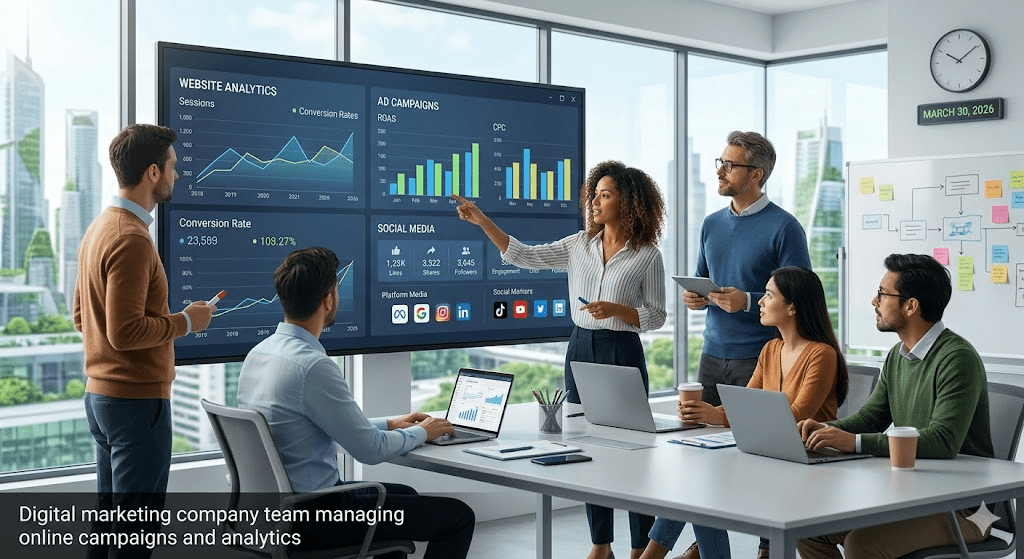
Digital marketing companies help businesses grow their online presence and generate revenue through the internet. They provide services like Search Engine Optimization (SEO), Pay-Per-Click advertising (PPC), social media marketing, content creation, email marketing, web design, and data analytics. In simple terms, they make sure your business gets found online, attracts the right audience, and converts visitors into paying customers. Whether you need more website traffic, leads, sales, or brand awareness — a digital marketing company builds and executes the strategy to get you there, using data and proven techniques. Introduction Imagine opening a beautiful shop in a busy city — but placing it on a street where nobody walks. That is exactly what happens when a business exists online without a proper digital marketing strategy. You can have the best product in the world, but if nobody finds you, nobody buys from you. This is precisely what digital marketing companies do — they put your business on the busiest streets of the internet, right in front of the people who are already looking for what you offer. The numbers prove just how massive this industry has become. The global digital marketing services market is projected to reach $750 billion in 2026 (Persistence Market Research) and is on track to hit $1.3 trillion by 2033. Every single dollar of that enormous market exists because businesses need expert help navigating the fast-moving, highly competitive world of online marketing. In this complete guide, you will learn exactly what digital marketing companies do, which services they provide, how their process works, and how to choose the right one for your business. Let’s dive in. What Is a Digital Marketing Company? (Full Definition) A digital marketing company is a professional agency that plans, creates, manages, and optimizes marketing campaigns across all digital channels — including search engines, social media platforms, websites, email, and mobile apps — with the goal of helping businesses attract customers and grow revenue online. Unlike traditional advertising agencies that focus on TV, radio, or print, digital marketing companies operate entirely in the online world. They combine creativity with technology and data science to deliver measurable, results-driven marketing that traditional agencies simply cannot match. The concept of digital marketing companies began evolving in the mid-1990s when the internet became commercially available. The first clickable banner ad appeared in 1994, and by the early 2000s — with the rise of Google, social media platforms, and email as mainstream communication tools — dedicated digital marketing agencies had become essential business partners for companies of all sizes. Today, a digital marketing company serves as your business’s complete online growth engine. They are not just running ads or posting on Instagram — they are building an integrated, multi-channel strategy that touches your customer at every stage of their buying journey, from the moment they first search for a solution all the way through to making a purchase and becoming a loyal repeat buyer. According to Research and Markets, the global digital marketing market was valued at $456.7 billion in 2025 and is expected to grow at a CAGR of 10.99% through 2034 — confirming that businesses worldwide are investing more in digital marketing every single year. What Services Do Digital Marketing Companies Provide? This is the core of what digital marketing companies do. Here is a detailed breakdown of every major service they offer and why each one matters: Search Engine Optimization (SEO) SEO is the process of optimizing your website so it ranks higher on Google and other search engines for keywords your customers are actively searching. When someone types “best running shoes near me” or “affordable web design services,” SEO determines whether your business appears on page one — or gets buried on page five where nobody ever looks. A digital marketing company handles technical SEO (site speed, mobile-friendliness, crawlability), on-page SEO (keyword optimization, meta tags, content structure), off-page SEO (building high-quality backlinks), and local SEO (optimizing your Google Business Profile for local searches). SEO is a long-term investment — typically delivering results over 3–6 months — but it creates a sustainable, compounding source of free organic traffic that pays dividends for years. Pay-Per-Click Advertising (PPC) PPC advertising — most commonly through Google Ads and Microsoft Bing Ads — puts your business at the very top of search results immediately, for a fee paid every time someone clicks your ad. A skilled digital marketing company conducts deep keyword research, writes compelling ad copy, builds optimized landing pages, sets up precise audience targeting, and manages your daily budget to ensure maximum return on every dollar spent. Unlike SEO, PPC delivers instant visibility. A well-run Google Ads campaign can generate leads and sales from day one. According to WordStream, businesses earn an average of $2 for every $1 spent on Google Ads — making PPC one of the highest-ROI marketing channels available when managed professionally. Social Media Marketing Social media marketing involves managing and growing your brand’s presence on platforms like Instagram, Facebook, TikTok, LinkedIn, Pinterest, and YouTube. Digital marketing companies create content strategies, design visuals, write captions, manage posting schedules, run paid social ads, engage with followers, and track performance metrics. With 5.66 billion social media users globally (HubSpot, 2025), social media marketing is one of the most powerful tools for building brand awareness, generating leads, and driving direct sales — especially for consumer-facing businesses. Content Marketing Content marketing is the strategic creation and distribution of valuable, relevant content — blogs, videos, infographics, podcasts, whitepapers, case studies, and guides — designed to attract, educate, and convert your target audience. Rather than interrupting people with ads, content marketing draws them in organically by answering their questions and solving their problems. A digital marketing company plans a content strategy aligned with your business goals, creates high-quality content optimized for both readers and search engines, and distributes it across the right channels for maximum reach and impact. Email Marketing Email marketing remains one of the highest-ROI digital marketing channels available. For every $1 spent on email marketing, businesses see an average return of $36–$42 (Litmus, 2024). Digital marketing companies build and segment your email list, design beautiful email templates, write compelling copy, set up automated drip campaigns and welcome sequences, and
Social Media Marketing Agency: What It Is & How It Works
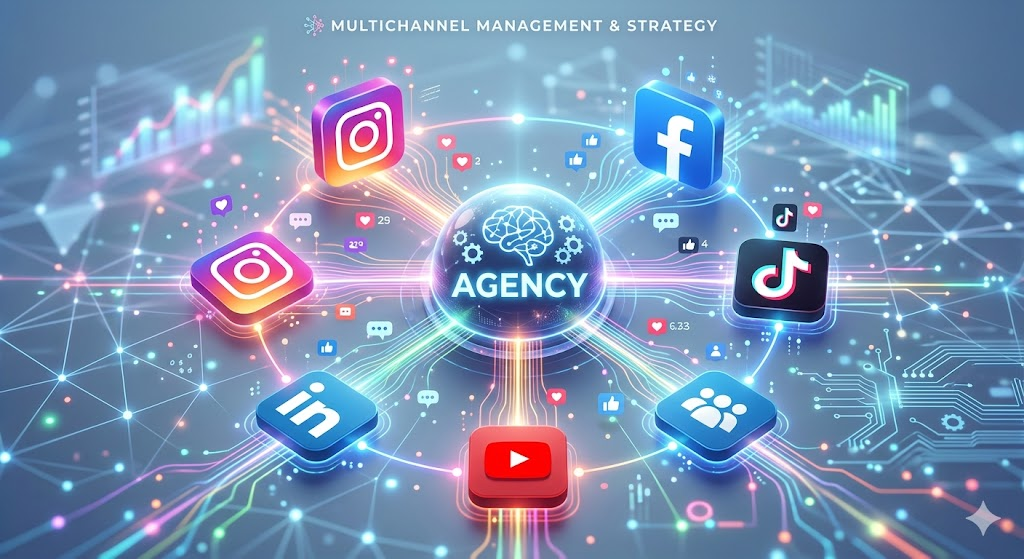
A Social Media Marketing Agency is a specialized company that helps businesses grow their brand, attract customers, and generate sales through social media platforms like Instagram, Facebook, TikTok, YouTube, and LinkedIn. These agencies handle everything — from content creation and posting schedules to paid advertising campaigns and community management. Instead of you learning and managing social media yourself, the agency does it all professionally on your behalf. The goal is simple: build your online presence, engage your target audience, and ultimately drive real business results through the power of social media. Introduction Think about the last time you discovered a brand on Instagram or clicked a Facebook ad that led you to buy something. Behind that experience was a Social Media Marketing Agency working silently in the background — crafting the content, targeting the right audience, and optimizing every detail for maximum impact. Here’s a number that puts it all into perspective: global social media ad spending is projected to reach $317 billion in 2026 (Statista), and that figure is only going up. Social media is no longer just a place to share photos — it is one of the most powerful business growth engines on the planet. Yet most business owners either don’t have the time, the skills, or the team to manage social media professionally. That is exactly where a Social Media Marketing Agency steps in. In this complete guide, you will learn exactly what a social media marketing agency is, what services it provides, how it works step by step, and — most importantly — whether hiring one is the right move for your business in 2026. What Is a Social Media Marketing Agency? (Full Explanation) A Social Media Marketing Agency (SMMA) is a professional service firm that specializes in managing, growing, and monetizing a business’s presence across social media platforms. It is a type of digital marketing agency, but with a laser focus on social channels rather than the broader online ecosystem. The concept of social media agencies began to take real shape around 2010–2012, when platforms like Facebook and Twitter started offering business pages and paid advertising tools. Before that, companies managed social media casually — if at all. As platforms grew more complex and competitive, it became clear that professional expertise was needed. By the mid-2010s, dedicated social media agencies had become a legitimate and booming industry. Today, a social media marketing agency acts as your brand’s online voice. They know the algorithms, the trending content formats, the best posting times, and the ad targeting strategies that turn followers into paying customers. Whether you are a small local bakery, a growing e-commerce brand, or a large corporation, a social media agency tailors its strategy to your specific goals, audience, and budget. In essence, hiring a social media marketing agency means outsourcing one of the most important — and most time-consuming — aspects of modern business growth to a team of trained professionals. What Does a Social Media Marketing Agency Do? (Core Services) A professional social media marketing agency offers a wide range of services. Here is a detailed breakdown of what they typically handle for their clients: Content Creation and Strategy is the heart of what any SMMA does. The agency creates scroll-stopping posts, eye-catching graphics, short-form videos (Reels, TikToks, YouTube Shorts), carousels, and stories that reflect your brand’s personality and speak directly to your target audience. Every piece of content is created with a purpose — to educate, entertain, or convert. Social Media Account Management means the agency takes full ownership of running your profiles. They handle the posting schedule, write captions, research and apply relevant hashtags, and maintain a consistent brand voice across all platforms. You never need to worry about “what to post today.” Paid Social Media Advertising is where agencies often deliver the most measurable results. They set up, run, and optimize paid campaigns on Meta (Facebook & Instagram), TikTok Ads, LinkedIn Ads, Pinterest Ads, and YouTube Ads. This includes audience targeting, A/B testing creatives, managing budgets, and maximizing your Return on Ad Spend (ROAS). Community Management involves actively engaging with your audience — responding to comments, answering DMs, handling customer complaints, and building a loyal community around your brand. A brand that talks to its audience, not just at it, builds deeper trust and loyalty. Influencer Marketing is another key service where agencies identify and collaborate with relevant influencers — from mega-celebrities to micro-influencers — to promote your product or service to highly engaged audiences. Analytics and Reporting ensures you always know what’s working. The agency tracks key performance metrics including reach, impressions, engagement rate, follower growth, click-through rates, conversion rates, and cost-per-result — and delivers clear monthly reports that tie social media activity directly to business outcomes. Platform-Specific Services are also offered, as different platforms require very different expertise. A great Instagram strategy is not the same as a winning LinkedIn strategy. Top agencies have platform specialists who understand the unique nuances of each channel. How Does a Social Media Marketing Agency Work? Step-by-Step Understanding the process from start to finish helps you know exactly what to expect when you hire an agency. Step 1 — Discovery Call & Business Understanding. The agency begins with a deep-dive consultation. They learn about your business, your products or services, your target audience, your competitors, and your marketing goals. This step is critical — a strategy built without understanding your business is a strategy built to fail. Step 2 — Social Media Audit. The agency conducts a thorough audit of your existing social media profiles. They analyze your current follower count, content performance, engagement rates, audience demographics, and competitor activity. This audit identifies what is working, what is not, and where the biggest opportunities lie. Step 3 — Strategy Development. Based on the discovery and audit, the agency builds a customized social media strategy. This includes choosing the right platforms, defining your brand voice and visual identity, setting specific KPIs (Key Performance Indicators), planning the content mix, and outlining the paid advertising approach. Step 4 — Content Planning & Production. The agency creates a content calendar — typically 30 days in advance — mapping out every
Advertising Agency vs Digital Marketing Agency Differences
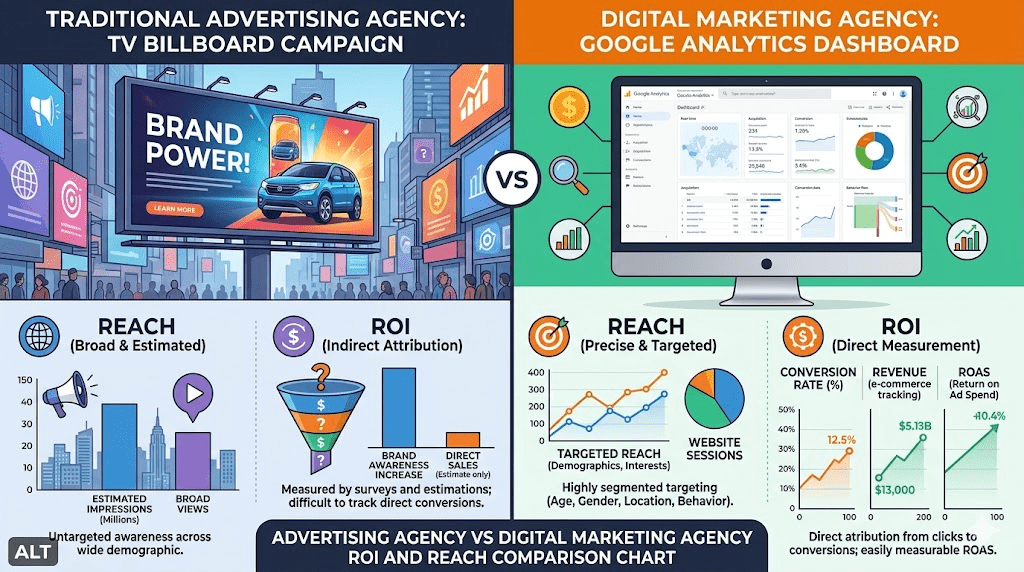
An Advertising Agency is a traditional firm that creates and places ads through offline channels like TV, radio, print, and billboards. A Digital Marketing Agency focuses on online channels — SEO, Google Ads, social media, email marketing, and content creation. The core difference is the medium: advertising agencies work in the physical world, while digital marketing agencies operate in the online world. Today, many businesses choose digital agencies for their measurable ROI, precise targeting, and cost-effectiveness. However, large brands often combine both for maximum market coverage. Introduction Imagine spending thousands of dollars on a full-page newspaper ad — and having absolutely no idea how many people actually read it. Now imagine running a Google Ad campaign and knowing exactly how many people clicked, where they came from, and how many bought your product. That contrast captures the heart of the advertising agency vs digital marketing agency debate perfectly. With global ad spending projected to surpass $1 trillion for the first time in 2026 (Dentsu Global), choosing the right agency to invest your marketing budget has never been more critical. One wrong decision can cost your business thousands — and months of lost growth. In this complete guide, we break down everything you need to know about advertising agencies vs digital marketing agencies — what they are, how they work, what they cost, and which one is the right fit for your business in 2026. Whether you’re a startup, a growing SME, or a large enterprise, this article will give you a clear, confident answer. What Is an Advertising Agency? (Full Explanation) An advertising agency is a company that specializes in creating, planning, and managing promotional campaigns for clients across traditional mass media channels. These agencies are the creative powerhouses behind the TV commercials, billboard campaigns, radio jingles, and magazine spreads that we have all grown up seeing. The history of advertising agencies goes back to 1842, when Volney Palmer opened the first recognized advertising agency in Philadelphia, USA (Vaia / Advertising History). In those early days, agencies simply bought newspaper space in bulk and resold it to businesses. Over the next century, agencies evolved into sophisticated creative studios employing copywriters, art directors, media planners, and brand strategists. The “Golden Age” of advertising — famously depicted in shows like Mad Men — ran from the 1950s through the 1980s. During this era, agencies like Ogilvy & Mather, BBDO, and McCann-Erickson dominated the industry, shaping consumer culture through unforgettable TV campaigns and print ads. Today, traditional advertising agencies still exist and serve a very important purpose. For large brands that need to reach mass audiences quickly — like Coca-Cola, Nike, or McDonald’s — a TV spot during prime time or a billboard in Times Square can deliver brand recognition that no online ad can replicate. However, the landscape has shifted dramatically, and advertising agencies that refuse to adapt are struggling. Core services of a traditional advertising agency include: What Is a Digital Marketing Agency? (Full Explanation) A digital marketing agency is a company that helps businesses grow their online presence, generate leads, and drive sales through internet-based marketing strategies and channels. Rather than buying TV slots or printing brochures, a digital marketing agency builds your brand across search engines, social media platforms, email inboxes, websites, and apps. Digital marketing agencies began emerging in the mid-to-late 1990s as the internet became commercially mainstream. The first clickable banner ad appeared in 1994, and from that moment forward, a new marketing universe was born. By the 2000s, Google Ads, social media platforms, and email marketing had created an entirely new set of tools that traditional agencies simply weren’t equipped to handle. Today, digital marketing agencies are the fastest-growing segment of the entire marketing services industry. According to IMARC Group, the global digital marketing market was valued at over $456 billion in 2025 and is on track to reach $1.2 trillion by 2034. This explosive growth reflects how decisively the business world has moved online. Core services of a digital marketing agency include: How Does Each Agency Model Work? Step-by-Step Understanding the operational workflow of each model makes the differences crystal clear. How a Traditional Advertising Agency Works: The process at a traditional advertising agency typically follows a structured, campaign-based timeline that can take weeks or even months from brief to execution. How a Digital Marketing Agency Works: Digital agency workflows are faster, more iterative, and heavily data-driven. Types of Each Agency Both advertising agencies and digital marketing agencies come in several distinct subtypes, each with a different focus. Types of Advertising Agencies: Types of Digital Marketing Agencies: Advertising Agency vs Digital Marketing Agency — Full Comparison Feature Advertising Agency Digital Marketing Agency Primary Channels TV, Radio, Print, Billboard SEO, PPC, Social, Email, Web Target Audience Mass / Broad audience Targeted / Specific segments ROI Measurement Difficult (estimated reach) Easy (real-time data tracking) Campaign Speed Weeks to months Days to weeks Budget Range High ($10,000–$1M+) Flexible ($500–$50,000+/mo) Best For Brand awareness, mass reach Lead generation, conversions Data & Analytics Limited (surveys, ratings) Comprehensive (live dashboards) Audience Targeting Demographic/geographic only Behavioral, interest, retargeting Creativity Style Storytelling, emotional impact Data-informed, conversion-focused Scalability Expensive to scale Easily scalable Ideal Business Size Large enterprises & brands Startups, SMEs, and enterprises Geographic Reach Local/National Local, National, and Global Benefits and Advantages of Each Model Top Benefits of Hiring a Traditional Advertising Agency: A traditional advertising agency brings unmatched creative storytelling ability and the power of mass media reach. When a brand needs to build deep emotional connections with a broad audience — think of iconic campaigns like Apple’s “Think Different” or Nike’s “Just Do It” — a traditional agency’s creative team is uniquely equipped to deliver that impact. TV advertising, in particular, still commands enormous authority; a well-placed primetime commercial can reach millions of viewers in a single airing. Traditional advertising also builds a sense of legitimacy and credibility in consumers’ minds. Seeing a brand advertised on television or in a prestigious publication triggers a trust response that many digital ads simply cannot replicate. Additionally, for businesses targeting older demographics (45+) who spend more time with TV, radio, and print, traditional advertising channels remain the most effective point of
Digital Marketing Agency vs SMMA: Key Differences Explained
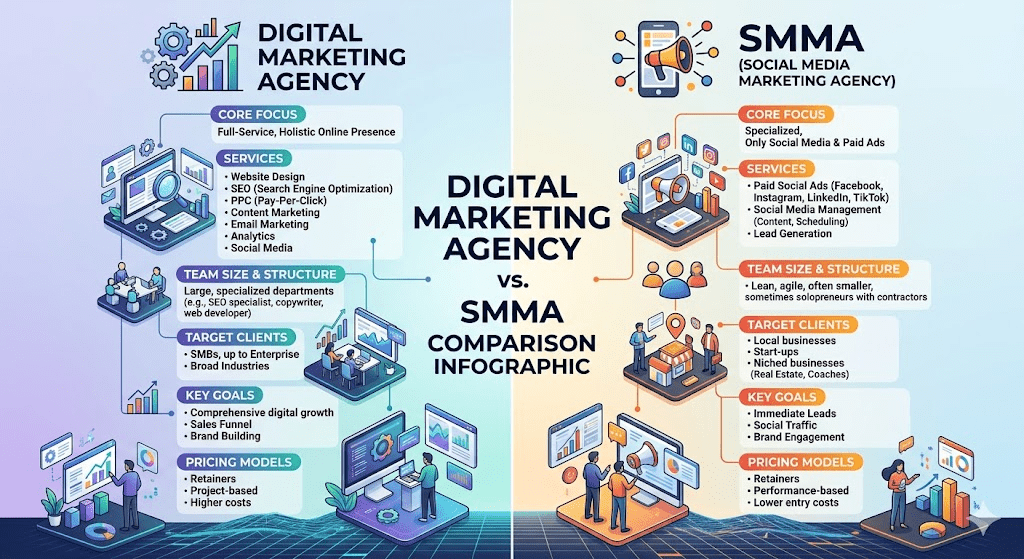
A Digital Marketing Agency is a full-service firm that handles SEO, PPC, email marketing, content creation, web design, and social media — all under one roof. An SMMA (Social Media Marketing Agency) is a specialized, niche agency that focuses exclusively on social media platforms like Instagram, Facebook, TikTok, and LinkedIn. The key difference is scope: a digital marketing agency casts a wide net across all online channels, while an SMMA dives deep into the social media ecosystem. For businesses needing broad online coverage, a digital agency is better. For brands laser-focused on social growth, an SMMA delivers more targeted results. Introduction Every business owner eventually faces a critical question: “Who should I hire to grow my brand online?” The two most popular answers today are a Digital Marketing Agency and an SMMA — but most people don’t actually know the difference. With the global digital marketing market valued at over $653 billion in 2025 (Expert Market Research), choosing the right marketing partner has never been more important. Make the wrong choice, and you burn your budget. Make the right one, and your business skyrockets. In this article, we break down the digital marketing agency vs SMMA debate in full detail. We’ll cover what each model is, how they work, their core differences, pros and cons, and — most importantly — which one is right for your specific situation. Whether you’re a business owner looking for help or an entrepreneur thinking of starting an agency, this guide covers everything you need to know. What Is a Digital Marketing Agency? (Full Explanation) A digital marketing agency is a full-service company that provides a comprehensive range of online marketing services to help businesses grow their digital presence. Think of it as a one-stop shop for everything internet marketing. These agencies have been around since the late 1990s, evolving alongside the internet itself. Early digital agencies focused primarily on website design and banner ads. Today, they have expanded into complex ecosystems that manage everything from organic search rankings to paid advertising, email automation, and beyond. A typical digital marketing agency offers services such as Search Engine Optimization (SEO), Pay-Per-Click advertising (PPC/Google Ads), content marketing, email marketing, web design and development, conversion rate optimization (CRO), influencer marketing, video marketing, and yes — social media management too. The reason digital marketing agencies matter so much in today’s landscape is simple: businesses can no longer rely on a single channel to reach customers. A potential buyer might discover your brand through a Google search, revisit your site via a retargeting ad, then finally convert after reading a compelling email. A full-service digital agency manages that entire journey. What Is an SMMA? (Social Media Marketing Agency Explained) SMMA stands for Social Media Marketing Agency. It is a specialized type of agency that focuses exclusively on helping businesses grow through social media platforms. While the concept of social media agencies has existed since platforms like Facebook and Twitter went mainstream, the term “SMMA” was heavily popularized around 2017–2019 by online entrepreneurs and course creators like Tai Lopez and others who packaged it as a low-barrier business model. An SMMA typically handles Instagram growth, Facebook Ads management, TikTok content strategy, LinkedIn B2B outreach, community management, influencer partnerships, short-form video production, and paid social campaigns. The beauty of the SMMA model is its lean, low-overhead structure — most are run by solo operators or small teams who serve clients remotely using just a laptop and an internet connection. It is important to note that there is some controversy around the SMMA label. As one viral Reddit thread in the r/agency community summarized: “SMMA, specifically the acronym, represents a scam pushed by gurus — but Social Media Marketing Agencies are real, proper businesses.” The term got a negative reputation due to the flood of online courses promising overnight riches. However, legitimate SMMAs deliver real, measurable results for clients every day. How Does Each Model Work? Step-by-Step Understanding how each model operates will help you see the functional differences more clearly. How a Digital Marketing Agency Works: How an SMMA Works: Types of Each Agency Model There are meaningful sub-types within each category that are worth knowing. Types of Digital Marketing Agencies: Types of SMMA Models: Digital Marketing Agency vs SMMA — Full Comparison Table Feature Digital Marketing Agency SMMA Scope of Services Broad — SEO, PPC, Email, Social, Web Narrow — Social Media Only Team Size Large (10–200+ employees) Small (1–20 people) Monthly Retainer $2,500 – $20,000+ $500 – $5,000 Best For Mid-to-large businesses Small businesses, startups Startup Cost High (office, tools, staff) Low (laptop + software) Specialization Generalist Social media specialist Reporting Multi-channel dashboards Social-focused analytics Scalability Highly scalable with systems Scalable but niche-limited Learning Curve High (multiple disciplines) Moderate (social platforms) Client Retention Generally higher Can be volatile Benefits and Advantages of Each Model Benefits of Hiring a Digital Marketing Agency: Choosing a full-service digital marketing agency brings unmatched breadth of expertise to your brand. You gain access to a team of specialists — SEO experts, paid media managers, content strategists, and web developers — all working on your growth simultaneously. This is particularly valuable for businesses that need consistent lead generation across multiple touchpoints. Additionally, full-service agencies provide comprehensive reporting that ties together performance data from all channels, making it easier to understand your complete return on investment. Large agencies also tend to have established relationships with media partners, access to premium tools (like SEMrush, HubSpot, and Salesforce), and proven systems built from years of client experience. Benefits of Hiring or Starting an SMMA: An SMMA delivers laser-focused expertise in social media, which is arguably the most powerful organic marketing channel in today’s landscape. With 5.42 billion social media users worldwide in 2025 (Social Pixel Pro), the potential audience reach through social platforms is extraordinary. SMMAs are typically more affordable than full-service agencies, making them accessible to small businesses and startups with limited budgets. They are also more agile — they can adapt quickly to platform algorithm changes, trending content formats, and cultural moments. For entrepreneurs, starting an SMMA has an incredibly low barrier to entry, requiring minimal startup capital compared to building a full agency.
Why Your Business Needs Digital Marketing Services

Your business needs professional digital marketing agency services because the online marketplace in 2026 is too fast, too competitive, and too complex to navigate alone. A professional agency gives you immediate access to a full team of specialists — SEO experts, paid media buyers, content strategists, and data analysts — without the massive overhead of building an in-house department. Agencies bring proven systems, cutting-edge tools, and cross-industry experience that delivers faster results and stronger ROI. According to industry data, a full in-house marketing team costs $400,000–$600,000 annually, while a comprehensive agency retainer typically runs $36,000–$180,000 per year — delivering the same expertise at a fraction of the cost. INTRODUCTION Here’s a hard truth most business owners eventually face: great products don’t sell themselves. In 2026, if your brand isn’t visible online — ranking on Google, running smart ads, and connecting with audiences on social media — your competitors are filling that space instead. The global digital marketing industry is now racing toward $807 billion in total spend (Statista/WordStream, 2026). Every major brand, fast-growing startup, and ambitious small business is competing for the same digital real estate. That competition has raised the stakes dramatically. Simply “doing some marketing” is no longer enough — you need a professional, data-driven strategy executed by experienced specialists. This is exactly why professional digital marketing agency services have become one of the smartest investments a modern business can make. In this article, you’ll discover the real, evidence-backed reasons why hiring a digital marketing agency isn’t a cost — it’s a growth accelerator. From ROI data and cost comparisons to AI strategy and common pitfalls, everything you need to make a confident decision is right here. What Are Digital Marketing Agency Services? (Full Explanation) Digital marketing agency services refer to the complete range of online marketing strategies and tactics that a professional agency provides to help businesses achieve their growth goals. These agencies combine data, creativity, and technology to connect brands with their target audience across the internet. The concept of digital marketing agencies emerged in the early 2000s as the internet became mainstream. Over the past two decades, these agencies have evolved from basic web design studios into full-service growth powerhouses. Today, a modern digital marketing agency may employ SEO strategists, paid media buyers, social media managers, videographers, data analysts, and AI specialists — all under one roof. Why does it matter in 2026? Because consumer behavior has shifted dramatically online. Over 5.56 billion people worldwide are now internet users (Statista, 2025). They discover products through Google searches, social media feeds, YouTube videos, and email newsletters. If your brand isn’t showing up where your customers are searching, your competitor’s brand is. A reliable digital marketing agency bridges that gap — efficiently and professionally. The core value of hiring an agency lies in three things: expertise, speed, and scalability. You get a team of specialists who already know what works, they implement strategies faster than any in-house hire, and they can scale campaigns up or down based on your budget and goals. How Do Digital Marketing Agency Services Work? Understanding how a digital marketing agency operates helps you set the right expectations. The process, while unique to each agency, typically follows a proven framework. Step 1: Discovery & Audit The agency starts by understanding your business, target audience, competitors, and current digital footprint. They run audits on your website, SEO health, social media presence, and existing ad campaigns to identify strengths and gaps. Step 2: Strategy Development Based on the audit findings, the agency builds a customized marketing strategy. This includes defining KPIs (Key Performance Indicators), selecting the right channels, setting budget allocation, and creating a content and campaign calendar. Step 3: Execution & Campaign Launch The agency’s specialists implement the strategy. SEO teams optimize your website and create content. Paid media experts launch Google Ads and Meta campaigns. Social media managers create and schedule posts. Email marketers design automated workflows. Step 4: Monitoring & Optimization Using tools like Google Analytics, SEMrush, HubSpot, and Meta Ads Manager, the agency tracks real-time performance. Campaigns are continuously refined to improve results — whether that means adjusting ad copy, updating keywords, or A/B testing landing pages. Step 5: Reporting & Communication Most agencies provide monthly or bi-weekly reports showing traffic growth, lead generation, conversion rates, cost-per-click, and ROI. Transparent reporting is a hallmark of a trustworthy agency. Step 6: Scale & Grow Once a strategy proves successful, the agency helps you scale. This could mean increasing ad spend, expanding into new markets, launching new content series, or integrating new channels like AI search optimization or influencer partnerships. Types of Digital Marketing Agency Services in 2026 Modern digital marketing agencies offer a wide spectrum of services. Here is a breakdown of the most important ones available in 2026: Service What It Does Best For SEO (Search Engine Optimization) Improves organic Google rankings Long-term traffic growth PPC / Google Ads Runs paid search & display ads Immediate lead generation Social Media Marketing Manages brand presence on platforms Brand awareness & engagement Content Marketing Creates blogs, videos, infographics Authority building & SEO Email Marketing Sends automated campaigns to subscribers Retention & nurturing Web Design & Development Builds and optimizes websites Conversion optimization Influencer Marketing Partners with creators/influencers Gen Z & Millennial reach Video Marketing Creates short-form & long-form videos Top-of-funnel engagement AI Marketing Uses AI tools for personalization & automation Scalable campaigns AEO (AI Engine Optimization) Optimizes content for AI search like ChatGPT Future-proofing SEO strategy Each of these services can be offered individually or as a bundled, integrated package. Many businesses in 2026 opt for full-service agency partnerships that combine several of these services into one cohesive strategy. IMPORTANT FACTS & STATISTICS The numbers behind digital marketing’s explosive growth confirm why agency services are more in demand than ever before. Fact 1 — Market Size: The global digital marketing industry is projected to reach $807 billion in 2026, up significantly from $667 billion in 2024, making it one of the fastest-growing sectors in the global economy. (Source: WordStream / Statista, 2026) Fact 2 — SEO Dominance: Websites, blogs, and SEO remain the #1 ROI-generating
Digital Marketing Agency for Real Estate Dubai 2026
A digital marketing agency for real estate Dubai helps property developers, brokers, and real estate companies attract qualified buyers online. These agencies use SEO, PPC advertising, social media marketing, content writing, and lead generation — all tailored to Dubai’s competitive property market. Dubai’s real estate market hit a record $149 billion in total sales in 2025, and 72% of overseas investors now buy properties entirely online — without a single physical visit. In this landscape, a professional digital marketing agency is not a luxury. It is the most powerful tool your real estate business can have in 2026. INTRODUCTION Dubai’s property market is on fire — and every developer, broker, and real estate agency is fighting for the same buyer’s attention online. The rules of real estate marketing have completely changed. Buyers no longer walk into your showroom first. They Google you, scroll your Instagram, watch your YouTube videos, and read your blog — all before making a single call. If your brand is invisible online, you are invisible to your buyers. That is exactly why choosing the right digital marketing agency for real estate Dubai is one of the most important business decisions you can make in 2026. According to Arabian Business, Dubai’s real estate market recorded a historic $149 billion in property sales in 2025 — a record-breaking year driven by global investors, Golden Visa seekers, and a rapidly growing expat community. At the same time, digital marketing is now driving 300% more traffic to real estate websites compared to traditional methods. At Sales Bouncer, we specialize in turning real estate businesses into market-dominating digital brands. This guide covers everything you need to know — what a real estate digital marketing agency does, which services matter most, and how to choose the right partner to grow your property business in Dubai’s most competitive market yet. What is a Digital Marketing Agency for Real Estate Dubai? A digital marketing agency for real estate Dubai is a specialized firm that designs, executes, and manages data-driven online marketing campaigns for property businesses operating in the UAE. Unlike general marketing agencies, a real estate-focused digital agency understands the unique dynamics of Dubai’s property sector — including off-plan sales cycles, RERA advertising regulations, international investor behavior, Arabic-language SEO, and platform-specific rules on Meta and Google. These agencies act as a bridge between your property and your buyer. They transform your development into a compelling digital story — one that reaches the right person, on the right platform, at the exact right moment in their buying journey. The landscape has shifted dramatically over the last five years. In the early days, Dubai real estate marketing meant glossy brochures, property expos, and roadside billboards. Today, it means AI-powered lead scoring, immersive virtual tours, hyper-targeted Instagram ads, multilingual SEO content, and WhatsApp automation — all running simultaneously across a carefully planned digital ecosystem. Why does this matter for you? Because Dubai’s real estate market recorded 125,538 property transactions in H1 2025 alone — a 26% year-on-year increase worth AED 431 billion. In a market this competitive, your digital visibility is your greatest competitive advantage. Without it, even the best-located, best-priced properties go unnoticed. Sales Bouncer brings together every element of this digital ecosystem under one roof — giving real estate businesses in Dubai a transparent, results-driven, and fully customized marketing partner. How Does Real Estate Digital Marketing Work in Dubai? Understanding the process helps you set clear expectations and measure real results. Here is exactly how a professional agency like Sales Bouncer approaches real estate digital marketing in Dubai: Step 1 — Discovery & Digital Audit Every successful campaign starts with deep research. The agency audits your existing website performance, current SEO rankings, competitor strategies, social media presence, and target audience profiles. This phase identifies the exact gaps and opportunities in your current digital footprint. Step 2 — Custom Strategy Development Based on the audit findings, a tailored marketing strategy is built specifically for your property business. This includes platform selection (Google, Meta, TikTok, LinkedIn, YouTube), keyword targeting in both English and Arabic, content calendar planning, budget allocation, and clear KPIs — such as cost-per-qualified-lead and monthly lead volume targets. Step 3 — Creative Asset Production This is where your brand comes to life digitally. High-quality content is produced — SEO-optimized blog articles, social media creatives, property videos, email templates, and landing pages. For off-plan projects, photorealistic 3D renders and virtual tours are created to give international buyers a complete visual experience without visiting in person. Step 4 — Campaign Launch & Multi-Channel Distribution Paid campaigns go live across Google Search, Google Display Network, Facebook, Instagram, and TikTok. Organic campaigns run in parallel through SEO content, Google My Business optimization, and targeted email sequences — creating a 360-degree digital presence that covers every stage of the buyer’s journey. Step 5 — Lead Capture & CRM Nurturing Qualified leads are captured through conversion-optimized landing pages and integrated directly into your CRM system. Automated WhatsApp and email follow-ups engage leads instantly — because in Dubai’s property market, speed of response is directly linked to conversion rate. Step 6 — Reporting, Analysis & Optimization Every campaign is tracked in real time with complete transparency. Monthly reports show which keywords are ranking, which ads are converting, where leads are dropping off, and exactly what needs to be improved. This continuous optimization cycle is what delivers compounding results over time. Key Services Offered by a Real Estate Digital Marketing Agency in Dubai The best agencies offer a comprehensive suite of services that work together as one integrated system. Here is what matters most for real estate businesses in Dubai — and exactly what Sales Bouncer delivers: Search Engine Optimization (SEO) SEO is the foundation of long-term digital growth. When a buyer searches “buy apartment in Dubai Marina” or “off-plan villas UAE 2026,” your website should appear on page one of Google. Sales Bouncer’s SEO services include full website audits, keyword research, on-page optimization, technical SEO, link building, and local SEO — all with detailed KPI reporting so you always know your rankings are moving in the right direction. Digital marketing drives 300% more traffic to real estate websites, and SEO is the engine behind that growth. Lead Generation Generating traffic means
The Role of Influencer Marketing in Social Media Management
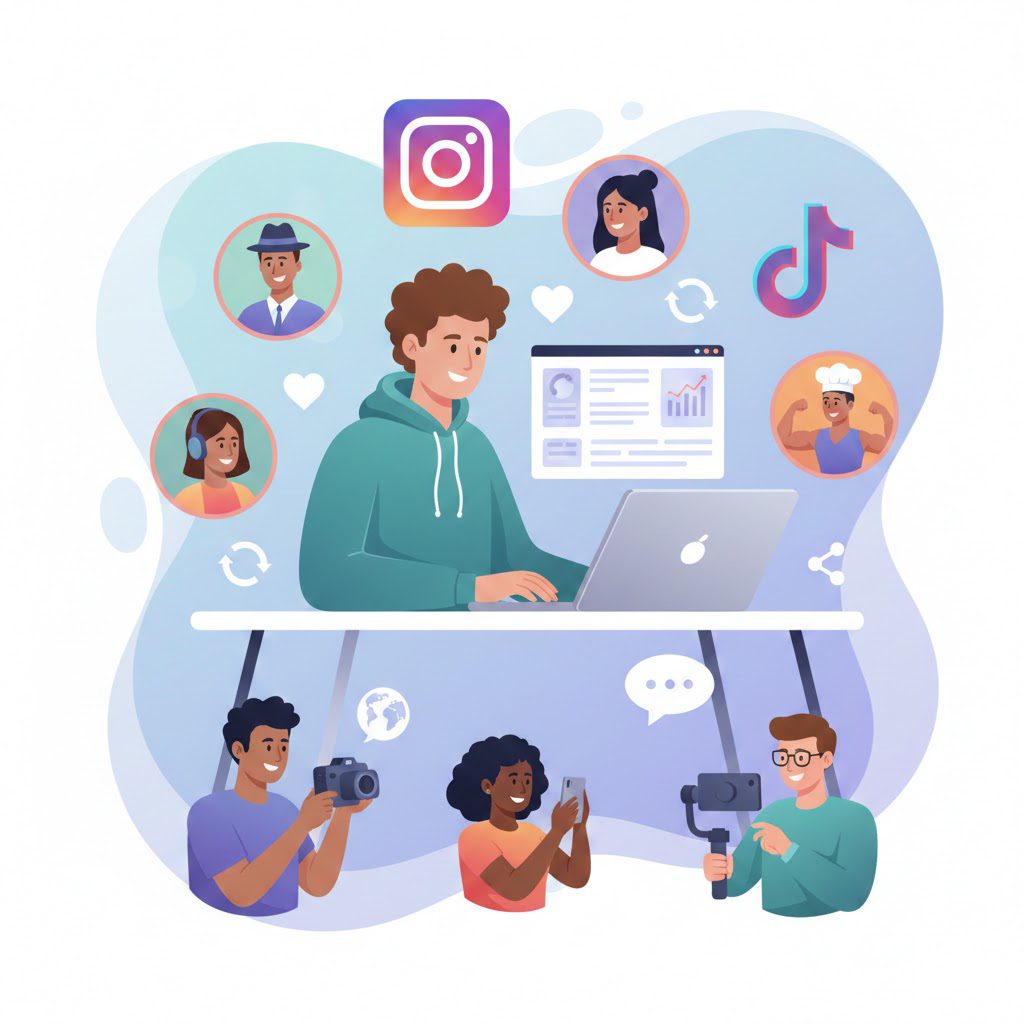
Influencer marketing has become a core component of modern social media management. As social platforms continue to prioritize authentic engagement and community-driven content, brands increasingly rely on influencers to communicate their messages more effectively. Rather than replacing social media management, influencer marketing strengthens it by extending reach, improving trust, and driving meaningful interactions. This guide explores how influencer marketing fits into social media management, why it matters, and how brands can use it strategically. Understanding Influencer Marketing in the Social Media Ecosystem Influencer marketing refers to collaborations between brands and individuals who have established credibility and audiences on social media platforms. These individuals influence opinions, behaviors, and purchasing decisions through content shared with their followers. Unlike traditional advertising, influencer marketing leverages personal relationships and perceived authenticity. According to widely accepted marketing definitions, influencers can range from celebrities to niche creators with small but highly engaged communities. This diversity makes influencer marketing adaptable to different social media management goals and budgets. Social media management, on the other hand, focuses on planning, creating, publishing, monitoring, and analyzing content across platforms. Influencer marketing integrates into this process as a collaborative content and distribution strategy rather than a standalone tactic. How Influencer Marketing Supports Social Media Management Expanding Organic and Paid Reach One of the primary roles of influencer marketing in social media management is expanding brand reach. Influencers allow brands to access audiences they may not reach through organic posting alone. When influencers share branded content, they introduce the brand to followers who already trust their opinions. This extended reach complements social media managers’ efforts to grow followers and visibility across platforms such as Instagram, TikTok, YouTube, and Facebook. Strengthening Brand Credibility and Trust Trust plays a critical role in social media success. Research and industry insights consistently show that audiences are more receptive to messages delivered by people they follow than by brands directly. Influencers humanize brand communication. Their endorsements often feel more genuine than traditional advertisements, which helps social media managers build credibility and long-term brand trust within online communities. Increasing Engagement Rates Engagement is a core metric in social media management. Influencer-generated content often achieves higher engagement rates than brand-owned content because it feels more relatable and conversational. Likes, comments, shares, and saves generated through influencer collaborations signal relevance to platform algorithms. This increased engagement supports broader social media performance and content visibility. The Strategic Role of Influencers in Content Creation Authentic Content Development Influencers are content specialists who understand platform-specific formats and audience preferences. By collaborating with influencers, social media managers gain access to content that aligns naturally with platform trends and user behavior. Rather than highly polished promotional material, influencer content often prioritizes storytelling, demonstrations, and personal experiences. This approach aligns with social media best practices focused on authenticity. Supporting Brand Storytelling Influencer marketing enhances brand storytelling by allowing multiple voices to communicate a consistent message. Influencers can interpret brand values in their own style while maintaining messaging guidelines set by social media managers. This multi-creator approach allows brands to tell richer stories across different platforms and audience segments. Influencer Types and Their Role in Social Media Strategy Nano and Micro Influencers Nano and micro influencers typically have smaller audiences but higher engagement rates. They are especially valuable for community-focused social media management strategies and niche markets. Their followers often view them as peers, making their recommendations feel highly trustworthy. Macro and Mega Influencers Macro and mega influencers offer large-scale visibility and are useful for awareness campaigns and product launches. While engagement rates may be lower compared to smaller influencers, their reach supports top-of-funnel social media objectives. Social media managers often balance large and small influencers to achieve both reach and engagement. Influencer Marketing and Audience Targeting One of the strongest advantages of influencer marketing is precision targeting. Influencers build audiences around specific interests, lifestyles, or industries. This allows social media managers to reach highly relevant user groups without relying solely on paid advertising algorithms. Targeted influencer collaborations help brands communicate the right message to the right audience at the right time. Measuring Performance and ROI in Social Media Management Influencer marketing contributes measurable value to social media management. Metrics commonly used include: Engagement rates Follower growth Traffic and referral data Conversions and sales Brand sentiment and awareness Modern social media management tools allow teams to track influencer performance alongside owned content, making influencer marketing part of a data-driven strategy rather than an experimental tactic. Long-Term Community Building Through Influencers Beyond short-term campaigns, influencer marketing supports long-term community building. Ongoing partnerships with influencers help brands maintain consistent visibility and foster loyalty within social media communities. This relationship-driven approach aligns with the broader goal of social media management: building sustainable, engaged audiences rather than one-time interactions. Challenges and Ethical Considerations While influencer marketing offers significant benefits, social media managers must also address challenges such as: Maintaining authenticity Ensuring disclosure and transparency Avoiding misalignment between influencer values and brand identity Clear guidelines, ethical practices, and compliance with platform and advertising regulations are essential for sustainable influencer strategies. The Future of Influencer Marketing in Social Media Management Industry research suggests that influencer marketing will continue to grow as platforms prioritize creator-driven content. Influencers are increasingly integrated into social media planning, content calendars, and performance analysis. Rather than being a trend, influencer marketing has become a foundational element of effective social media management strategies. Final Thoughts Influencer marketing plays a vital role in modern social media management by enhancing reach, credibility, engagement, and audience targeting. When strategically integrated, it supports content creation, storytelling, and measurable performance outcomes. For brands seeking to build trust and relevance in competitive digital environments, influencer marketing is no longer optional—it is a strategic necessity within social media management.
Why Mobile-First Design Matters More Than Ever in 2026
Mobile-first design is no longer a trend or optional best practice. It has become a foundational approach to building digital experiences that meet modern user behavior, search engine requirements, and performance expectations. As mobile devices continue to dominate how people access the internet, businesses that fail to prioritize mobile experiences risk losing visibility, engagement, and revenue. This guide explores why mobile-first design matters more than ever, how it impacts SEO and user experience, and what principles define an effective mobile-first strategy. Understanding the Mobile-First Design Approach Mobile-first design is a design and development strategy where the mobile version of a website or application is created before the tablet or desktop versions. Instead of shrinking a desktop layout to fit smaller screens, designers begin with the smallest screen and progressively enhance the experience for larger devices. This approach forces teams to focus on what truly matters: essential content, core functionality, and usability under constraints such as limited screen space and variable network conditions. Industry design publications consistently emphasize that mobile-first is not just about layout but about prioritization and clarity in user experience. The Shift in How People Access the Internet Mobile Devices Now Dominate Web Traffic Mobile usage has surpassed desktop usage globally. Research cited across UX and digital strategy sources shows that more than 60% of global web traffic comes from mobile devices, making mobile the primary way users interact with websites today This shift means websites designed primarily for desktop users no longer reflect real user behavior. Mobile-first design aligns digital experiences with how audiences actually browse, search, and convert. Mobile Usage Is Context-Driven Mobile users often browse on the go, during short sessions, or while multitasking. Design sources highlight that mobile users value speed, simplicity, and immediate access to information more than visual complexity . Mobile-first design directly supports these behaviors by reducing friction and cognitive load. Why Mobile-First Design Is Critical for SEO Google Uses Mobile-First Indexing Google officially uses mobile-first indexing, meaning it primarily evaluates the mobile version of a website when determining search rankings. If a site’s mobile experience is slow, incomplete, or difficult to use, its visibility in search results can suffer — even if the desktop version performs well . He makes mobile-first design a direct ranking factor, not just a usability consideration. Performance and Core Web Vitals Mobile-first design naturally encourages better performance. By designing under mobile constraints, teams optimize images, reduce unnecessary scripts, and prioritize fast loading. Performance metrics such as loading speed and interactivity are part of Google’s Core Web Vitals, which influence SEO outcomes. How Mobile-First Design Improves User Experience Clear Content Hierarchy Small screens force designers to prioritize content. Mobile-first layouts highlight essential information first and remove distractions. UX research consistently shows that a clear hierarchy improves comprehension, engagement, and task completion. Touch-Friendly Interactions Mobile-first design accounts for finger-based navigation rather than mouse clicks. Buttons, spacing, and interactive elements are optimized for touch, reducing user frustration and accidental interactions. Design experts emphasize that touch-friendly interfaces significantly improve usability on mobile devices. Performance Advantages of Mobile-First Design Faster Load Times Mobile-first sites are typically lighter and faster because they are built with performance constraints in mind from the start. Faster load times reduce bounce rates and improve overall user satisfaction, especially on mobile networks where connectivity may vary. Better Stability Across Devices By starting small and enhancing upward, mobile-first design ensures consistent performance across screen sizes. Desktop layouts become enhancements rather than bloated foundations, leading to more stable and predictable user experiences. Business Impact of Mobile-First Design Higher Engagement and Conversions Mobile-optimized experiences tend to keep users engaged longer and guide them more effectively toward actions such as sign-ups, purchases, or inquiries. Industry studies cited by UX strategy blogs indicate that improved mobile usability correlates with higher conversion rates and customer satisfaction. Stronger Brand Perception A fast, intuitive mobile experience reflects positively on a brand. Users often associate mobile usability with professionalism and trustworthiness, while poor mobile experiences can damage credibility. Core Principles That Define Effective Mobile-First Design Content Before Decoration Mobile-first design emphasizes meaningful content over visual excess. Design authorities stress that stripping designs to their essentials helps users find what they need faster and improves overall clarity. Progressive Enhancement Rather than removing features for mobile, mobile-first design builds a strong core experience first, then adds enhancements for larger screens. This principle ensures accessibility, performance, and functionality across all devices. Performance as a Design Constraint Performance is treated as a design requirement, not a technical afterthought. Optimized media, efficient layouts, and minimal dependencies are integral to mobile-first thinking. Mobile-First vs Mobile-Friendly vs Responsive Design Mobile-friendly design adapts an existing desktop site to work on smaller screens, often as a secondary step. Responsive design uses flexible layouts to adjust across devices, but does not necessarily prioritize mobile needs first. Mobile-first design differs because it starts with mobile constraints and user behavior as the foundation. UX experts consistently describe mobile-first as a strategy, while responsive design is a technique used within that strategy. Why Mobile-First Design Is No Longer Optional The convergence of mobile dominance, Google’s mobile-first indexing, rising performance expectations, and evolving user behavior has made mobile-first design essential. Websites that continue to prioritize desktop experiences first risk falling behind in search rankings, usability, and customer trust. Designing for mobile first is not about excluding desktop users — it is about creating stronger, more focused experiences that scale effectively across all devices. Final Thoughts Mobile-first design matters more than ever because it aligns digital experiences with reality: how people browse, how search engines rank content, and how performance affects business outcomes. By prioritizing mobile users from the start, organizations create faster, clearer, and more effective digital products that stand the test of time.
2026 UI/UX Trends: A Complete Designer’s Handbook

Introduction: Why UI/UX Design Is Entering a New Era in 2026 UI and UX design in 2026 is no longer just about aesthetics or usability. They are about intelligence, responsibility, and adaptability. As technology becomes more embedded in daily life, digital experiences are expected to feel intuitive, inclusive, ethical, and emotionally aware. Advancements in artificial intelligence, mixed reality, and data-driven personalization are reshaping how users interact with products. At the same time, designers are being challenged to create interfaces that protect user privacy, promote digital well-being, and reduce environmental impact. The following sections explore the most dominant UI/UX trends of 2026, backed by industry research and expert analysis. Smart Interfaces Are Redefining User Interaction Multimodal Experiences Are Becoming the New Standard In 2026, users no longer rely on a single mode of interaction. Interfaces are increasingly designed to support multiple input methods simultaneously, including touch, voice, gestures, text, and even contextual signals. This shift allows users to interact naturally depending on their environment and abilities. For example, a user might start an interaction using voice and seamlessly switch to touch without friction. Multimodal UX improves accessibility, efficiency, and overall user satisfaction, making digital experiences more human-like and flexible. AI Is Evolving from a Tool into a Design Partner Artificial intelligence in UI/UX has moved far beyond automation. In 2026, AI acts as a co-pilot within interfaces, assisting users by predicting intent, offering contextual guidance, and adapting layouts in real time. From AI-generated content suggestions to intelligent onboarding flows, designers now build experiences that continuously learn from user behavior. This approach reduces cognitive load while improving engagement, especially in complex applications like SaaS platforms and enterprise tools. Interfaces That Adapt to Individual User Behavior Personalization has evolved into adaptive UX, where interfaces dynamically change based on user preferences, habits, and context. Rather than static dashboards, users experience layouts that reorganize themselves, content that prioritizes relevance, and interactions that feel tailored without being intrusive. This trend focuses on delivering value while maintaining transparency and control, ensuring personalization enhances trust rather than undermining it. Invisible and Immersive Interaction Models Are Expanding Zero-UI and Ambient Experiences Are Gaining Momentum Zero-UI design removes traditional graphical interfaces altogether, relying on voice commands, gestures, and environmental cues. In 2026, this approach is becoming more common in smart devices, automotive systems, and IoT ecosystems. By eliminating unnecessary screens, zero-UI experiences create seamless interactions that feel natural and less distracting, particularly in hands-free or real-world scenarios. Spatial and 3D UX Is Moving into the Mainstream. Immersive design is no longer limited to gaming or experimental projects. Spatial UX, including 3D interfaces, augmented reality, and mixed reality environments, is increasingly integrated into everyday digital products. These experiences allow users to interact with content in three dimensions, improving comprehension, engagement, and realism. Designers must now consider depth, motion, and spatial orientation as core UX principles. Human-Centric UX Patterns Are Leading Design Decisions Hyper-Personalization with Ethical Boundaries While personalization remains a key UX strategy, 2026 emphasizes ethical personalization. Designers are expected to balance customization with user privacy, consent, and transparency. This means offering meaningful control over data usage, explaining personalization logic clearly, and avoiding manipulative design patterns. Ethical personalization builds long-term trust while still delivering tailored experiences. Functional Minimalism Paired with Purposeful Micro-Interactions Minimalist design continues to dominate, but with a stronger focus on functionality over aesthetics alone. Clean interfaces reduce distractions while highlighting essential actions. Micro-interactions—such as subtle animations, haptic feedback, and transition cues—play a critical role in guiding users, confirming actions, and adding personality without overwhelming the interface. Emotional and Empathetic Design Is Becoming Essential UX in 2026 increasingly acknowledges user emotions. Interfaces are designed to respond empathetically by using supportive language, calming visuals, and adaptive feedback during moments of frustration or success. This approach enhances emotional connection, improves retention, and ensures digital products feel respectful and human-centered. Inclusive and Ethical UX Is No Longer Optional Accessibility and Neuro-Inclusion Are Built-In by Default Accessibility standards are expanding to address diverse cognitive, sensory, and physical needs. Designers are focusing on inclusive typography, color contrast, motion sensitivity controls, and simplified interaction patterns. Neuro-inclusive design ensures interfaces are usable by people with ADHD, dyslexia, and other cognitive differences, making digital products accessible to a broader audience. Ethical and Transparent Design Practices Build Trust In response to growing user awareness, ethical UX design in 2026 prioritizes honesty and clarity. This includes avoiding dark patterns, making privacy settings easy to understand, and clearly communicating how user data is handled. Transparency has become a competitive advantage, reinforcing credibility and long-term user loyalty. Sustainability and Digital Wellbeing Are Core UX Principles Sustainable UX Is Influencing Design Decisions Sustainability has entered the UX conversation through energy-efficient interfaces, optimized performance, and reduced digital waste. Lightweight design choices not only improve performance but also lower environmental impact. Designers are encouraged to think beyond visuals and consider how digital products affect global resources. UX That Promotes Healthier Digital Habits Digital well-being is now a design responsibility. Interfaces are being designed to reduce cognitive overload, encourage mindful usage, and prevent burnout. Features such as usage reminders, simplified navigation, and reduced notification fatigue contribute to healthier digital interactions. Visual UI Evolution in 2026 Expressive Visual Styles Are Challenging Uniform Design While minimalism remains popular, 2026 also sees a rise in expressive and bold visual styles. Designers are experimenting with unconventional layouts, typography, and color palettes to stand out in saturated digital markets. This balance between clarity and creativity allows brands to maintain usability while expressing a unique identity. Adaptive Layouts for Multi-Device Experiences With users interacting across phones, tablets, wearables, and immersive devices, UI layouts must adapt seamlessly. Responsive design has evolved into context-aware design, adjusting not just size but structure and interaction patterns based on device and environment. Conclusion: What These UI/UX Trends Mean for the Future The UI/UX trends dominating 2026 highlight a shift toward intelligent, ethical, and human-centered design. Designers are no longer just problem-solvers; they are shaping how people interact with technology on a deeper emotional and societal
How to Elevate Your Content Creation Process With AI

Artificial intelligence is reshaping how content is planned, created, optimized, and distributed. As content demands increase across blogs, social media, videos, and digital platforms, creators and businesses are turning to AI to work faster without sacrificing quality. When used strategically, AI enhances creativity, improves efficiency, and helps scale content production while keeping human insight at the core. This guide explains how to elevate your content creation process with AI, from understanding its value to applying it responsibly across your workflow. Why AI Matters in Modern Content Creation Today’s audiences expect content that is relevant, engaging, and consistent across channels. Meeting these expectations manually can be time-consuming and resource-intensive. AI helps bridge this gap by automating repetitive tasks and providing data-driven support, allowing creators to focus more on strategy, storytelling, and audience connection. What AI Content Creation Really Means AI content creation involves using artificial intelligence technologies, such as natural language processing and machine learning, to assist with content ideation, drafting, editing, optimization, and repurposing. Rather than replacing human creators, AI acts as an intelligent assistant that supports decision-making and accelerates production while humans maintain control over quality and creativity. Key Benefits of Using AI in Your Workflow Integrating AI into your content workflow delivers tangible benefits that improve both output and performance. Speed, Efficiency, and Consistency AI significantly reduces the time required to produce content. It can generate outlines, drafts, and revisions in minutes, helping teams meet tight deadlines. AI also helps maintain consistency in tone, style, and formatting, which is especially important for brands managing content across multiple platforms and teams. Data-Driven Insights and Personalization AI analyzes audience behavior, performance trends, and engagement patterns to inform content decisions. This allows creators to tailor content to specific audiences and create personalized experiences at scale. By relying on data instead of assumptions, AI helps improve relevance, engagement, and overall content effectiveness. Top AI Tools for Every Type of Content AI tools now support a wide range of content formats, making them valuable across creative and marketing teams. Writing and SEO Tools AI writing tools assist with brainstorming topics, structuring content, improving readability, refining tone, and optimizing for search intent. They help creators produce clear, well-structured content while reducing editing time and minimizing errors. Visual and Design AI Platforms Design-focused AI tools help generate images, layouts, and branded visuals quickly. They enable creators to maintain visual consistency and produce professional designs without extensive design expertise, making visual content creation more accessible and efficient. Video and Audio AI Solutions AI tools for video and audio support script creation, voiceovers, subtitles, transcription, and editing. These tools make it easier to create and repurpose multimedia content, expanding reach and engagement across different formats. Step-by-Step AI Content Creation Workflow To maximize results, AI should be integrated thoughtfully into each stage of the content creation process. Ideation and Research With AI AI helps generate content ideas based on audience interests, trending topics, and historical performance. It can summarize research, identify content gaps, and suggest angles that align with user intent. This streamlines the planning phase and ensures ideas are grounded in data. Drafting and Refining Content AI can transform outlines into structured drafts and assist with editing by improving clarity, flow, and grammar. While AI speeds up drafting, human review is essential to ensure accuracy, originality, and alignment with brand voice. This collaboration produces content that is both efficient and authentic. Publishing, Repurposing, and Optimizing AI supports optimization by improving headlines, formatting, and readability. It also helps repurpose long-form content into social posts, summaries, email copy, or scripts, extending the value of each piece. Performance analysis then feeds back into the workflow, enabling continuous improvement. How to Use AI Responsibly and Effectively AI is powerful, but responsible use is critical to maintaining trust and quality. Keeping the Human Touch in Your Content AI lacks emotional intelligence, lived experience, and true creativity. Human input is essential for storytelling, empathy, and originality. The most effective content strategies use AI for efficiency while relying on humans to shape messaging, provide insight, and connect with audiences on a deeper level. Avoiding Common AI Pitfalls Overusing AI without oversight can lead to generic content, factual errors, or repetitive messaging. Clear prompts, defined goals, and careful editing are necessary to avoid these issues. Human review ensures content remains accurate, unique, and aligned with ethical standards. The Future of AI in Content Creation AI will continue to evolve and play a larger role in content ecosystems. Understanding future trends helps creators prepare for what’s next. Full Workflow Automation and AI Agents Advancements in AI may enable more end-to-end automation, including content planning, scheduling, and distribution. AI agents could handle routine tasks while creators focus on strategy, creativity, and high-level decision-making. Balancing Creativity and Technology The future of content creation lies in collaboration. Creators who balance AI efficiency with human creativity will produce content that is scalable, engaging, and meaningful. Technology will enhance the process, but human judgment will remain essential. Final Thoughts Elevating your content creation process with AI is about working smarter, not replacing creativity. By integrating AI into research, drafting, optimization, and distribution, creators can produce high-quality content faster and more consistently. When guided by human insight and ethical use, AI becomes a powerful partner in building impactful, audience-focused content for the digital age.
How Personalization Drives Success in Digital Marketing

Personalization has become a defining factor in modern digital marketing. As audiences interact with hundreds of brands daily, generic messaging is no longer effective. Personalization allows businesses to tailor their communication, offers, and experiences to individual users, making marketing efforts more relevant, engaging, and impactful. What Personalization Means in Digital Marketing Personalization in digital marketing refers to the practice of delivering customized content, products, or experiences to users based on their data, preferences, and behavior. Instead of presenting the same message to every customer, brands adjust their messaging to match individual needs and interests. What a Personalized Experience Really Is A personalized experience uses customer data such as browsing behavior, purchase history, location, or device type to create content that feels relevant to the individual. This can include product recommendations, customized emails, or tailored website content. How Personalization Differs from Generic Marketing Generic marketing focuses on broad audiences with uniform messaging. Personalization, on the other hand, recognizes that customers have different motivations and expectations. By addressing individuals rather than groups, brands can communicate more effectively. Real-World Examples of Personalization Examples include online stores suggesting products based on previous purchases, streaming platforms recommending content based on viewing history, and emails that address users by name while reflecting their interests. Why Personalization Is Essential for Digital Marketing Success Consumers now expect brands to understand their needs. When companies fail to meet these expectations, customers quickly disengage. Increasing Consumer Expectations Modern consumers are accustomed to personalized digital experiences. When brands recognize preferences and anticipate needs, customers feel valued and understood. Cutting Through Digital Noise With countless advertisements competing for attention, personalization helps messages stand out. Relevant content is more likely to capture attention than generic promotions. Personalization as a Competitive Advantage Businesses that successfully personalize their marketing gain an edge over competitors by creating stronger emotional connections and more meaningful customer relationships. Key Benefits of Personalization for Brands Personalization does not only improve customer experience; it also delivers measurable business results. Higher Engagement and Interaction Rates Personalized content encourages users to interact more frequently with emails, websites, and advertisements because it aligns with their interests. Better Conversion and Return on Investment When users receive relevant offers, they are more likely to make a purchase. This improves conversion rates and maximizes marketing spend efficiency. Improved Customer Loyalty and Retention Customers are more likely to return to brands that consistently deliver relevant and personalized experiences, leading to long-term loyalty. Enhanced Customer Experience Across Channels Personalization ensures consistency across platforms, whether customers engage through email, websites, social media, or mobile apps. The Science Behind Personalization: Data and Technology Personalization is powered by data and advanced technology that enables marketers to understand and predict customer behavior. How Customer Data Fuels Personalization Data such as demographics, behavior patterns, and engagement history helps marketers tailor messages and experiences to individual users. Segmentation and Behavioral Insights Segmentation groups users based on shared characteristics, while behavioral analysis focuses on actions users take. Together, they allow for precise targeting. Recommendation Systems and Automation Automated systems analyze large datasets to deliver personalized recommendations in real time, making personalization scalable and efficient. Personalization Across Marketing Channels Personalization can be applied across multiple digital touchpoints to create a cohesive experience. Personalized Email Campaigns Emails tailored to user behavior and preferences perform better than mass emails, leading to higher open and click-through rates. Dynamic Website Customization Websites can display different content depending on the visitor, such as customized landing pages or location-based offers. Social Media and Advertising Personalization Personalized ads target users based on interests and behavior, making campaigns more relevant and effective. Mobile and App-Based Personalization Mobile apps use personalization to send relevant notifications, recommend features, and enhance usability. Best Practices for Implementing Personalization Successfully Effective personalization requires strategy, balance, and ethical data use. Segmenting the Audience Effectively Clear segmentation ensures messages are relevant without becoming overly narrow or repetitive. Tailoring Content and Offers Content should reflect user interests while maintaining brand consistency and clarity. Balancing Automation with Human Insight While automation enables scale, human oversight ensures personalization remains authentic and meaningful. Respecting Privacy and Transparency Customers must understand how their data is used. Transparency builds trust and ensures compliance with privacy standards. Challenges and Pitfalls in Personalization Despite its benefits, personalization also presents challenges. Data Collection and Privacy Concerns Improper data handling can lead to compliance issues and loss of customer trust. Avoiding Over-Personalization Excessive personalization may feel intrusive. Brands must strike a balance between relevance and comfort. Preventing Personalization Errors Inaccurate data or assumptions can result in irrelevant or inappropriate messaging that harms brand perception. Emerging Trends: AI and the Future of Personalization Technology continues to shape how personalization evolves. Predictive and AI-Driven Personalization Artificial intelligence enables marketers to predict user behavior and deliver personalized experiences proactively. Real-Time Personalization at Scale Real-time data processing allows brands to adjust experiences instantly based on user actions. Next-Generation Experiences Technologies such as voice interfaces and immersive digital experiences are expanding personalization beyond traditional formats. Measuring the Success of Personalization Efforts To ensure effectiveness, personalization strategies must be evaluated regularly. Engagement Metrics Metrics such as click-through rates, time spent, and interaction frequency indicate user interest. Conversion and Revenue Impact Tracking sales and conversions helps determine how personalization influences business outcomes. Customer Lifetime Value and Retention Long-term metrics reveal whether personalization strengthens ongoing customer relationships. Conclusion Personalization plays a critical role in digital marketing success by aligning brand messaging with individual customer needs. When implemented thoughtfully, it enhances engagement, improves conversions, and builds lasting customer loyalty. As technology continues to advance, personalization will remain a central component of effective digital marketing strategies.