
Your business needs professional digital marketing agency services because the online marketplace in 2026 is too fast, too competitive, and too complex to navigate alone. A professional agency gives you immediate access to a full team of specialists — SEO experts, paid media buyers, content strategists, and data analysts — without the massive overhead of building an in-house department. Agencies bring proven systems, cutting-edge tools, and cross-industry experience that delivers faster results and stronger ROI. According to industry data, a full in-house marketing team costs $400,000–$600,000 annually, while a comprehensive agency retainer typically runs $36,000–$180,000 per year — delivering the same expertise at a fraction of the cost.
INTRODUCTION
Here’s a hard truth most business owners eventually face: great products don’t sell themselves. In 2026, if your brand isn’t visible online — ranking on Google, running smart ads, and connecting with audiences on social media — your competitors are filling that space instead.
The global digital marketing industry is now racing toward $807 billion in total spend (Statista/WordStream, 2026). Every major brand, fast-growing startup, and ambitious small business is competing for the same digital real estate. That competition has raised the stakes dramatically. Simply “doing some marketing” is no longer enough — you need a professional, data-driven strategy executed by experienced specialists.
This is exactly why professional digital marketing agency services have become one of the smartest investments a modern business can make. In this article, you’ll discover the real, evidence-backed reasons why hiring a digital marketing agency isn’t a cost — it’s a growth accelerator. From ROI data and cost comparisons to AI strategy and common pitfalls, everything you need to make a confident decision is right here.

What Are Digital Marketing Agency Services? (Full Explanation)
Digital marketing agency services refer to the complete range of online marketing strategies and tactics that a professional agency provides to help businesses achieve their growth goals. These agencies combine data, creativity, and technology to connect brands with their target audience across the internet.
The concept of digital marketing agencies emerged in the early 2000s as the internet became mainstream. Over the past two decades, these agencies have evolved from basic web design studios into full-service growth powerhouses. Today, a modern digital marketing agency may employ SEO strategists, paid media buyers, social media managers, videographers, data analysts, and AI specialists — all under one roof.
Why does it matter in 2026? Because consumer behavior has shifted dramatically online. Over 5.56 billion people worldwide are now internet users (Statista, 2025). They discover products through Google searches, social media feeds, YouTube videos, and email newsletters. If your brand isn’t showing up where your customers are searching, your competitor’s brand is. A reliable digital marketing agency bridges that gap — efficiently and professionally.
The core value of hiring an agency lies in three things: expertise, speed, and scalability. You get a team of specialists who already know what works, they implement strategies faster than any in-house hire, and they can scale campaigns up or down based on your budget and goals.
How Do Digital Marketing Agency Services Work?
Understanding how a digital marketing agency operates helps you set the right expectations. The process, while unique to each agency, typically follows a proven framework.
Step 1: Discovery & Audit The agency starts by understanding your business, target audience, competitors, and current digital footprint. They run audits on your website, SEO health, social media presence, and existing ad campaigns to identify strengths and gaps.
Step 2: Strategy Development Based on the audit findings, the agency builds a customized marketing strategy. This includes defining KPIs (Key Performance Indicators), selecting the right channels, setting budget allocation, and creating a content and campaign calendar.
Step 3: Execution & Campaign Launch The agency’s specialists implement the strategy. SEO teams optimize your website and create content. Paid media experts launch Google Ads and Meta campaigns. Social media managers create and schedule posts. Email marketers design automated workflows.
Step 4: Monitoring & Optimization Using tools like Google Analytics, SEMrush, HubSpot, and Meta Ads Manager, the agency tracks real-time performance. Campaigns are continuously refined to improve results — whether that means adjusting ad copy, updating keywords, or A/B testing landing pages.
Step 5: Reporting & Communication Most agencies provide monthly or bi-weekly reports showing traffic growth, lead generation, conversion rates, cost-per-click, and ROI. Transparent reporting is a hallmark of a trustworthy agency.
Step 6: Scale & Grow Once a strategy proves successful, the agency helps you scale. This could mean increasing ad spend, expanding into new markets, launching new content series, or integrating new channels like AI search optimization or influencer partnerships.
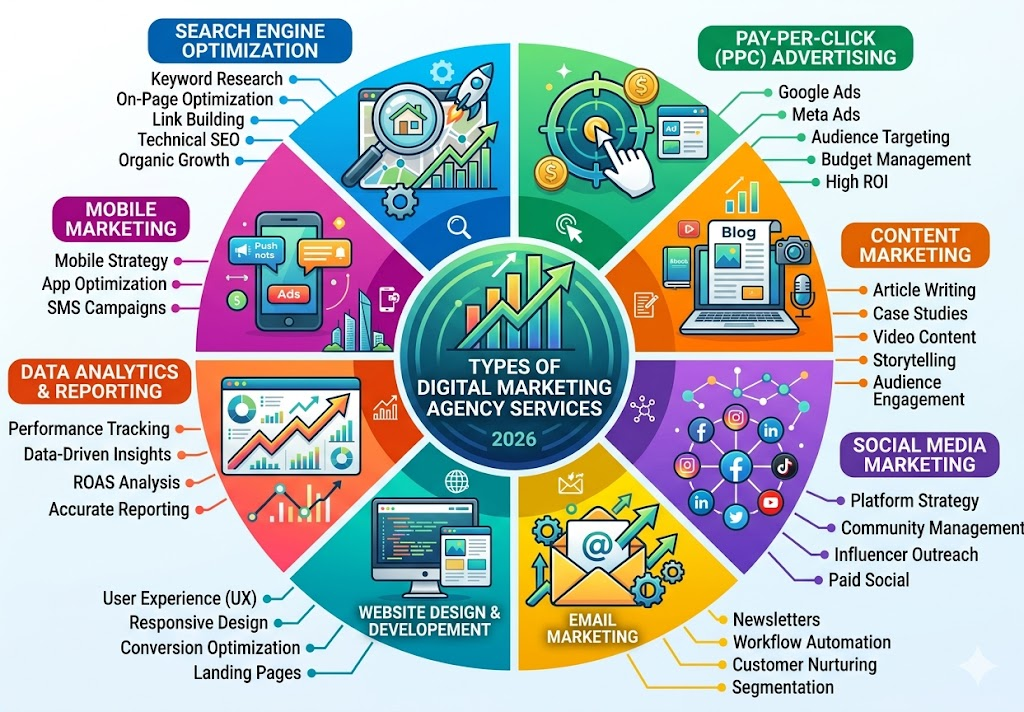
Types of Digital Marketing Agency Services in 2026
Modern digital marketing agencies offer a wide spectrum of services. Here is a breakdown of the most important ones available in 2026:
| Service | What It Does | Best For |
|---|---|---|
| SEO (Search Engine Optimization) | Improves organic Google rankings | Long-term traffic growth |
| PPC / Google Ads | Runs paid search & display ads | Immediate lead generation |
| Social Media Marketing | Manages brand presence on platforms | Brand awareness & engagement |
| Content Marketing | Creates blogs, videos, infographics | Authority building & SEO |
| Email Marketing | Sends automated campaigns to subscribers | Retention & nurturing |
| Web Design & Development | Builds and optimizes websites | Conversion optimization |
| Influencer Marketing | Partners with creators/influencers | Gen Z & Millennial reach |
| Video Marketing | Creates short-form & long-form videos | Top-of-funnel engagement |
| AI Marketing | Uses AI tools for personalization & automation | Scalable campaigns |
| AEO (AI Engine Optimization) | Optimizes content for AI search like ChatGPT | Future-proofing SEO strategy |
Each of these services can be offered individually or as a bundled, integrated package. Many businesses in 2026 opt for full-service agency partnerships that combine several of these services into one cohesive strategy.
IMPORTANT FACTS & STATISTICS
The numbers behind digital marketing’s explosive growth confirm why agency services are more in demand than ever before.
Fact 1 — Market Size: The global digital marketing industry is projected to reach $807 billion in 2026, up significantly from $667 billion in 2024, making it one of the fastest-growing sectors in the global economy. (Source: WordStream / Statista, 2026)
Fact 2 — SEO Dominance: Websites, blogs, and SEO remain the #1 ROI-generating marketing channel for businesses in 2026. Meanwhile, 40.65% of website traffic still comes from organic search, dwarfing AI referral traffic at just 0.26%. (Source: HubSpot State of Marketing Report 2026 / Ahrefs)
Fact 3 — AI Adoption in Marketing: Nearly 94% of marketers plan to use AI to assist with content creation in 2026, and 46% of marketers already use AI to scale creative production. (Source: HubSpot State of Marketing Report 2026 / Smartly 2026 Digital Advertising Trends Report)
Fact 4 — Short-Form Video ROI: Short-form video is now the highest-ROI content format for marketers in 2026, with 104% more marketers naming it their top format compared to 2024. YouTube Shorts alone generates 200 billion daily views. (Source: HubSpot State of Marketing Report 2026 / Alphabet Q4 2025 Earnings)
Fact 5 — Email Marketing Staying Power: There are 4.59 billion email users worldwide (Statista), and about 75% of marketers maintained or increased their email marketing investment in 2026 — proving that email remains a foundational digital marketing channel despite the rise of social media. (Source: Statista / HubSpot 2026)
Fact 6 — Content Marketing Growth: The global content marketing industry revenue is estimated at $94 billion in 2025 and is expected to grow by 10.4% in 2026. (Source: Hostinger Digital Marketing Statistics, 2026)
FAQ SECTION (People Also Ask)
The cost of digital marketing agency services varies widely based on scope, agency size, and location. On average, monthly retainers range from $1,500 to $10,000+ for SMBs, while enterprise-level engagements can exceed $50,000 per month. Project-based work (like a website redesign or a one-time campaign) is typically priced separately. Always ask for a detailed breakdown of what’s included before signing any contract.
Q2: What services should a digital marketing agency offer?
A full-service digital marketing agency should offer at minimum: SEO (Search Engine Optimization), PPC (Pay-Per-Click) advertising, social media marketing, content marketing, email marketing, and web design/development. In 2026, the best agencies also provide AI-driven marketing, video production, influencer marketing management, and AI Engine Optimization (AEO) to keep clients competitive in evolving search environments.
Q3: How long does it take to see results from a digital marketing agency?
The timeline depends on the services used. Paid advertising (PPC/Meta Ads) can generate results within days or weeks. SEO and content marketing are long-term plays, typically showing meaningful traction within 3–6 months, with compounding results over 12+ months. Email marketing and social media campaigns can show engagement improvements within the first 30–60 days depending on existing audience size.
Q4: How do I choose the right digital marketing agency for my business?
Start by defining your goals, budget, and target audience clearly. Then evaluate agencies on five key criteria: relevant industry experience, proven case studies with measurable results, transparent reporting practices, communication style, and cultural fit with your brand. Always request references or a discovery call before committing. Avoid agencies that promise guaranteed #1 Google rankings — that’s a red flag for shady practices.
Q5: Is hiring a digital marketing agency worth it for small businesses?
Absolutely — especially for small businesses. SMBs that lack the resources to build a full in-house marketing department benefit tremendously from agency partnerships. Agencies provide access to a diverse team of specialists, premium tools, and proven strategies at a fraction of the cost of full-time hires. Studies consistently show that businesses working with professional marketing agencies grow faster and generate higher ROI than those relying solely on unguided in-house efforts.
CONCLUSION
Digital marketing agency services are no longer a luxury reserved for Fortune 500 companies — they are a practical, cost-effective growth engine for businesses of all sizes in 2026. From SEO and PPC to AI-powered content and short-form video, the range of services available today is broader and more powerful than ever before.
The global digital marketing market is racing toward $807 billion this year. Brands that partner with the right agencies — those that combine data, creativity, strategy, and emerging technology — are the ones winning market share.
Whether you’re just starting your digital journey or looking to scale an existing strategy, the key is to define clear goals, choose an agency that aligns with your vision, and commit to a long-term partnership built on transparency and results.
Ready to grow your brand online in 2026? Drop a comment below with your biggest digital marketing challenge, share this article with someone building their business, or explore our related guides to dive deeper into SEO, content marketing, and paid advertising strategies.