
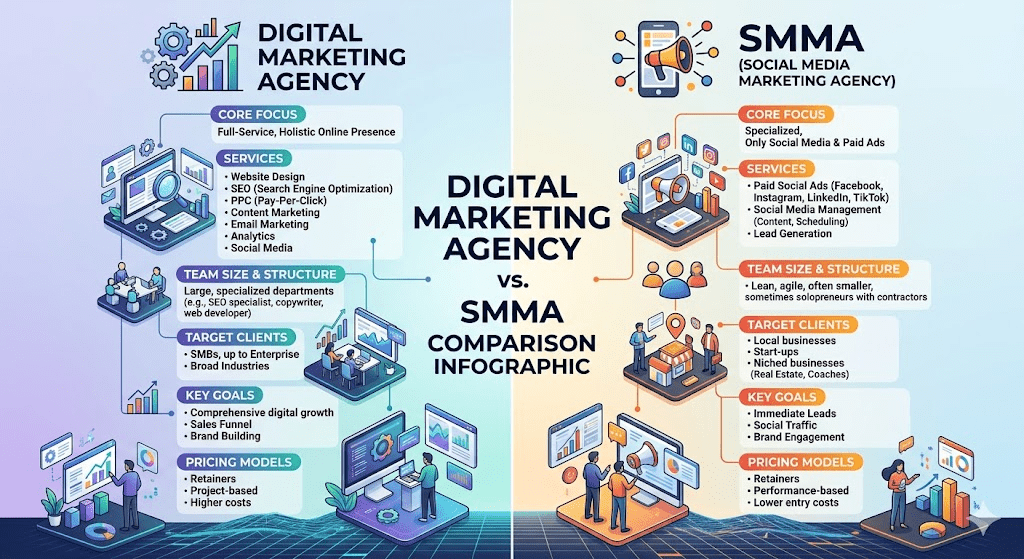
A Digital Marketing Agency is a full-service firm that handles SEO, PPC, email marketing, content creation, web design, and social media — all under one roof. An SMMA (Social Media Marketing Agency) is a specialized, niche agency that focuses exclusively on social media platforms like Instagram, Facebook, TikTok, and LinkedIn. The key difference is scope: a digital marketing agency casts a wide net across all online channels, while an SMMA dives deep into the social media ecosystem. For businesses needing broad online coverage, a digital agency is better. For brands laser-focused on social growth, an SMMA delivers more targeted results.
Introduction
Every business owner eventually faces a critical question: “Who should I hire to grow my brand online?” The two most popular answers today are a Digital Marketing Agency and an SMMA — but most people don’t actually know the difference.
With the global digital marketing market valued at over $653 billion in 2025 (Expert Market Research), choosing the right marketing partner has never been more important. Make the wrong choice, and you burn your budget. Make the right one, and your business skyrockets.
In this article, we break down the digital marketing agency vs SMMA debate in full detail. We’ll cover what each model is, how they work, their core differences, pros and cons, and — most importantly — which one is right for your specific situation. Whether you’re a business owner looking for help or an entrepreneur thinking of starting an agency, this guide covers everything you need to know.
What Is a Digital Marketing Agency? (Full Explanation)
A digital marketing agency is a full-service company that provides a comprehensive range of online marketing services to help businesses grow their digital presence. Think of it as a one-stop shop for everything internet marketing.
These agencies have been around since the late 1990s, evolving alongside the internet itself. Early digital agencies focused primarily on website design and banner ads. Today, they have expanded into complex ecosystems that manage everything from organic search rankings to paid advertising, email automation, and beyond.
A typical digital marketing agency offers services such as Search Engine Optimization (SEO), Pay-Per-Click advertising (PPC/Google Ads), content marketing, email marketing, web design and development, conversion rate optimization (CRO), influencer marketing, video marketing, and yes — social media management too.
The reason digital marketing agencies matter so much in today’s landscape is simple: businesses can no longer rely on a single channel to reach customers. A potential buyer might discover your brand through a Google search, revisit your site via a retargeting ad, then finally convert after reading a compelling email. A full-service digital agency manages that entire journey.
What Is an SMMA? (Social Media Marketing Agency Explained)
SMMA stands for Social Media Marketing Agency. It is a specialized type of agency that focuses exclusively on helping businesses grow through social media platforms. While the concept of social media agencies has existed since platforms like Facebook and Twitter went mainstream, the term “SMMA” was heavily popularized around 2017–2019 by online entrepreneurs and course creators like Tai Lopez and others who packaged it as a low-barrier business model.
An SMMA typically handles Instagram growth, Facebook Ads management, TikTok content strategy, LinkedIn B2B outreach, community management, influencer partnerships, short-form video production, and paid social campaigns. The beauty of the SMMA model is its lean, low-overhead structure — most are run by solo operators or small teams who serve clients remotely using just a laptop and an internet connection.
It is important to note that there is some controversy around the SMMA label. As one viral Reddit thread in the r/agency community summarized: “SMMA, specifically the acronym, represents a scam pushed by gurus — but Social Media Marketing Agencies are real, proper businesses.” The term got a negative reputation due to the flood of online courses promising overnight riches. However, legitimate SMMAs deliver real, measurable results for clients every day.
How Does Each Model Work? Step-by-Step
Understanding how each model operates will help you see the functional differences more clearly.
How a Digital Marketing Agency Works:
- Discovery & Audit — The agency conducts a full audit of your current digital presence, covering your website, SEO health, ad accounts, social channels, and content.
- Strategy Development — A multi-channel strategy is built, aligning SEO, paid media, social, email, and content into one cohesive plan.
- Team Assignment — Dedicated specialists (SEO managers, PPC experts, content writers, social media managers) are assigned to your account.
- Execution — Campaigns run simultaneously across multiple channels.
- Reporting — Monthly reports cover performance across all channels, with data from Google Analytics, Google Ads, social platforms, and email platforms.
- Optimization — The team continuously tweaks and improves based on data insights.
How an SMMA Works:
- Niche & Platform Selection — The agency identifies which social platforms are most relevant for your target audience (e.g., Instagram for e-commerce, LinkedIn for B2B).
- Content Strategy — A dedicated content calendar is built with planned posts, reels, stories, and campaigns.
- Ad Campaign Setup — Paid social campaigns (Meta Ads, TikTok Ads) are created and launched.
- Community Management — The agency responds to comments, DMs, and engages with followers to build brand loyalty.
- Influencer Coordination — Where relevant, influencer partnerships are arranged.
- Analytics & Reporting — Monthly social-specific reports track reach, engagement, follower growth, and ad spend ROI.
Types of Each Agency Model
There are meaningful sub-types within each category that are worth knowing.
Types of Digital Marketing Agencies:
- Full-Service Agency — Handles every aspect of digital marketing end-to-end, from SEO to social to email. Best for mid-to-large businesses with diverse needs.
- SEO Agency — Focuses purely on search engine optimization and organic traffic.
- PPC/Paid Media Agency — Specializes in Google Ads, Microsoft Ads, and programmatic advertising.
- Content Marketing Agency — Creates blogs, videos, whitepapers, and other assets to drive inbound traffic.
- Performance Marketing Agency — Results-driven; charges based on leads, sales, or conversions delivered.
Types of SMMA Models:
- Niche SMMA — Serves clients in one specific industry only (e.g., only real estate agents, only dentists, only restaurants). Higher expertise, easier client acquisition.
- Platform-Specific SMMA — Focuses on one platform exclusively (e.g., “We only run TikTok ads”).
- Content-Only SMMA — Creates and publishes social content but does not run paid ads.
- Paid Ads SMMA — Runs Facebook and Instagram ad campaigns but doesn’t manage organic content.
- Full-Social SMMA — Manages both organic content and paid social ads across multiple platforms.
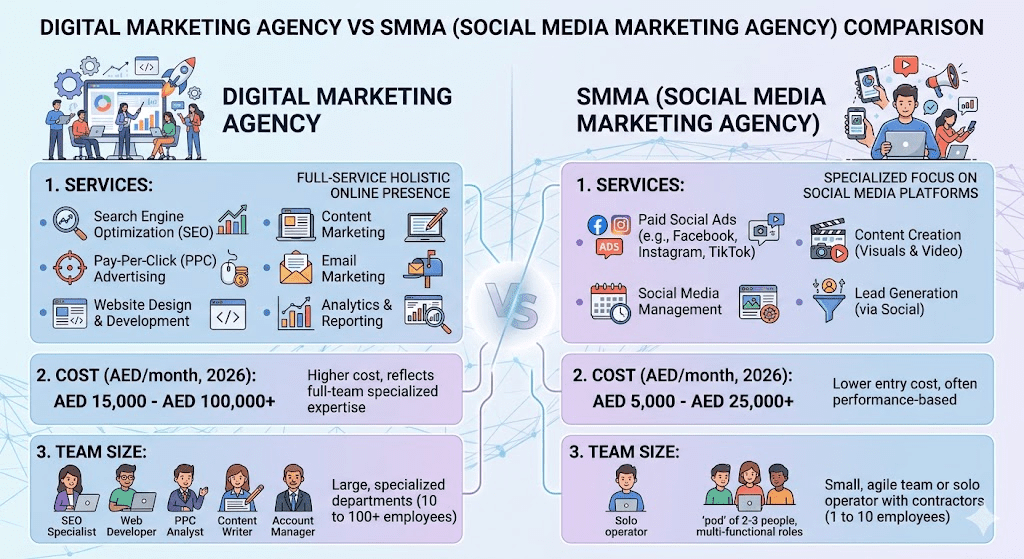
Digital Marketing Agency vs SMMA — Full Comparison Table
| Feature | Digital Marketing Agency | SMMA |
|---|---|---|
| Scope of Services | Broad — SEO, PPC, Email, Social, Web | Narrow — Social Media Only |
| Team Size | Large (10–200+ employees) | Small (1–20 people) |
| Monthly Retainer | $2,500 – $20,000+ | $500 – $5,000 |
| Best For | Mid-to-large businesses | Small businesses, startups |
| Startup Cost | High (office, tools, staff) | Low (laptop + software) |
| Specialization | Generalist | Social media specialist |
| Reporting | Multi-channel dashboards | Social-focused analytics |
| Scalability | Highly scalable with systems | Scalable but niche-limited |
| Learning Curve | High (multiple disciplines) | Moderate (social platforms) |
| Client Retention | Generally higher | Can be volatile |
Benefits and Advantages of Each Model
Benefits of Hiring a Digital Marketing Agency:
Choosing a full-service digital marketing agency brings unmatched breadth of expertise to your brand. You gain access to a team of specialists — SEO experts, paid media managers, content strategists, and web developers — all working on your growth simultaneously. This is particularly valuable for businesses that need consistent lead generation across multiple touchpoints. Additionally, full-service agencies provide comprehensive reporting that ties together performance data from all channels, making it easier to understand your complete return on investment. Large agencies also tend to have established relationships with media partners, access to premium tools (like SEMrush, HubSpot, and Salesforce), and proven systems built from years of client experience.
Benefits of Hiring or Starting an SMMA:
An SMMA delivers laser-focused expertise in social media, which is arguably the most powerful organic marketing channel in today’s landscape. With 5.42 billion social media users worldwide in 2025 (Social Pixel Pro), the potential audience reach through social platforms is extraordinary. SMMAs are typically more affordable than full-service agencies, making them accessible to small businesses and startups with limited budgets. They are also more agile — they can adapt quickly to platform algorithm changes, trending content formats, and cultural moments. For entrepreneurs, starting an SMMA has an incredibly low barrier to entry, requiring minimal startup capital compared to building a full agency. Many successful SMMA owners generate $5,000–$30,000+ per month working with just 5–10 clients.
Common Mistakes and Challenges to Avoid
Mistakes Businesses Make When Choosing Between the Two:
One of the most common errors is hiring a full-service digital marketing agency when you only truly need social media help — and then paying a premium for services you never use. Conversely, many businesses hire an SMMA expecting them to also improve their Google rankings or build their email list, leading to frustration when those results never come.
Another critical mistake is choosing based on price alone. The cheapest SMMA or agency is almost never the best option. Low-cost providers often use cookie-cutter templates, outsourced labor, or vanity metrics (likes and followers) instead of real business outcomes (leads and revenue).
Challenges Faced by SMMA Owners:
The SMMA space has become increasingly competitive. As LinkedIn marketing expert Jungwook Park noted in late 2024, “The SMMA model, built on Facebook ads and social media content, has reached its limit. The market is oversaturated, and businesses are tired of poor results.” This highlights the need for SMMA owners to deliver genuine, measurable ROI rather than surface-level engagement metrics.
Challenges for Digital Marketing Agencies:
Full-service agencies struggle with talent retention, rising tool costs, and the challenge of staying current across too many disciplines simultaneously. The rise of AI-driven marketing tools is also forcing traditional agencies to rethink their service offerings and pricing structures.
Best Practices and Expert Tips
For Businesses Choosing an Agency:
Before signing any contract, clearly define your primary marketing goal — whether that is brand awareness, lead generation, e-commerce sales, or local traffic. This single exercise will tell you whether you need a full-service digital agency or a focused SMMA. Always request case studies in your specific industry, ask for transparent reporting access, and insist on performance benchmarks written into your agreement.
For Entrepreneurs Starting an SMMA:
Pick a specific niche and own it completely. Trying to serve every type of business is the fastest path to mediocre results and poor referrals. Specializing — for example, exclusively serving med spas or online coaches — makes you the obvious expert and justifies premium pricing. Start with one or two free or discounted clients to build a portfolio, then charge confidently once you have results to show.
For Entrepreneurs Starting a Digital Marketing Agency:
Avoid the temptation to offer every service from day one. Start with one or two core services where you already have deep expertise, deliver exceptional results, then expand your offerings as you build a reliable team and recurring revenue base.
Important Facts & Statistics
Backing up your marketing decisions with data is essential. Here are five verified facts that highlight the scale and importance of both models in today’s landscape:
- The global digital marketing market reached approximately $653 billion in 2025 and is projected to exceed $750 billion by 2026, according to Expert Market Research and Persistence Market Research. This signals enormous opportunity for both agency types.
- 5.42 billion people worldwide use social media as of 2025 (Social Pixel Pro / Statista), representing roughly 67% of the global population — validating the massive reach that SMMAs can deliver for their clients.
- 92% of businesses use social media for marketing (MarketingLTB, 2025), demonstrating that social media management is now a non-negotiable business function, not an optional extra.
- The average ROI for social media marketing is $3–$5 for every $1 spent (iPromote, 2025), making SMMA services a highly attractive investment for small-to-medium businesses.
- 83% of B2B marketers use social media for advertising (Dreamgrow, 2025), showing that even in the traditionally SEO-and-email-dominated B2B space, social platforms — and therefore SMMAs — are delivering serious value.
FAQ Section — People Also Ask
Q1: Is SMMA the same as a digital marketing agency?
No. An SMMA (Social Media Marketing Agency) is a type of digital marketing agency, but not the same thing. A digital marketing agency covers a broad range of services including SEO, PPC, email marketing, content creation, and web development. An SMMA focuses specifically on social media platforms such as Instagram, Facebook, TikTok, and LinkedIn. Think of SMMA as a specialized subset within the wider digital marketing agency category.
Q2: Is SMMA still worth starting in 2025–2026?
Yes, but with conditions. While the SMMA market has become more competitive and some argue it is oversaturated at the generic level, highly specialized SMMAs that serve a specific industry niche and deliver proven, measurable results continue to thrive. The key is differentiation — choosing a specific niche, mastering one or two platforms deeply, and charging based on results rather than activity. Data shows that social media ad spending is still growing globally, meaning client budgets for social media services remain strong.
Q3: How much does a digital marketing agency charge per month?
Pricing varies widely based on the scope of services, agency size, and your business’s needs. A full-service digital marketing agency typically charges between $2,500 and $20,000+ per month on a retainer basis. Smaller boutique agencies may start at $1,000–$2,500/month. An SMMA is generally more affordable, with retainers ranging from $500 to $5,000/month depending on the number of platforms managed and whether paid ad management is included.
Q4: Which is better for a small business — a digital marketing agency or an SMMA?
For most small businesses, an SMMA is the better starting point. It is more affordable, highly targeted, and directly addresses where small business customers spend their time — social media. A full-service digital agency may offer more services than a small business actually needs, resulting in wasted budget. Once a business grows and requires multi-channel marketing (SEO + paid ads + email + social), upgrading to a full-service digital marketing agency becomes the logical next step.
Q5: Can I run both an SMMA and a digital marketing agency at the same time?
Technically yes, but it is not recommended for beginners. Running both models simultaneously creates confusion around positioning, pricing, and talent requirements. The smartest approach is to start with a niche SMMA, build a strong portfolio and reliable income, then gradually expand your service offerings toward becoming a full-service digital agency. Many of today’s successful digital marketing agencies started as small social media shops and evolved organically over time.
Conclusion
The digital marketing agency vs SMMA debate doesn’t have a one-size-fits-all answer — and that’s actually good news. It means there’s a right fit for everyone. If your business needs a comprehensive online strategy spanning SEO, paid search, email, and social, a full-service digital marketing agency is your best investment. If your primary goal is to dominate social media, build a loyal community, and run high-converting social ads on a focused budget, an SMMA is the smarter, leaner choice.
For entrepreneurs, both models offer real paths to financial independence — but success in either requires genuine skill, consistent delivery, and a relentless focus on client results.
The bottom line? Choose depth over breadth when you’re starting out, serve your clients exceptionally well, and let results speak louder than any guru’s promise.