
An Advertising Agency is a traditional firm that creates and places ads through offline channels like TV, radio, print, and billboards. A Digital Marketing Agency focuses on online channels — SEO, Google Ads, social media, email marketing, and content creation. The core difference is the medium: advertising agencies work in the physical world, while digital marketing agencies operate in the online world. Today, many businesses choose digital agencies for their measurable ROI, precise targeting, and cost-effectiveness. However, large brands often combine both for maximum market coverage.
Introduction
Imagine spending thousands of dollars on a full-page newspaper ad — and having absolutely no idea how many people actually read it. Now imagine running a Google Ad campaign and knowing exactly how many people clicked, where they came from, and how many bought your product. That contrast captures the heart of the advertising agency vs digital marketing agency debate perfectly.
With global ad spending projected to surpass $1 trillion for the first time in 2026 (Dentsu Global), choosing the right agency to invest your marketing budget has never been more critical. One wrong decision can cost your business thousands — and months of lost growth.
In this complete guide, we break down everything you need to know about advertising agencies vs digital marketing agencies — what they are, how they work, what they cost, and which one is the right fit for your business in 2026. Whether you’re a startup, a growing SME, or a large enterprise, this article will give you a clear, confident answer.
What Is an Advertising Agency? (Full Explanation)
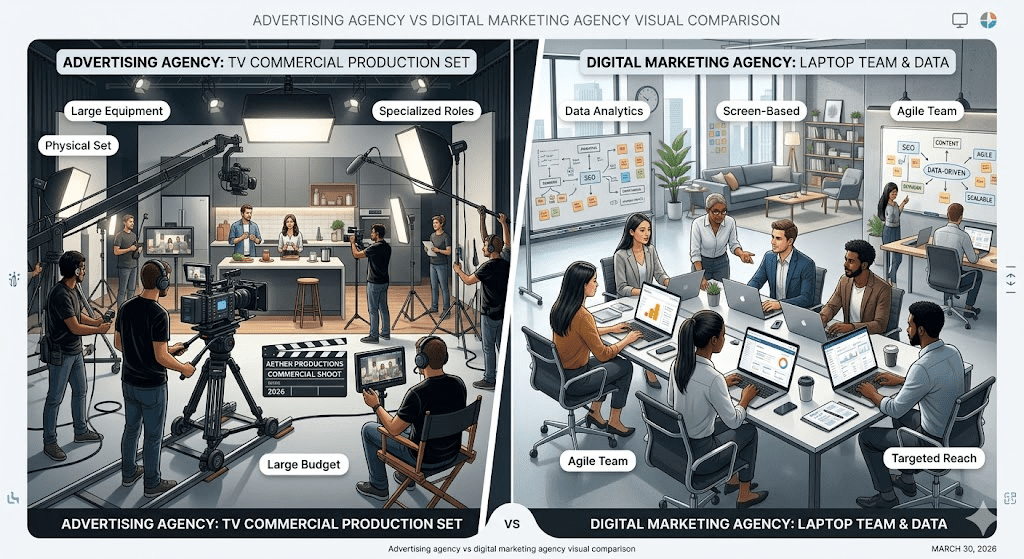
An advertising agency is a company that specializes in creating, planning, and managing promotional campaigns for clients across traditional mass media channels. These agencies are the creative powerhouses behind the TV commercials, billboard campaigns, radio jingles, and magazine spreads that we have all grown up seeing.
The history of advertising agencies goes back to 1842, when Volney Palmer opened the first recognized advertising agency in Philadelphia, USA (Vaia / Advertising History). In those early days, agencies simply bought newspaper space in bulk and resold it to businesses. Over the next century, agencies evolved into sophisticated creative studios employing copywriters, art directors, media planners, and brand strategists.
The “Golden Age” of advertising — famously depicted in shows like Mad Men — ran from the 1950s through the 1980s. During this era, agencies like Ogilvy & Mather, BBDO, and McCann-Erickson dominated the industry, shaping consumer culture through unforgettable TV campaigns and print ads.
Today, traditional advertising agencies still exist and serve a very important purpose. For large brands that need to reach mass audiences quickly — like Coca-Cola, Nike, or McDonald’s — a TV spot during prime time or a billboard in Times Square can deliver brand recognition that no online ad can replicate. However, the landscape has shifted dramatically, and advertising agencies that refuse to adapt are struggling.
Core services of a traditional advertising agency include:
- Television commercial production and media buying
- Radio advertisement scripting and placement
- Print advertising (newspapers, magazines, brochures)
- Outdoor advertising (billboards, transit ads, hoardings)
- Brand identity and creative concept development
- Public relations and press campaigns
- Event sponsorship and experiential marketing
What Is a Digital Marketing Agency? (Full Explanation)
A digital marketing agency is a company that helps businesses grow their online presence, generate leads, and drive sales through internet-based marketing strategies and channels. Rather than buying TV slots or printing brochures, a digital marketing agency builds your brand across search engines, social media platforms, email inboxes, websites, and apps.
Digital marketing agencies began emerging in the mid-to-late 1990s as the internet became commercially mainstream. The first clickable banner ad appeared in 1994, and from that moment forward, a new marketing universe was born. By the 2000s, Google Ads, social media platforms, and email marketing had created an entirely new set of tools that traditional agencies simply weren’t equipped to handle.
Today, digital marketing agencies are the fastest-growing segment of the entire marketing services industry. According to IMARC Group, the global digital marketing market was valued at over $456 billion in 2025 and is on track to reach $1.2 trillion by 2034. This explosive growth reflects how decisively the business world has moved online.
Core services of a digital marketing agency include:
- Search Engine Optimization (SEO) — ranking on Google organically
- Pay-Per-Click Advertising (PPC / Google Ads / Bing Ads)
- Social Media Marketing (Instagram, Facebook, LinkedIn, TikTok)
- Content Marketing (blogs, videos, infographics, podcasts)
- Email Marketing and automation
- Conversion Rate Optimization (CRO)
- Web design and development
- Analytics, tracking, and data reporting
- Influencer marketing and affiliate campaigns
How Does Each Agency Model Work? Step-by-Step
Understanding the operational workflow of each model makes the differences crystal clear.
How a Traditional Advertising Agency Works:
The process at a traditional advertising agency typically follows a structured, campaign-based timeline that can take weeks or even months from brief to execution.
- Client Brief — The business meets with account managers to share campaign goals, target audience, budget, and timelines.
- Research & Strategy — The agency researches the market, competitors, and audience demographics.
- Creative Development — Copywriters and art directors develop concepts, scripts, slogans, and visual designs.
- Media Planning — Media planners decide which channels to use (TV channels, radio stations, publications) and when to place ads for maximum reach.
- Media Buying — The agency negotiates and purchases ad slots from TV networks, radio stations, or print publishers — often at bulk rates.
- Production — Commercials are filmed, recorded, or printed at professional studios.
- Campaign Launch — Ads go live across selected media channels.
- Post-Campaign Analysis — Agencies review estimated reach, audience surveys, and brand recall studies — but direct ROI measurement remains difficult.
How a Digital Marketing Agency Works:
Digital agency workflows are faster, more iterative, and heavily data-driven.
- Discovery & Audit — The agency audits your website, existing ad accounts, social profiles, and competitor landscape.
- Strategy & Goal Setting — A tailored digital strategy is built around measurable KPIs (Key Performance Indicators) like leads, traffic, cost-per-click, or revenue.
- Campaign Setup — SEO strategies are mapped, paid ad campaigns are built, content calendars are created, and email sequences are designed.
- Launch — Campaigns go live across chosen digital channels.
- Real-Time Monitoring — The agency monitors performance daily using tools like Google Analytics, Google Ads, SEMrush, HubSpot, and Meta Ads Manager.
- Optimization — Based on live data, ads are adjusted, content is refined, and budgets are reallocated to what’s working.
- Monthly Reporting — Clients receive detailed reports showing exact results — traffic, conversions, cost-per-lead, and return on ad spend (ROAS).
Types of Each Agency
Both advertising agencies and digital marketing agencies come in several distinct subtypes, each with a different focus.
Types of Advertising Agencies:
- Full-Service Advertising Agency — Handles everything from strategy to creative production to media buying across all traditional channels.
- Creative Boutique — A smaller, specialist firm focused purely on generating big, bold creative ideas. They usually outsource media buying.
- Media Buying Agency — Specializes in purchasing ad placements in bulk at negotiated rates across TV, radio, print, and OOH (Out-of-Home).
- Brand Agency — Focused on brand identity, positioning, visual design, and long-term brand narrative.
- Public Relations (PR) Agency — Manages earned media, press releases, media relationships, and reputation management.
Types of Digital Marketing Agencies:
- Full-Service Digital Agency — Covers all online channels from SEO to paid ads to social media and email. Best for businesses wanting one integrated partner.
- SEO Agency — Specializes exclusively in search engine optimization and organic traffic growth.
- PPC / Paid Media Agency — Runs Google Ads, Microsoft Ads, and programmatic display campaigns.
- Social Media Agency (SMMA) — Focused on growing brands through Instagram, Facebook, LinkedIn, and TikTok.
- Content Marketing Agency — Produces blogs, videos, whitepapers, and podcasts to drive inbound leads.
- Performance Marketing Agency — Results-first model; often charges based on leads or sales delivered.
Advertising Agency vs Digital Marketing Agency — Full Comparison
| Feature | Advertising Agency | Digital Marketing Agency |
|---|---|---|
| Primary Channels | TV, Radio, Print, Billboard | SEO, PPC, Social, Email, Web |
| Target Audience | Mass / Broad audience | Targeted / Specific segments |
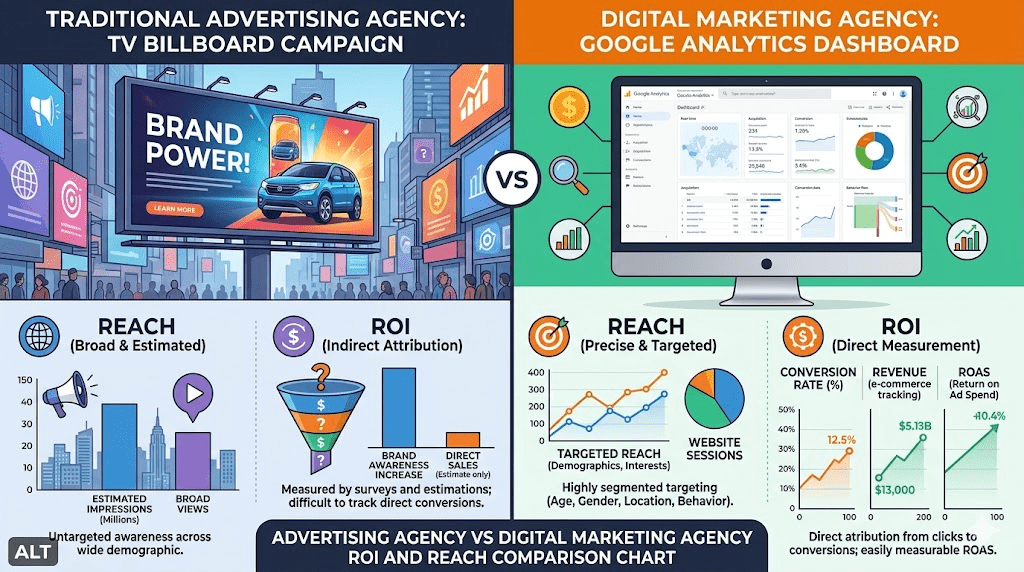
| ROI Measurement | Difficult (estimated reach) | Easy (real-time data tracking) |
| Campaign Speed | Weeks to months | Days to weeks |
| Budget Range | High ($10,000–$1M+) | Flexible ($500–$50,000+/mo) |
| Best For | Brand awareness, mass reach | Lead generation, conversions |
| Data & Analytics | Limited (surveys, ratings) | Comprehensive (live dashboards) |
| Audience Targeting | Demographic/geographic only | Behavioral, interest, retargeting |
| Creativity Style | Storytelling, emotional impact | Data-informed, conversion-focused |
| Scalability | Expensive to scale | Easily scalable |
| Ideal Business Size | Large enterprises & brands | Startups, SMEs, and enterprises |
| Geographic Reach | Local/National | Local, National, and Global |
Benefits and Advantages of Each Model
Top Benefits of Hiring a Traditional Advertising Agency:
A traditional advertising agency brings unmatched creative storytelling ability and the power of mass media reach. When a brand needs to build deep emotional connections with a broad audience — think of iconic campaigns like Apple’s “Think Different” or Nike’s “Just Do It” — a traditional agency’s creative team is uniquely equipped to deliver that impact. TV advertising, in particular, still commands enormous authority; a well-placed primetime commercial can reach millions of viewers in a single airing. Traditional advertising also builds a sense of legitimacy and credibility in consumers’ minds. Seeing a brand advertised on television or in a prestigious publication triggers a trust response that many digital ads simply cannot replicate. Additionally, for businesses targeting older demographics (45+) who spend more time with TV, radio, and print, traditional advertising channels remain the most effective point of contact.
Top Benefits of Hiring a Digital Marketing Agency:
The advantages of a digital marketing agency center on precision, measurability, and cost-efficiency. A 2024 HubSpot study found that businesses using digital campaigns see an average ROI of $2.80 per dollar spent — far surpassing traditional advertising’s often-unmeasurable returns. Digital agencies can target your ideal customer with remarkable accuracy — by age, location, income level, interests, buying behavior, and even what websites they recently visited. Every campaign is fully trackable, meaning you know exactly which ad generated which sale. Digital marketing is also far more accessible to small and medium-sized businesses; you can start a Google Ads campaign with a budget as low as $5/day, something no TV commercial can match. Furthermore, digital campaigns are extremely agile — if an ad isn’t working, it can be paused, adjusted, and relaunched within hours, not weeks.
Common Mistakes and Challenges
Mistakes Businesses Make When Choosing Between the Two:
One of the most costly errors businesses make is hiring a traditional advertising agency when their target audience primarily lives online — and vice versa. A restaurant in a local market might waste $20,000 on a regional TV campaign when targeted Facebook and Google ads at a fraction of the cost could drive far more actual foot traffic.
Another common mistake is assuming that a digital marketing agency can replace all forms of brand building. Digital ads excel at driving short-term conversions, but they can struggle to create the deep emotional brand equity that long-form TV storytelling builds over years. The most successful brands — Apple, Samsung, Amazon — actually use both agency types in tandem.
Challenges Facing Traditional Advertising Agencies Today:
The shift to digital is creating real pressure on traditional agencies. Ad-skipping technology, declining print readership, and the rise of streaming services (which have far fewer traditional ad slots than broadcast TV) have all eroded the effectiveness and reach of traditional channels. According to eMarketer, digital is now the main engine of global ad growth, with traditional media share shrinking year over year.
Challenges Facing Digital Marketing Agencies:
Digital agencies face their own hurdles — rapidly changing platform algorithms, rising ad costs (Google CPCs have increased significantly year-over-year), growing consumer ad fatigue, and increasing data privacy regulations (like GDPR and Apple’s iOS privacy changes) that limit targeting capabilities. Staying current requires constant learning and adaptation.
Best Practices — How to Choose the Right One for Your Business
The decision between an advertising agency and a digital marketing agency ultimately comes down to four key factors: your target audience, your budget, your goals, and your timeline.
Follow these best practices when choosing:
- Know your audience first. If your customers are 18–45 and spend hours online every day, a digital marketing agency is your priority. If you’re selling a product to 55+ consumers who watch cable TV and read newspapers, a traditional advertising agency may deliver better reach.
- Define your primary goal clearly. Awareness campaigns with broad reach favor traditional advertising agencies. Lead generation, e-commerce sales, and app downloads favor digital marketing agencies.
- Start with digital if you’re budget-conscious. Digital marketing offers far more flexibility and lower minimum budgets, making it the smarter starting point for startups and SMEs.
- Consider a hybrid approach for large brands. Enterprises with significant budgets should explore using both — a traditional agency for mass brand awareness and a digital agency for targeted lead generation and conversion.
- Always demand transparent reporting. A credible digital marketing agency will give you access to live dashboards. A credible advertising agency will provide audience reach estimates and brand survey data. If any agency cannot explain how they measure results, walk away.
- Evaluate their portfolio in your industry. Whether traditional or digital, the best agencies have proven case studies in your niche.
Important Facts & Statistics
Here are five powerful, verified data points that define the advertising agency vs digital marketing agency landscape in 2026:
- Global ad spend is set to surpass $1 trillion for the first time in 2026, growing at 5.1% — with digital channels driving the majority of that growth (Dentsu Global, December 2025). This confirms that digital is the dominant force in modern advertising.
- The global advertising agencies industry is valued at $444.7 billion in 2026 (IBISWorld), while the digital marketing segment alone is projected to reach $750 billion in the same year (Persistence Market Research) — indicating that digital has already overtaken traditional in total market value.
- Businesses using digital marketing see an average ROI of $2.80 for every $1 spent, compared to traditional advertising, which struggles to provide direct ROI measurement at all (HubSpot, 2024). This data point alone explains why the shift to digital is accelerating.
- 69% of total global ad spend in 2026 will flow through digital channels (Medium / Global Digital Advertising Report, 2026), meaning that for every $10 spent on advertising worldwide, nearly $7 goes to online platforms.
- The first advertising agency was founded in 1842, yet it took 150+ years for the industry to face its greatest disruption — the internet. Today, traditional agencies that have failed to embrace digital transformation are losing clients at an accelerating rate (History of Advertising / Vaia).
FAQ Section — People Also Ask
Q1: What is the main difference between an advertising agency and a digital marketing agency?
An advertising agency focuses on traditional media channels — TV, radio, print, and outdoor advertising — to create broad brand awareness campaigns. A digital marketing agency focuses exclusively on online channels like SEO, Google Ads, social media, email, and content marketing. The biggest practical difference is measurability: digital agencies provide real-time, data-backed performance reports, while traditional advertising agencies often rely on estimated reach and audience surveys. For most modern businesses, digital marketing agencies offer better value for money and measurable results.
Q2: Which is better — an advertising agency or a digital marketing agency?
Neither is universally “better” — it depends entirely on your business goals, target audience, and budget. For mass brand awareness and reaching older demographics, traditional advertising agencies still hold value. For targeted lead generation, measurable ROI, and cost-efficient campaigns, digital marketing agencies are the superior choice for most businesses in 2026. Large enterprises often benefit from using both in an integrated strategy, while startups and SMEs should prioritize digital marketing agencies due to their lower cost and higher measurability.
Q3: How much does an advertising agency charge compared to a digital marketing agency?
Traditional advertising agencies are significantly more expensive. A single TV commercial can cost anywhere from $50,000 to several million dollars when you factor in production and media buying. A national print or billboard campaign can run $10,000–$500,000+. Digital marketing agencies, by contrast, typically charge monthly retainers ranging from $1,000 to $20,000+, depending on the scope of services. This makes digital agencies far more accessible for small and medium-sized businesses working with limited budgets.
Q4: Can a business use both an advertising agency and a digital marketing agency at the same time?
Absolutely — and many successful businesses do exactly this. Using both agencies creates an integrated marketing approach: the advertising agency builds mass brand awareness through TV, radio, and print (top of the funnel), while the digital marketing agency captures and converts that interested audience through targeted online campaigns (middle and bottom of the funnel). This “omnichannel” strategy maximizes both brand reach and conversion rates. Companies like Nike, Coca-Cola, and Amazon effectively combine both approaches at scale.
Q5: Are traditional advertising agencies becoming obsolete?
Not entirely, but they are under significant pressure to evolve. Traditional advertising agencies that refuse to embrace digital capabilities are losing clients rapidly. However, TV advertising still delivers unmatched reach for certain demographics, and outdoor advertising (billboards, transit) remains highly effective in urban markets. The most successful traditional agencies are reinventing themselves as “integrated agencies” — combining the creative strength of traditional advertising with the data-driven precision of digital marketing. Pure traditional agencies that resist change, however, are increasingly struggling to justify their cost.
Conclusion
The advertising agency vs digital marketing agency debate is not really about which one is “better” in absolute terms — it’s about which one is right for you, right now. Traditional advertising agencies bring creative power, mass reach, and brand prestige that have shaped consumer culture for over 180 years. Digital marketing agencies bring precision targeting, real-time data, measurable ROI, and cost-efficiency that today’s fast-moving business environment demands.
For most businesses in 2026 — especially startups, SMEs, and e-commerce brands — a digital marketing agency is the smarter, more accessible, and more results-driven choice. But for large enterprises building global brand awareness, the combination of both is the ultimate winning strategy.
The key takeaway is simple: know your audience, define your goals, understand your budget, and choose accordingly.