
To calculate your PPC advertising budget, start by defining your revenue goal. Then determine your average conversion rate, average order value (AOV), and your target cost per acquisition (CPA). Use this core formula:PPC Budget=Average Order ValueRevenue Goal×Cost Per Acquisition (CPA)
For example, if your monthly revenue goal is $10,000, your AOV is $100, and your CPA is $15, you need 100 customers and a budget of $1,500 per month. Always track your metrics, test small, and scale only what works.
Every dollar you waste on PPC advertising is a dollar your competitor happily picks up. Yet, most businesses set their PPC budgets based on gut feeling — and that is a recipe for burning cash.
PPC (Pay-Per-Click) advertising is one of the fastest ways to drive targeted traffic and generate revenue. But without a calculated, data-driven budget, even the best campaigns fall flat. The difference between profit and loss often comes down to one thing: knowing exactly how much to spend before you launch.
Here’s a fact that will make you pay attention: global PPC spending is projected to hit $351.55 billion, and businesses that use Google Ads report an average ROI of 200% — meaning $2 earned for every $1 spent (Source: Statista, Google Economic Impact Report). But those returns don’t happen by accident.
In this article, you’ll learn how to calculate your PPC advertising budget the right way — step by step. We’ll cover the essential formulas, budgeting models, common mistakes, and expert strategies to make every cent count.
A PPC advertising budget is the total amount of money you allocate to run pay-per-click campaigns over a set period — typically daily, monthly, or quarterly. It governs how often your ads appear, how competitive your bids are, and ultimately how much traffic and revenue you can generate.
PPC advertising works on a simple principle: you pay only when someone clicks your ad. Platforms like Google Ads, Microsoft Ads, Meta Ads, and LinkedIn Ads all operate on this model. Your budget determines your daily spend cap, and the platform distributes that spend throughout the day based on your targeting settings.
The concept gained mainstream traction in the early 2000s when Google launched AdWords (now Google Ads) in 2000, revolutionizing the way businesses advertise online. Today, it is a cornerstone of digital marketing strategy for companies of all sizes.
Why does calculating your PPC budget correctly matter so much? Because an underfunded campaign won’t generate enough data to optimize. An overfunded one bleeds money without strategy. The goal is to find the Goldilocks zone — a budget that is just right for your goals, audience, and industry benchmarks.
Calculating your PPC budget isn’t guesswork. It is a systematic process built on real business data. Follow these steps carefully.
Start with the end in mind. Ask yourself: “How much revenue do I want to generate from PPC this month?” For example, let’s say your goal is $20,000 in monthly revenue.
Your AOV is the average amount a customer spends per transaction. If your monthly sales total $50,000 across 500 orders, your AOV is $100.AOV=Number of Orders Total Revenue
Divide your revenue goal by your AOV.
Customers Needed=AOVRevenue Goal=$100$20,000=200 customers
Your conversion rate tells you how many visitors actually become customers. If 2 out of every 100 visitors buy, your conversion rate is 2%. The average PPC conversion rate across all industries is 2.35%, rising to 3.75% on Google Ads specifically.
Clicks Needed=Conversion Rate Customers Needed=0.0235200≈8,511 clicks
Research your average CPC for your industry. The average CPC on Google Ads is approximately $2.69 for search ads and $0.63 for display ads (Source: WordStream). Legal, finance, and insurance industries can see CPCs exceeding $50 per click.
PPC Budget=Clicks Needed×Average CPC=8,511×$2.69≈$22,895/month
If this number is beyond your current capacity, work backwards — reduce your revenue goal or improve your conversion rate first before scaling spend.
Daily Budget=30.4Monthly Budget=30.4$22,895≈$753/day
Google allows up to 2x your daily budget on high-performing days, so never set it so tight that spikes cut your campaigns off mid-day.
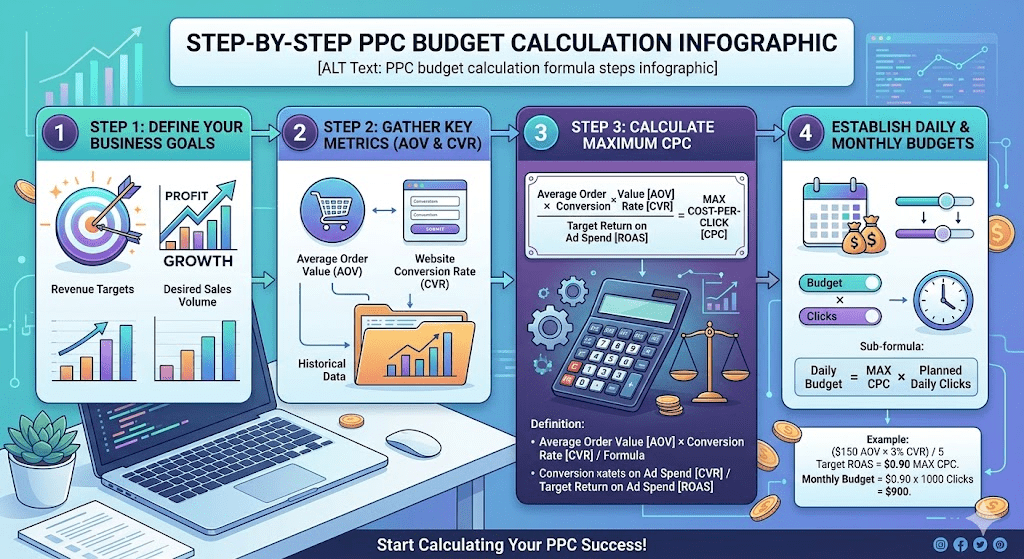
Not every business budgets PPC the same way. Here are the most widely used budgeting models, each with its own strengths.
| Budgeting Model | Best For | Description |
|---|---|---|
| Goal-Based Budgeting | eCommerce, Lead Gen | Budget set by revenue/lead goals and CPA targets |
| Percentage of Revenue | Established businesses | Allocate 5–15% of monthly revenue to PPC |
| Competitive Parity | Competitive markets | Match or exceed what competitors are spending |
| Fixed Budget | Startups, testing | Set flat budget, optimize within constraints |
| Lifetime Value (LTV) Based | SaaS, subscription | Base budget on customer LTV, not just one sale |
The goal-based model is widely considered the most strategic and data-driven approach. The percentage of revenue model is a useful starting point — the Digital Marketing Institute recommends allocating between 5% and 12% of total revenue toward digital advertising for most industries.
Benefits of Calculating Your PPC Budget Correctly
Getting your PPC budget calculation right isn’t just about saving money. It’s about unlocking the full potential of your paid advertising strategy. Here are the key benefits:
Even experienced marketers fall into these traps. Knowing them in advance will save you thousands of dollars.
Mistake 1: Setting a Budget Without a Goal Spending $1,000/month on PPC “because it seems right” is not a strategy. Always tie your budget to a specific, measurable objective — leads, sales, or ROAS targets.
Mistake 2: Ignoring Industry CPC Benchmarks Legal keywords average over $50 per click, while eCommerce averages around $1.16. Researching your industry benchmarks before budgeting prevents nasty surprises.
Mistake 3: Overspending on the Display Network Early Display ads average a conversion rate of 0% to 1% — far lower than search’s 3.1% to 6%. New advertisers should prioritize search campaigns first, then expand to display once profitable.
Mistake 4: Never Adjusting the Budget PPC isn’t a set-it-and-forget-it channel. Seasonal trends, competitor activity, and algorithm changes require regular budget reviews — ideally weekly.
Mistake 5: Confusing Revenue Goals with Profit Goals If you set a revenue goal without accounting for your product margin, you could technically “hit your numbers” while losing money. Always calculate your target CPA based on profit margin, not just revenue.
Pro Tip: Use Google’s Keyword Planner to forecast CPC estimates and monthly search volume before you set a budget. It’s free and gives you real market data.
Following these best practices will help you build a sustainable, scalable PPC budgeting strategy from day one.
Start by testing with a smaller budget before scaling. A test budget of $500–$1,000 over 2–4 weeks gives you enough data to identify which keywords, audiences, and ad creatives actually convert. Only then should you increase spend.
Use Smart Bidding strategies carefully. Google’s automation can save up to 20% in ad spend (Source: Karooya), but only if your conversion tracking is properly set up and your audience signals are strong. Automation amplifies your strategy — good or bad.
Always build in a testing budget. The 70/20/10 rule is popular among experienced PPC managers: allocate 70% of your budget to proven campaigns, 20% to emerging strategies, and 10% to experimental tests.
Monitor your Quality Score. A higher Quality Score lowers your effective CPC, meaning the same budget generates more clicks. Focus on ad relevance, expected CTR, and landing page experience to keep Quality Scores high.
Leverage ad scheduling to concentrate your budget during peak conversion hours. If your analytics show that most conversions happen between 9 AM and 6 PM on weekdays, reduce bids (or pause campaigns) during off-hours.
Set budget alerts and automated rules inside Google Ads. These notify you when spend thresholds are crossed or when CPA rises above your target, so you can react quickly without babysitting campaigns 24/7.
Many marketers wonder whether to invest in PPC or SEO. The truth is they serve different purposes, and the smartest businesses invest in both. Here’s how they compare:
| Factor | PPC Budget | SEO Budget |
|---|---|---|
| Speed of Results | Immediate (hours to days) | Slow (3–12 months) |
| Cost Structure | Pay per click | Ongoing content & technical investment |
| Traffic Sustainability | Stops when budget ends | Compounds over time |
| Targeting Precision | Highly precise (keywords, audiences, location) | Broader, intent-based |
| ROI Timeline | Short-term measurable | Long-term compounding |
| Best For | Product launches, promotions, fast growth | Brand authority, organic long-term traffic |
| Control | High (bids, targeting, scheduling) | Limited (algorithm-dependent) |
The ideal approach is to use PPC for immediate revenue generation while building SEO for long-term organic dominance. They work best together, not as either-or choices.
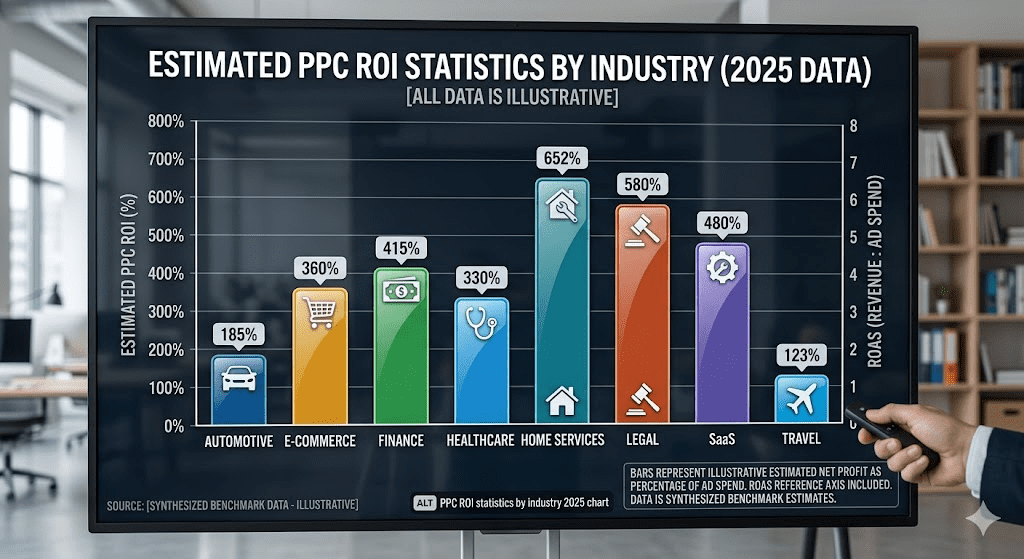
The following statistics are sourced from leading industry authorities and reflect current market conditions through 2025–2026:
A good starting PPC budget depends on your industry, goals, and competition. For small businesses, $500–$2,000/month is a reasonable starting point. Mid-size companies often invest $5,000–$20,000/month. The key is not the amount — it’s ensuring the budget is large enough to generate statistically meaningful data. At minimum, aim to get 100–200 clicks per week to properly test and optimize your campaigns.
Your target CPA (Cost Per Acquisition) should be based on your profit margin. If your product sells for $100 and your profit margin is 40%, you have $40 in gross profit. To remain profitable, your CPA must be below $40. A common guideline is to set your target CPA at 30–50% of your gross profit per sale, leaving room to cover overhead and still generate net profit.Target CPA=Gross Profit per Sale×Acceptable Margin Percentage
Start small, then scale. Begin with a testing budget of $500–$1,500 to gather real performance data over 2–4 weeks. Identify which keywords, audiences, and ads generate the best CPA. Once you have winning combinations, incrementally increase your budget — ideally in 20–30% increments — while monitoring that CPA doesn’t rise disproportionately.
You should review your PPC budget weekly at minimum and conduct deeper audits monthly. Key triggers for immediate budget adjustments include a sudden spike in CPC, CPA exceeding your target by more than 20%, seasonal demand shifts, or new competitor activity. For high-spend accounts (over $10,000/month), daily monitoring of spend pacing is strongly recommended to prevent budget exhaustion before end-of-day.
ROAS (Return on Ad Spend) measures how much revenue you generate for every dollar spent on ads. It is calculated as:ROAS=Ad SpendRevenue from Ads×100
A ROAS of 400% means you earned $4 for every $1 spent. The average ROAS across most industries is approximately 2.87:1 (Source: OpenSend). ROAS is directly tied to budgeting — it tells you whether increasing your budget will increase profitability or simply amplify your losses. Always establish a minimum target ROAS before scaling any PPC campaign.
Calculating your PPC advertising budget the right way is not rocket science — but it does require discipline, data, and a clear understanding of your business goals. By working through the formula step by step — from revenue targets and AOV to conversion rates, CPC benchmarks, and CPA targets — you build a budget that is grounded in reality, not guesswork.
The businesses that consistently win with PPC are not necessarily the ones spending the most. They are the ones spending the smartest. They know their numbers, test before scaling, and continuously optimize based on real performance data.
Now it’s your turn. Start with your revenue goal, run the numbers, and build a PPC budget that actually drives results. If you found this guide helpful, share it with a fellow marketer, drop your questions in the comments below, or explore our related guides on Google Ads setup and conversion rate optimization.