SaaS brands should run branded PPC campaigns because competitors are actively bidding on your brand name — right now. Branded campaigns protect your high-intent traffic, give you full control over your messaging, lower your cost-per-click, and boost conversion rates. When someone searches your brand name, they are already 80–90% sold. Losing that click to a competitor is one of the most expensive mistakes a SaaS company can make. Running a branded campaign ensures your ad appears at the top of Google before your competitor’s does — putting you in control of the most critical moment in the buyer’s journey.
Introduction
Imagine spending months building brand awareness, running content campaigns, and growing organic traffic — only for a customer to Google your brand name and click on a competitor’s ad right above your listing. That is not a hypothetical. It is happening to SaaS companies every single day.
SaaS branded campaigns — PPC ads that target your own brand name as a keyword — are one of the most underutilized and highest-ROI strategies in modern digital marketing. Yet many SaaS founders and marketers skip them entirely, assuming organic rankings are “good enough.” They are wrong, and it is costing them real revenue.
Here’s a number that should change your mind: 46% of all Google clicks go to the top three paid ads — not organic results (Source: inBeat). And for every major SaaS product, three to five competitors are already bidding on your branded keywords (Source: Hey Digital). That means your hardest-earned traffic — people who already know your name and want to buy — is being intercepted.
In this article, we break down the 5 most compelling reasons why every SaaS brand must run branded campaigns, backed by data, real-world examples, and expert strategy.
What Are SaaS Branded Campaigns? (Full Explanation)
A branded campaign is a PPC campaign where you bid on your own brand name as a keyword. When a user types your company name — or a variation of it — into Google, your ad appears at the very top of the search results page, ahead of organic listings and ahead of any competitor ads.
For SaaS companies, branded keywords typically include your company name alone (e.g., “HubSpot”), your name plus a modifier (e.g., “HubSpot pricing,” “HubSpot reviews,” “HubSpot vs Salesforce”), and even common misspellings of your brand. These are known as brand-modified queries, and they represent some of the most valuable search traffic on the internet because the person typing them already knows who you are.
The concept of branded bidding has evolved significantly alongside Google Ads. In the early days of PPC, bidding on your own name seemed unnecessary — if you rank organically, why pay? Today, that logic is dangerously outdated. Google’s SERPs have become more competitive and cluttered, and the paid ad section now dominates above-the-fold real estate on most branded searches.
For SaaS specifically, branded campaigns matter even more than in most industries. SaaS buying journeys are long and involve multiple touchpoints. A branded search often signals the final stage of that journey — the moment a prospect has done their research and is ready to make a decision. Losing that click is losing the deal.
Reason #1: Competitors Are Already Bidding on Your Brand Name
This is the single most urgent reason SaaS brands need to run branded campaigns — and the one most people learn about the hard way.
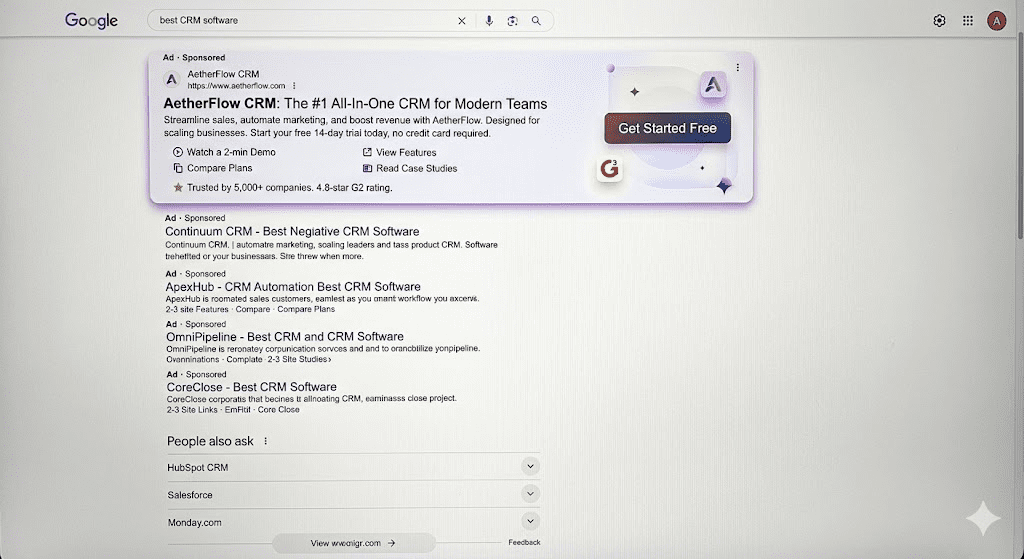
Go to Google right now and type in any well-known SaaS brand name. Before you reach their own website, you will likely see one or more competitors advertising directly above it. This is not accidental. It is a deliberate, well-funded strategy. For every SaaS product that gains traction, three to five competitors begin bidding on its branded keywords (Source: Hey Digital). Smaller players use larger brands’ name recognition to carve out market space — and Google allows it.
This matters enormously because the people typing your brand name into Google are bottom-of-funnel prospects. They have done their research. They know your name. They are one click away from signing up. When a competitor’s ad appears above yours, they intercept that traffic at the most commercially valuable moment in the entire buyer’s journey.
The solution is not to hope competitors won’t do this. The solution is to run your own branded campaign so that your ad appears first — before theirs. As the brand owner, you have a significant Quality Score advantage. Google rewards you with better ad positions and lower CPCs than competitors receive when bidding on your name, because your ads are inherently more relevant to searches for your brand. This means you can outrank competitors on your own branded keywords for less money than they spend trying to steal your traffic.
According to Search Engine Land, brands in competitive categories should allocate 15–25% of their total paid search budget specifically to brand protection campaigns. Within that allocation, 40% should cover core brand defense, 25% for competitive comparison queries, 20% for reputation and review queries, and 15% for feature-specific searches. This isn’t defensive spending — it’s protecting the revenue you’ve already earned through brand building.
Reason #2: Branded Campaigns Are the Cheapest, Highest-Converting Ads You’ll Ever Run
Here is a truth most SaaS marketers don’t fully appreciate: branded campaigns are almost always the most cost-efficient PPC campaigns in your entire account.
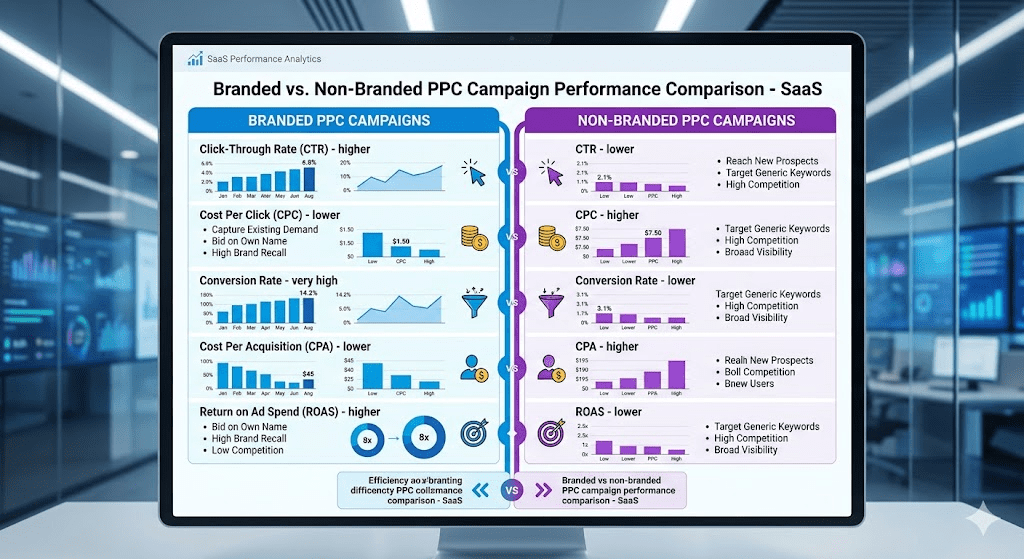
Because you own the brand, your ads are maximally relevant to branded searches. Google’s Quality Score algorithm rewards high relevance with lower CPCs and better ad positions. In practical terms, this means your cost-per-click on branded keywords is a fraction of what you pay for non-branded, competitive keywords. While a competitive SaaS keyword like “project management software” might cost $15–$50 per click, your branded keywords may cost as little as $0.50–$3.00 per click — sometimes even less.
And the conversion rates? Dramatically higher. Users searching for your brand name by definition already know who you are. They are not browsing; they are evaluating or ready to buy. The average PPC conversion rate across all campaigns is 2.35% (Source: Mayple), but branded campaigns routinely convert at 10–25% because of the searcher’s pre-existing intent and familiarity.
Consider the math: if your average non-branded campaign costs $20 per click and converts at 3%, your cost per acquisition is approximately $667. A branded campaign at $2 per click converting at 15% delivers a cost per acquisition of just $13. That is a 50x difference in efficiency on the same advertising platform.
For SaaS companies — where customer acquisition cost (CAC) is already under significant pressure (the median SaaS company now spends $2.00 to acquire $1.00 of new ARR, a 14% increase from 2023, per Benchmarkit 2025) — branded campaigns are not just a nice-to-have. They are one of the most practical levers available to reduce CAC without sacrificing volume.
Reason #3: You Control the Narrative — Messaging, Offers, and Landing Pages
Organic search results give you almost no control over what a potential customer sees when they find you. Google decides which pages to show, what meta descriptions to display, and in what order your links appear. A prospect searching your brand name organically might land on a blog post, your homepage, a pricing page — or worse, a third-party review page that links to your competitors.
Branded campaigns put you in complete control of the customer’s first impression.
With a branded PPC campaign, you decide exactly what ad copy appears, what offer is highlighted, and where the click leads. You can use your branded ad to promote a free trial, a limited-time discount, a product demo, or a testimonial page. You can dynamically serve different ads based on the specific search query — directing someone searching “[Your Brand] vs Competitor” to a dedicated comparison landing page, and sending someone searching “[Your Brand] pricing” directly to your pricing page with a strong CTA.
This level of precision is impossible with organic listings alone. According to Search Engine Land’s 2026 brand defense guide, high-performing SaaS companies create distinct landing pages for four types of branded queries: trust and validation queries (e.g., “Is [Brand] legit?“), feature-specific queries (e.g., “Does [Brand] have [feature]?“), comparison queries (e.g., “[Brand] vs [Competitor]“), and niche concern queries (e.g., “Is [Brand] expensive?“). Each page is tailored to address that specific intent — converting far more effectively than a generic homepage ever could.
Branded campaigns also serve as a real-time messaging laboratory. Because ad copy is fully A/B testable, SaaS brands can run experiments on headlines, value propositions, and CTAs directly against their warmest, most receptive audience. The insights gained — which benefits resonate, which objections arise most often — can then be applied across all marketing channels. This is actionable customer intelligence that your organic listings will never provide.
Reason #4: Branded Campaigns Dominate Google Search Real Estate
On any given branded SERP (Search Engine Results Page), there is a finite amount of prime real estate — and every pixel of it tells a story to the searcher. The brands that occupy more of that space signal authority, credibility, and market dominance.
When you run a branded campaign, your paid ad appears above your organic listing. This means you potentially occupy two of the most prominent positions on the first page — the top paid slot and the top organic slot. Add in Google Sitelinks, which expand your ad with multiple sub-links to different sections of your website, and you can dominate an enormous portion of the visible SERP for your brand name.
This matters psychologically as much as it does commercially. Users who see a brand appearing in both paid and organic results subconsciously perceive that brand as larger, more established, and more trustworthy. The sheer visual footprint of a well-structured branded campaign — with sitelinks, callout extensions, review stars, and structured snippets — can take up to 50% of the above-the-fold screen space on desktop. That is a powerful signal to a prospect who is still evaluating.
Beyond just your brand name, branded campaigns allow you to capture the full spectrum of brand-modified queries across the entire marketing funnel:
- Awareness-stage queries like “[Brand Name]” — serve ads with general value proposition messaging
- Consideration-stage queries like “[Brand] reviews” or “[Brand] vs [Competitor]” — serve comparison or testimonial-focused ads
- Decision-stage queries like “[Brand] free trial” or “[Brand] sign up” — serve conversion-optimized ads with a frictionless CTA
Each of these query types represents a real person at a specific point in their buying journey. Branded campaigns let you meet every single one of them with exactly the right message. Without branded campaigns, each of these opportunities defaults to an organic listing that is generic, uncontrolled, and vulnerable to competitor displacement.
Reason #5: Branded Campaigns Protect Your Brand Equity and Revenue
The most overlooked dimension of branded campaigns is what they prevent from happening — not just what they generate. And what they prevent can be catastrophically expensive.
When you don’t run branded campaigns, you create a vacuum. That vacuum is filled by competitors, third-party review aggregators (like G2, Capterra, and Trustpilot), affiliate comparison websites, and resellers — all of whom bid on your brand terms and use that traffic for their own commercial purposes. Review aggregators, in particular, are sophisticated operators. They bid on “[Your Brand] reviews” and “[Your Brand] alternatives” because these queries are extremely high-intent. When a prospect lands on a G2 comparison page, they see your product alongside four competitors — and those competitors are paying for premium placement on that page.
This is a direct threat to your brand equity — the accumulated trust and recognition you’ve invested in building. Every branded click that doesn’t land on your own property is an opportunity for another narrative to take hold. A well-funded competitor with a strong G2 presence can systematically intercept your brand-aware prospects and redirect them before they ever reach your product.
The financial stakes are real. For B2B SaaS companies where the average customer acquisition cost is $1,200 (Source: Phoenix Strategy Group, 2025) and the average CAC payback period is 23 months, losing a single bottom-of-funnel prospect to a competitor through a branded search is not a minor inconvenience. It is a significant revenue event.
Running branded campaigns allows you to reclaim that SERP real estate, ensuring that prospects searching for validation, reviews, or comparisons land on your testimonial pages, your comparison landing pages, and your case studies — not a third-party page where your competitors are paying for prominence. According to Search Engine Land, brands should allocate 20% of their brand protection budget specifically to reputation and review queries to counter this threat directly.
Additionally, branded campaigns protect the quality score health of your entire Google Ads account. Because branded campaigns typically generate high CTRs and strong conversion data, they send positive quality signals to Google’s algorithm. A healthier account-level quality score benefits all your non-branded campaigns too — lowering CPCs and improving ad positions across the board. It’s a rising tide that lifts all your paid advertising.
Best Practices for Running SaaS Branded Campaigns
Knowing why to run branded campaigns is only half the battle. Here’s how to do it right from day one.
Segment by intent, not just by keyword. Don’t lump all branded keywords into a single campaign. Create separate ad groups for core brand terms, review/reputation queries, competitor comparison queries, and feature-specific queries. Each group needs tailored ad copy and a dedicated landing page matched to that specific intent.
Bid to protect, not just to appear. For core branded keywords, aim for 95%+ impression share. Never let your branded campaign run out of budget mid-day. The cost is low enough that budget caps on branded campaigns are almost never justified — the opportunity cost of a lost branded impression far outweighs the CPC.
Use all available ad extensions aggressively. Sitelinks, callout extensions, structured snippets, and review extensions all expand your ad’s visual footprint on the SERP. More space means more trust signals, more conversion paths, and less room for competitors. Using ad extensions can increase CTRs by up to 15% (Source: Google).
Build intent-matched landing pages. Your branded homepage is a starting point, not an ending point. Create dedicated landing pages for reviews (featuring testimonials and case studies), competitor comparisons (with honest side-by-side tables), pricing queries (with clear, transparent pricing or a strong trial CTA), and feature queries (with product demos and technical details).
Monitor auction insights weekly. Google Ads’ Auction Insights report shows you exactly which competitors are bidding on your brand terms and at what frequency. If a competitor begins showing in more than 40% of your branded auctions, it signals an aggressive competitive threat that requires immediate strategic response — including potential CPC bid increases and expanded ad coverage.
Important Facts & Statistics
Here are five powerful, verified statistics that illustrate why SaaS branded campaigns are non-negotiable in today’s market:
46% of all Google clicks go to the top three paid ads on a search results page — meaning organic positions four and below often go unclicked, even for branded searches (Source: inBeat). This single statistic makes the case for branded campaigns more compellingly than any argument could.
The average CPC on branded keywords is 3–10x lower than equivalent non-branded keywords in the same industry. While SaaS non-branded keywords average $4.13–$5.34 per click (Source: Dreamdata 2025 Benchmarks), branded keywords for the same brand routinely cost $0.50–$2.00 per click — delivering dramatically lower CPAs for the highest-intent audience.
Global paid search spending reached $351.55 billion in 2025 (Source: Statista), with B2B SaaS representing one of the fastest-growing segments. As more money floods into paid search, competition for every keyword — including branded ones — intensifies. The cost of not defending your brand terms grows proportionally with overall market spend.
The average B2B SaaS customer acquisition cost is $1,200 (Source: Phoenix Strategy Group, 2025), with a payback period of 23 months. Given these economics, losing a single bottom-of-funnel branded prospect to a competitor through a paid ad is not just a lost click — it is a lost revenue event worth thousands of dollars in lifetime customer value.
Ad extensions can increase CTR by up to 15% (Source: Google), and branded campaigns are uniquely positioned to leverage the full suite of extensions — sitelinks, callouts, structured snippets, review stars — because of their inherently high relevance scores. More extensions mean more SERP real estate, more trust signals, and more conversion opportunities for the same CPC.
FAQ Section — People Also Ask
Q1: Are branded campaigns worth it if I already rank #1 organically?
Yes — absolutely. Organic position #1 is valuable, but it sits below paid ads. If competitors are bidding on your brand (and in the SaaS space, they almost certainly are), their paid ads appear above your organic listing. Running your own branded campaign ensures you hold the top position in the SERP. Additionally, having both a paid and organic listing for your brand significantly increases your total click-through rate and visible real estate on the page. Studies consistently show that pausing branded campaigns does not result in equivalent organic traffic gains — up to 89% of that paid traffic remains unrecovered by organic clicks (Source: Analyzify).
Q2: How much should a SaaS company budget for branded campaigns?
Industry best practice from Search Engine Land recommends allocating 15–25% of your total paid search budget to comprehensive brand protection. Within that allocation: 40% toward core brand defense (exact-match brand terms), 25% toward competitive comparison defense, 20% toward reputation and review query campaigns, and 15% toward feature and niche queries. Branded CPCs are low enough that even a modest budget of $500–$1,500/month can deliver excellent branded coverage for most early-stage SaaS companies. Scale the budget as your brand grows and competitive bidding pressure increases.
Q3: What if my competitors stop bidding on my brand — should I stop my branded campaigns?
Not necessarily. Even without direct competitor bidding, branded campaigns deliver value through message control, intent-matched landing pages, SERP dominance, and conversion rate optimization. Competitors can re-enter the auction at any time, and review aggregators are almost always present on branded SERPs regardless of direct competitor activity. Treat branded campaigns as a permanent fixture of your paid search strategy, not a reactive measure. Reduce budgets during low-threat periods if needed, but maintain core brand coverage as a baseline.
Q4: Can competitors legally bid on my SaaS brand name in Google Ads?
Yes — Google allows competitors to bid on your brand name as a keyword, but they are generally prohibited from using your trademarked brand name in the text of their ad copy or headline without your permission. If you discover a competitor using your brand name in their ad text, you can file a trademark infringement complaint directly with Google. Monitor competitor ads regularly using Google’s Auction Insights report and conduct manual branded searches weekly to identify any policy violations. This is an important part of an active brand protection strategy.
Q5: What types of landing pages work best for SaaS branded campaigns?
Different branded queries require different landing pages to maximize conversion. For core brand searches, a dedicated homepage or conversion-focused landing page with a strong free trial CTA works best. For “[Brand] reviews” queries, send users to a testimonials page with video case studies, star ratings, and logos of well-known customers. For “[Brand] vs [Competitor]” queries, a dedicated comparison page with a feature-by-feature table and migration incentives performs best. For “[Brand] pricing” queries, a transparent pricing page with a clear upgrade path is ideal. Never send all branded traffic to your generic homepage — it wastes the intent signal these searches carry.
Conclusion
The case for SaaS branded campaigns is not just compelling — it is urgent. Competitors are bidding on your brand name right now. Review aggregators are intercepting your best prospects before they reach your website. And the highest-intent traffic your marketing has ever generated — people who already know your name and are ready to decide — is being lost to a competitor’s ad above your organic listing.
Branded campaigns solve all of this at the lowest possible cost-per-click and the highest possible conversion rate of any campaign type you will ever run. They give you message control, SERP dominance, funnel coverage, and protection for the brand equity you’ve worked hard to build.
If you are running PPC for a SaaS product and branded campaigns are not already in your account, start today. Structure them by intent, build dedicated landing pages, and monitor your auction insights weekly. Your brand deserves to be in first place — on your own search results.
Found this article useful? Share it with your marketing team, leave a comment with your branded campaign experience, or explore our related guides on SaaS Google Ads strategy and landing page optimization. The brands that protect their search real estate are the ones that win — consistently.
Because in SaaS, the last click before signup belongs to you — not your competitor.