
What are the best PPC landing page tweaks to increase conversion rate?
The most impactful PPC landing page tweaks to increase conversion rate include matching your ad copy to your landing page headline, removing navigation menus, adding a transparent pricing table, using customer testimonials, improving page load speed, and creating mobile-friendly designs. Other key tactics include A/B testing individual elements, using exit-intent pop-ups, adding live chat, simplifying lead forms, using social proof pop-ups, and reinforcing search intent through targeted keywords. Together, these tweaks reduce friction, build trust, and guide visitors toward taking action — directly boosting your ROI.
INTRODUCTION
You’re spending real money on every single click. But what happens after the click? That’s where most PPC campaigns silently bleed budget.
PPC landing page optimization is the single most overlooked lever in digital advertising. According to data from Involve.me and SEO Sherpa, the average landing page conversion rate sits between 6.6% and 10.76% — meaning up to 93% of your paid traffic might be leaving without converting. That’s an enormous amount of wasted ad spend.
The good news? You don’t need to rebuild your entire website. Small, strategic tweaks to your PPC landing pages can produce dramatic improvements in conversion. In this article, we’re walking you through 12 proven PPC landing page tweaks to increase your conversion rate — all backed by real case studies, data, and expert best practices. Whether you’re running Google Ads, Meta Ads, or any other PPC platform, these strategies apply directly to your campaigns.
Let’s get into it.
What Is PPC Landing Page Optimization? (Full Explanation)
PPC landing page optimization (also known as Landing Page Optimization or LPO) is the process of improving specific elements of a pay-per-click ad’s destination page to convert more visitors into leads, subscribers, or customers.
When someone clicks your Google Ad or Facebook Ad, they land on a page — your landing page. If that page doesn’t immediately resonate with them, they bounce. You’ve paid for the click, but you’ve earned nothing in return.
Unlike your homepage, a PPC landing page is purpose-built for a single goal: getting the visitor to take one specific action. It could be signing up for a trial, booking a demo, making a purchase, or submitting a form. The more aligned that page is with the visitor’s intent, the higher your conversion rate will be.
The reason PPC landing page optimization matters so much is simple: improving your conversion rate doesn’t require more ad spend. It requires smarter use of existing traffic. According to Unbounce’s Conversion Benchmark Report, industry median conversion rates range from 3.8% (SaaS) to 12.3% (Legal). The difference between those numbers isn’t budget — it’s optimization.
How Do PPC Landing Pages Work?
Understanding how a PPC landing page fits into the customer journey helps you optimize it more effectively. Here’s the step-by-step flow:
- A user searches for a keyword (e.g., “best CRM software for small business”)
- Your PPC ad appears in the search results, targeting that keyword
- The user clicks the ad — their intent is now clearly defined
- They land on your landing page — this page must immediately match that intent
- They evaluate your offer based on your headline, copy, visuals, and social proof
- They take action (or leave) depending on how convincing and frictionless the experience is
The quality of every step between #1 and #6 determines your conversion rate. A disconnect anywhere in that chain — especially between step #2 and step #4 — is where most PPC campaigns fail.
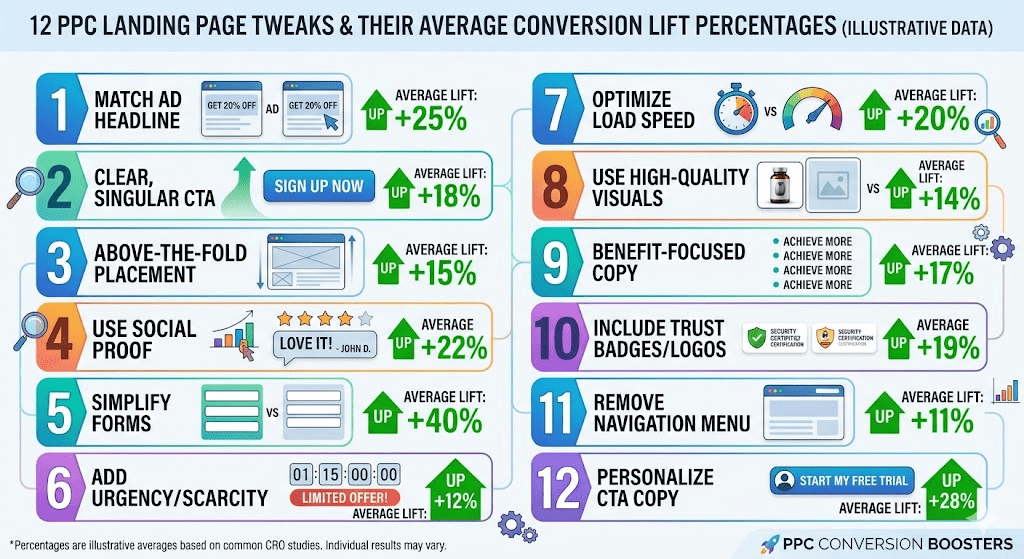
12 Proven PPC Landing Page Tweaks to Increase Conversion Rate
These are the 12 highest-impact changes you can make to your PPC landing pages right now.
Tweak #1: Include a Transparent Pricing Table
One of the most powerful yet underused conversion drivers is a clear, upfront pricing table on your PPC landing page. When visitors arrive from a paid ad, they’re already interested — they just need the information to make a decision. If your pricing is buried or hidden, they leave to research alternatives, and you lose them permanently.
A real-world example: digital agency HeyDigital added a pricing table to a client’s landing page (Up Content) and saw a 7.51% increase in conversions without changing anything else. Pricing transparency removes doubt, accelerates decision-making, and signals confidence in your product.
Pro Tip: If you offer multiple tiers, highlight the recommended or most popular plan with a visual badge. This uses the psychological principle of anchoring to steer decisions.
Tweak #2: Match Your Landing Page Headline to Your Ad Copy
This is arguably the single most important rule in PPC optimization: message match. If your Google Ad says “Get Free Analytics Software for Small Teams” and your landing page headline reads “Welcome to Our Platform,” you’ve already lost the visitor.
Visitors expect continuity between the ad they clicked and the page they landed on. When the messaging matches, it reinforces their intent and builds instant trust. When it doesn’t match, it creates confusion — and confusion kills conversions.
A great example is Zoho Analytics, whose PPC ad for “analytics software” leads to a landing page where the exact phrase “Analytics Software” appears prominently in the H1 headline. The result is a seamless, reassuring user experience. Repeat the exact keyword from your ad group in your landing page headline and subheadings to reinforce intent at every scroll.
Tweak #3: Add Personalized Live Chat
Live chat isn’t just a customer support tool — it’s a powerful conversion accelerator on PPC landing pages. According to Involve.me’s research, visitors who use live chat are 16x more likely to purchase, and live chat can increase conversions by approximately 20% on landing pages.
The key word here is personalized. Generic “Hi there! How can we help?” messages are easy to ignore. Instead, trigger chat messages that are specific to the keyword ad group the visitor came from. For example, if someone clicked an ad for “enterprise project management software,” your chat popup should open with: “Looking for a project management tool built for enterprise teams? I can help.”
This level of intent-matching shows the visitor that you understand their specific need — which dramatically increases the chance they’ll engage and ultimately convert.
Tweak #4: Showcase Customer Testimonials
People trust other people far more than they trust brands. Customer testimonials on your PPC landing page serve as powerful social proof that your product or service delivers on its promises. According to data from Involve.me, 37% of top-performing landing pages include testimonials, and adding a single customer testimonial has been shown to increase conversions by up to 34%.
To get the most out of your testimonials, follow these best practices: use real names and photos (or company logos for B2B), pull quotes that address a specific pain point your target audience relates to, include quantitative results where possible (e.g., “This tool reduced our ad spend waste by 43%”), and match the customer profile to the audience you’re targeting.
If your ad targets small business owners, feature testimonials from small business owners — not Fortune 500 companies. Relevance is everything.
Tweak #5: Remove Navigation Menus and Distracting Links
Your PPC landing page is not your website homepage. It has one job: to convert visitors. Every navigation link, footer menu, or external link you include is an escape route that pulls the visitor away from your CTA.
The data on this is startling: removing navigation links from a landing page can increase conversions by up to 100% (a doubling of the conversion rate), according to research compiled by Involve.me. Yet astonishingly, only 16% of landing pages currently remove their navigation bar — meaning 84% of marketers are actively sabotaging their own conversions.
Strip your PPC landing page down to the essentials: a compelling headline, benefit-driven copy, social proof, and a single crystal-clear CTA. Remove the header menu, hide the footer links, and eliminate any content that doesn’t directly serve the conversion goal.
Tweak #6: Use Exit-Intent Pop-Ups
Not every visitor is ready to convert on the first pass. Some are distracted, some are still evaluating, and some just need one more nudge. Exit-intent pop-ups appear at the precise moment a visitor’s mouse moves toward closing the tab — giving you a last chance to make your case.
The most effective exit-intent pop-ups are highly tailored to the keyword ad group the visitor came from. If someone landed on your page after clicking an ad comparing two software products, your exit pop-up should reference that exact comparison: “Not sure which tool is right for you? See our full breakdown →”
Generic pop-ups offering 10% discounts are easily dismissed. Intent-specific pop-ups that feel helpful, not desperate, can recapture a significant portion of otherwise lost traffic and meaningfully increase your overall PPC conversion rate.
Tweak #7: Convert Lead Forms into Lead-Qualifying Forms
Most PPC landing pages use simplified lead forms asking only for a name and email address. This approach maximizes the volume of leads — but often at the expense of quality. If your sales team is buried under leads that never close, you’re not getting ROI from your PPC spend.
Consider adding one or two qualifying questions to your lead form. Questions like “What’s your monthly ad budget?” or “How many employees are in your company?” give your sales team crucial context and allow you to segment leads automatically. The trade-off is a slightly lower form conversion rate, but a dramatically higher lead quality and close rate.
A data point worth noting: reducing a form from 11 fields to 4 fields can increase conversions by 120%. The sweet spot is 3–4 fields that capture both contact info and at least one qualifying data point.
Tweak #8: Build Mobile-First Landing Pages
Here is a fact that should reshape your entire approach to PPC landing page design: 82.9% of landing page traffic now comes from mobile devices. If your PPC landing page isn’t designed for mobile first, you’re losing the majority of your paid traffic before they even read your headline.
Mobile-friendly PPC landing pages convert at approximately 11–12%, compared to 10.7% for desktop-focused pages. The gap is growing as mobile usage increases. Key mobile optimization principles include large, thumb-friendly CTA buttons, short paragraphs with ample white space, content prioritized above the fold, minimal form fields, and fast load times (more on that next).
Use Google’s free Mobile-Friendly Test tool to audit your existing landing pages. Any page that fails this test is actively costing you conversions.
Tweak #9: Improve Your Landing Page Load Speed
Speed is a conversion factor. Every extra second of load time costs you visitors — and money. Research compiled from Google’s own data shows that pages loading in 1 second have 3x higher conversion rates than pages that take 5 seconds. Even a 1-second delay causes approximately a 7% drop in conversions.
From a PPC perspective, slow landing pages don’t just hurt conversions — they hurt your Google Ads Quality Score too. A poor Quality Score raises your cost-per-click (CPC), meaning you’re paying more and converting less. That’s a double loss.
Use tools like Google PageSpeed Insights, GTmetrix, or Pingdom to identify speed bottlenecks. Common culprits include uncompressed images, render-blocking JavaScript, unoptimized fonts, and slow server response times. Target a load time of under 2 seconds for optimal conversion performance.
Tweak #10: Align Landing Page Copy with Your Ad Copy
Your PPC ad and your landing page are two chapters of the same story. If the story changes between the ad and the page, visitors feel deceived — even if unintentionally. This disconnect (called a “message mismatch”) is one of the leading causes of high bounce rates and low conversion rates on PPC campaigns.
Think of it this way: your ad is a promise, and your landing page is the delivery of that promise. If your ad promises “Get 50% off your first month of CRM software,” your landing page headline must immediately confirm: “Claim Your 50% Off — Month One of [Product] Is On Us.”
Every element — the headline, subheadings, CTA text, imagery, and even the tone of the copy — should feel like a natural continuation of the ad the visitor clicked. The tighter the alignment, the higher your Quality Score, the lower your CPC, and the higher your conversion rate.
Tweak #11: Run Ongoing A/B Tests
Landing pages are rarely perfect on the first build. The most successful PPC marketers treat their landing pages as living documents — constantly tested, refined, and improved. A/B testing (split testing) is the systematic process of comparing two versions of a page element to determine which performs better.
The critical rule of A/B testing is this: test only one variable at a time. If you change the headline and the CTA button color simultaneously, you won’t know which change caused the result. Test one element, measure the outcome, then move to the next variable. Common elements worth testing include the headline, CTA button copy, CTA button color, hero image, form field count, page layout, and pricing presentation.
According to research by Involve.me, 77% of businesses worldwide use A/B testing on their pages. Only 1 in 8 tests produces a statistically significant winner — but that 1 winner can be transformative. Commit to continuous testing, and your conversion rate will compound over time.
Tweak #12: Add Social Proof Pop-Ups
Beyond static testimonials, real-time social proof pop-ups show visitors that other people are actively using and trusting your product — right now. Tools like UseProof, TrustPulse, or Fomo display notifications like “Sarah from Chicago just signed up 3 minutes ago” or “47 people are viewing this page right now.”
This tactic leverages the psychological principle of social validation — we look to others’ behavior to guide our own decisions, especially in uncertain situations. LawnStarter, a lawn care marketplace, saw significant conversion improvements by displaying real-time booking notifications including the customer’s first name, location, and time of booking.
These micro-trust signals work because they’re dynamic, specific, and credible. When combined with static testimonials, they create a powerful, multi-layered trust architecture that significantly reduces hesitation and increases the likelihood of conversion.
Types of PPC Landing Pages — Which One Should You Use?
Not all PPC landing pages serve the same purpose. Choosing the right type for your campaign goal is essential.
| Landing Page Type | Best For | Key Feature |
|---|---|---|
| Click-Through Page | E-commerce, SaaS trials | Warms visitors before checkout |
| Lead Generation Page | B2B, service businesses | Captures name, email, and qualifying info |
| Sales Page | Direct-response, info products | Long-form copy, full sales argument |
| Squeeze Page | Email list building | Minimal design, single opt-in form |
| Product Detail Page | E-commerce | Product specs, reviews, buy button |
| Webinar/Event Page | Thought leadership, education | Date, speakers, registration form |
| Thank-You Page | Post-conversion upsell | Confirmation + next-step CTA |
Understanding which type fits your campaign goal helps you apply the 12 tweaks above in the most targeted way possible.
Common PPC Landing Page Mistakes to Avoid
Even experienced marketers make these costly errors. Knowing what not to do is just as important as knowing best practices.
The first major mistake is sending paid traffic to your homepage. A homepage is designed for everyone — a landing page is designed for one specific visitor with one specific intent. According to research, 44% of B2B companies still direct paid ad traffic to their homepage, which is one of the most significant causes of poor PPC ROI.
The second mistake is using vague or passive CTAs. Words like “Submit,” “Click Here,” or “Learn More” are weak. High-converting CTAs are specific and action-oriented: “Get My Free Quote,” “Start My 14-Day Trial,” or “Download the Guide Now.”
The third mistake is ignoring mobile experience. With over 82% of landing page traffic coming from mobile devices, a desktop-only design is no longer acceptable.
The fourth mistake is not tracking the right metrics. Many marketers only track clicks and form submissions. You should also track scroll depth, time on page, heatmap behavior, and micro-conversions to understand the full picture of how visitors interact with your page.
Best Practices for High-Converting PPC Landing Pages
The foundation of every high-performing PPC landing page rests on a few non-negotiable principles. Your headline must answer the visitor’s immediate question: “Am I in the right place?” Your CTA must be visible above the fold, action-oriented, and repeated at logical points down the page. Your copy should be written at a 5th–7th grade reading level — research shows that simpler writing converts at 11.1%, while complex copy converts at only 5.3%.
Trust signals should be omnipresent: security badges, money-back guarantees, customer logos, star ratings, and testimonials. Your form should ask for the minimum viable information. And every element on the page should pass the “would removing this hurt conversions?” test — if not, remove it.
Finally, always track your landing page performance inside Google Ads using conversion tracking. Tie landing page performance to actual ad spend to understand your true cost-per-conversion, and use that data to prioritize which tweaks to implement first.
IMPORTANT FACTS & STATISTICS
These verified facts will give you a clearer picture of just how important PPC landing page optimization is:
- Average landing page conversion rate is 6.6%–10.76% across industries, with top performers exceeding 11% (Source: Involve.me, SEO Sherpa, 2025–2026)
- Removing navigation links from a landing page can double conversion rates — yet only 16% of landing pages currently remove the nav bar (Source: Involve.me, 2025)
- Page speed is a critical factor — pages that load in 1 second convert at 3x the rate of pages that take 5 seconds (Source: Google / Involve.me)
- Adding video to a landing page can increase conversions by up to 86%, and 38.6% of marketers say video has the biggest positive impact on conversion rates (Source: Involve.me, 2025)
- Addressing buyer fears and objections on a landing page can increase conversion rates by approximately 80%, as demonstrated in an Inbound experiment cited by Marcus Sheridan (Source: Involve.me, 2025)
FAQ SECTION (People Also Ask)
Q1: What is a PPC landing page, and how is it different from a homepage?
A PPC landing page is a standalone web page specifically designed to receive traffic from a pay-per-click ad and convert that visitor into a lead or customer. Unlike a homepage, which serves multiple audiences and goals, a PPC landing page has a single, focused purpose aligned with the ad that brought the visitor there. It typically has no navigation menu, minimal distractions, and one clear call-to-action. This focused design is why dedicated PPC landing pages convert significantly better than homepages — yet 44% of B2B companies still send paid traffic to their homepage.
Q2: What is a good conversion rate for a PPC landing page?
A good PPC landing page conversion rate depends heavily on your industry. According to Unbounce’s Conversion Benchmark Report, industry median rates range from 3.8% (SaaS) to 12.3% (Legal). The overall average across all industries falls between 6.6% and 10.76%. If your conversion rate is above 10%, you’re in elite territory. If it’s below 2%, your landing page has a significant optimization problem. Benchmark against your specific industry for the most relevant comparison, and always aim to improve your own baseline through continuous A/B testing.
Q3: How many form fields should a PPC landing page have?
Research consistently shows that fewer form fields produce higher conversion rates. Reducing a form from 11 fields to just 4 can increase conversions by 120%. The optimal number for most PPC campaigns is 3–4 fields: typically first name, email address, and one qualifying question. Only ask for information that’s immediately necessary. Asking for phone numbers, company size, or sensitive data too early creates friction and causes visitors to abandon the form. You can always collect additional information later in your sales funnel, after establishing trust.
Q4: How does A/B testing help improve PPC landing page conversion rates?
A/B testing (split testing) allows you to compare two versions of a landing page element to determine which performs better with real visitors. You might test different headlines, CTA button colors or text, hero images, form lengths, or pricing presentations. The key rule is to test only one variable at a time, so you can attribute any change in conversion rate to that specific element. While only about 1 in 8 tests produces a statistically significant winner, those wins compound over time. Businesses that consistently A/B test their landing pages see an average 30% lift in conversion rates from using CRO tools and testing disciplines.
Q5: Does landing page speed affect PPC Quality Score?
Yes, absolutely. Landing page speed is a direct factor in Google Ads’ Quality Score calculation. A slow landing page leads to a poor user experience signal, which lowers your Quality Score. A lower Quality Score means higher cost-per-click (CPC) and lower ad placement — so you pay more and appear less prominently. Conversely, a fast, relevant, mobile-friendly landing page improves your Quality Score, lowers your CPC, and improves your ad position. Google’s data shows that pages loading in 1 second have 3x higher conversion rates than those taking 5 seconds. Prioritizing page speed benefits both your conversion rate and your ad economics simultaneously.
CONCLUSION
Optimizing your PPC landing pages is not a one-time project — it’s an ongoing commitment that pays compounding dividends over time. The 12 tweaks covered in this article — from matching your ad copy and adding pricing transparency, to speeding up your page and running systematic A/B tests — are all proven strategies that have delivered real, measurable results for businesses just like yours.
You don’t need to implement all 12 at once. Start with the highest-impact changes: remove your navigation menu, match your headline to your ad copy, and compress your page images for speed. Then layer in social proof, live chat, and exit-intent pop-ups. Track your results meticulously, test continuously, and let the data guide your next move.
Every improvement to your PPC landing page conversion rate means more revenue from the same ad budget. That’s the most powerful ROI lever in digital marketing.
Ready to start optimizing? Pick your top 3 tweaks from this list and implement them this week. Then drop a comment below — we’d love to hear which tweak made the biggest difference for your campaigns!