The best SaaS demand generation agencies for B2B growth in 2026 include Hey Digital, Refine Labs, Directive Consulting, Powered by Search, Kalungi, Single Grain, 42 Agency, Ironpaper, Omniscient Digital, and Disruptive. These agencies specialize in full-funnel demand creation, paid media, ABM, content marketing, and pipeline-aligned measurement. They don’t just generate leads — they build systems that convert awareness into revenue. The right agency depends on your company’s stage, budget, ICP clarity, and whether you need paid, organic, or multi-channel execution.
Introduction
If your B2B SaaS company is generating leads but struggling to fill the pipeline, you’re not alone — and the problem might not be your product. It might be your demand generation strategy.
In 2026, the B2B SaaS market is valued at over $497 billion (Fortune Business Insights), and competition for buyer attention has never been fiercer. Standing out requires more than running ads or sending email blasts. It requires a systematic, full-funnel approach to creating, capturing, and converting demand.
That’s exactly where the best SaaS demand generation agencies for B2B growth make their mark. These specialist agencies understand how SaaS buyers research, evaluate, and purchase — and they build marketing programs that align with that journey from first touchpoint to closed deal.
In this guide, you’ll discover the top 10 agencies, what makes each one unique, how demand generation works, the key benefits of hiring an expert agency, common mistakes to avoid, and how to choose the right partner for your growth stage.
Whether you’re a Series A startup or a scaling enterprise, this guide will help you make a confident decision.
What is SaaS Demand Generation? (Full Explanation)
Demand generation is the process of creating awareness, interest, and desire for your SaaS product among your ideal customers — long before they’re ready to buy. Unlike lead generation, which focuses on capturing contact information, demand generation works at a higher, more strategic level.
Think of lead generation as fishing with a net — you’re pulling in whatever swims by. Demand generation is like building an ecosystem where your ideal fish naturally thrive, are attracted to your pond, and trust you enough to swim toward the hook when the time is right.
In the context of B2B SaaS, demand generation is particularly critical because buying journeys are long, involve multiple stakeholders, and rarely follow a straight line. Research from Forrester shows that B2B buyers complete 57–70% of their purchase journey before ever contacting a vendor. This means your marketing needs to be working hard during those unseen stages.
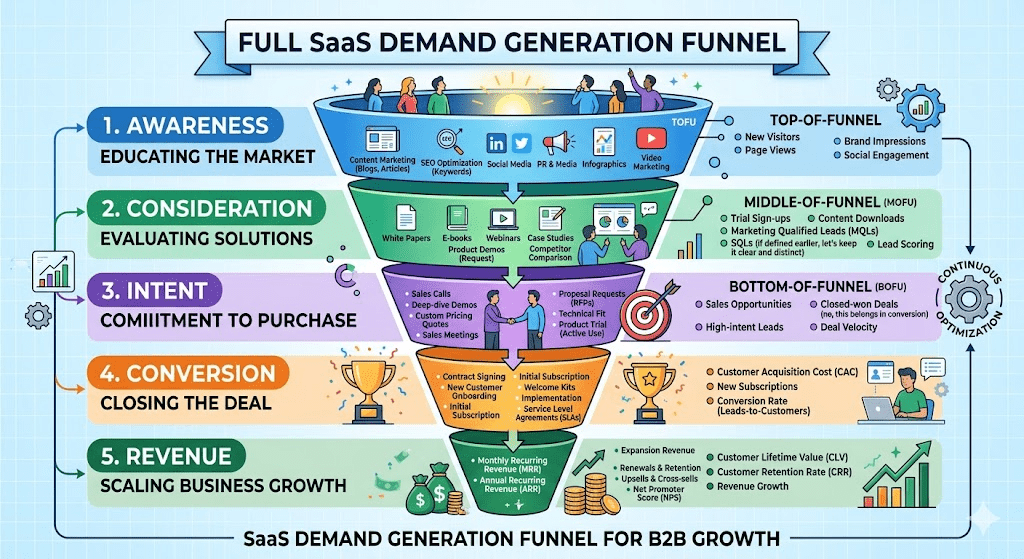
A strong SaaS demand generation strategy typically spans three core stages:
- Demand Creation: Building awareness among buyers who don’t yet know they have a problem your product solves. This includes thought leadership content, social media, and brand storytelling.
- Demand Capture: Engaging buyers who are actively researching solutions — through paid search, SEO-optimized landing pages, and comparison content.
- Demand Conversion: Nurturing high-intent prospects through the funnel to a sales-qualified conversation, using retargeting, case studies, webinars, and ABM tactics.
The best agencies treat all three stages as a unified system, not isolated campaigns. They align marketing directly to pipeline, CAC (Customer Acquisition Cost), and LTV (Lifetime Value) — not vanity metrics like impressions or raw lead volume.
How Does B2B SaaS Demand Generation Work?
Understanding the mechanics behind demand generation helps you ask the right questions when evaluating agencies. Here’s how a high-performing demand gen program typically operates, step by step:
Step 1 — Define Your ICP (Ideal Customer Profile) Every effective program starts here. The agency works with your sales and marketing teams to identify exactly who you’re targeting: company size, industry, decision-maker roles, pain points, and buying triggers. Without sharp ICP clarity, campaigns waste budget on the wrong audience.
Step 2 — Develop Messaging and Positioning Before a single ad is written or piece of content is published, strong agencies invest time in understanding your unique value proposition. How is your SaaS product different? What specific pain does it solve? The messaging framework becomes the backbone of all campaign creative.
Step 3 — Build a Multi-Channel Strategy The best demand generation programs rarely rely on a single channel. A typical B2B SaaS program might combine LinkedIn Ads for brand awareness, Google Ads for high-intent capture, SEO content for organic pipeline, and email nurture sequences to move prospects closer to a sales conversation.
Step 4 — Launch, Test, and Iterate Agencies run structured experiments — testing ad creatives, landing page headlines, CTA variations, and audience segments. This “test-and-learn” culture is what separates elite agencies from those that just “manage campaigns.”
Step 5 — Measure Pipeline and Revenue Impact The agency connects marketing activity to your CRM (HubSpot, Salesforce, etc.) to track how demand programs influence opportunities, pipeline value, and closed-won revenue. MQL counts are replaced with metrics that actually matter to leadership.
Step 6 — Optimize and Scale With data flowing in, the agency continuously refines what’s working. Winning channels get more budget. Underperforming tactics are paused. Over time, demand generation becomes a predictable, compounding growth engine.
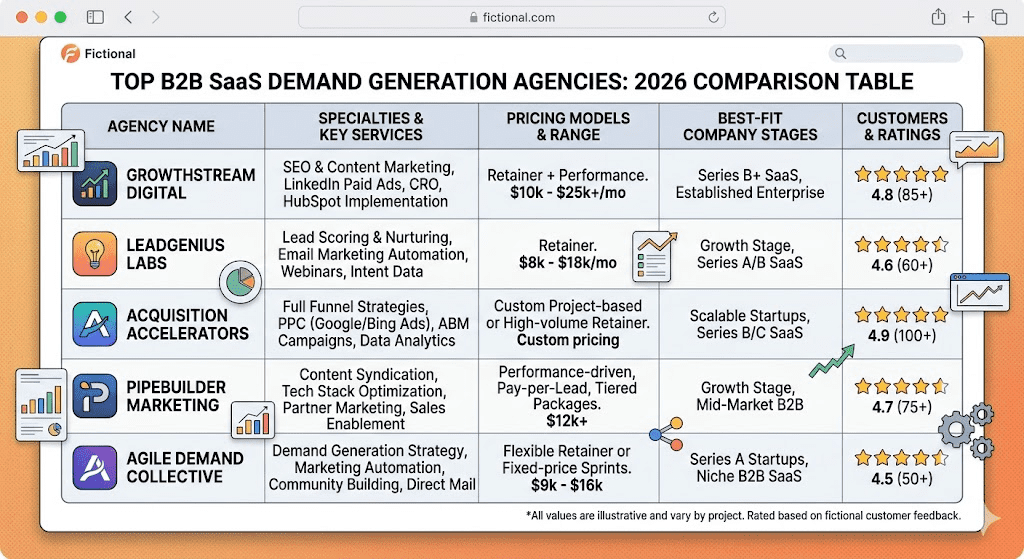
Top 10 Best SaaS Demand Generation Agencies for B2B Growth
Here is a comprehensive overview of the leading agencies in 2026, each with distinct strengths, specialties, and ideal client profiles.
| Agency | Primary Specialty | Best For | Pricing |
|---|---|---|---|
| Hey Digital | Paid-led full-funnel demand gen | Series A–C+ SaaS companies | Custom |
| Refine Labs | Demand creation & category building | Mid-market & Enterprise SaaS | Custom |
| Directive Consulting | CAC/LTV-focused customer generation | Growth-stage SaaS | Custom |
| Powered by Search | SEO + paid hybrid demand gen | Series A–C companies | Custom |
| Kalungi | GTM strategy + fractional CMO | Early-stage SaaS | Custom |
| Single Grain | Experimentation-led growth marketing | B2B & B2C SaaS | Custom |
| 42 Agency | Narrative + product marketing | Complex-product SaaS | Custom |
| Ironpaper | ABM-led demand generation | Enterprise B2B SaaS | Custom |
| Omniscient Digital | Content-led organic demand | Organic-first SaaS teams | Custom |
| Disruptive | Scalable paid demand generation | Growth-stage SaaS | Custom |
Hey Digital
Hey Digital is a B2B SaaS performance marketing agency that specializes in paid-led demand generation. Their approach is uniquely built around pipeline stages, not individual channels, making them ideal for SaaS companies that want their ad spend to translate directly into qualified pipeline. They work with clients like Hotjar, Toggl, Todoist, PostHog, and UserTesting — companies that need repeatable, scalable demand systems. What sets Hey Digital apart is their emphasis on cross-channel campaign orchestration and structured creative experimentation, ensuring that messaging evolves alongside your buyers.
Refine Labs
Refine Labs is arguably the most recognized name in B2B SaaS demand generation. Founded by Chris Walker, the agency is famous for popularizing the “demand creation vs. demand capture” distinction and championing pipeline-focused measurement over MQL reporting. They work primarily with mid-market and enterprise SaaS companies, building category-level awareness through paid social, content distribution, and community-led strategies. Their publicly documented methodology is a major trust signal — you can evaluate their thinking before signing a contract. Clients like Clari, Algolia, and Cognism have credited Refine Labs with transforming how their leadership teams think about marketing performance.
Directive Consulting
Directive Consulting has carved out a unique niche with what they call “Customer Generation” — a methodology that replaces the standard lead-count dashboard with a model built around CAC and LTV. They serve exclusively SaaS and tech companies, which means every campaign decision is informed by deep vertical expertise. Their programs span Google Ads, LinkedIn, paid social, and revenue forecasting, making them a strong fit for SaaS companies that have found product-market fit and need a commercial-minded partner to scale acquisition efficiently.
Powered by Search
Powered by Search focuses on helping Series A through Series C SaaS companies make the critical transition from lead generation to demand generation. Their standout quality is their multi-channel integration — combining paid media, SEO, and content so that marketing doesn’t stop working the moment you pause your ad budget. They’re particularly strong for SaaS teams building a durable, long-term marketing engine rather than relying on short-term campaign spikes.
Kalungi
Kalungi is purpose-built for early-stage SaaS companies that need both strategic guidance and execution support. They offer fractional CMO services alongside demand generation, making them ideal for startups that don’t yet have a senior marketing leader. Their go-to-market planning capability means they help founders build foundational demand generation systems from scratch — not just run campaigns on an existing infrastructure.
Single Grain
Single Grain, co-founded by Eric Siu, applies an experimentation-first mindset to SaaS demand generation. They work with both B2B and B2C SaaS companies, helping teams discover which combinations of messaging, channels, and funnel mechanics create sustained demand. Their strength lies in rapid A/B testing and the ability to quickly identify what’s driving conversion — then double down on it.
42 Agency
42 Agency is a unique hybrid of product marketing and demand generation. They believe that strong demand starts with strong narrative and positioning — and that most SaaS companies run campaigns before they’ve truly earned the right to sell. Their work is best suited to SaaS companies with complex products that need a clear, compelling story before scaling paid distribution.
Ironpaper
Ironpaper specializes in ABM (Account-Based Marketing)-led demand generation for enterprise B2B companies with long, multi-stakeholder sales cycles. They begin every engagement with deep ICP development and account selection — no campaigns launch until the targeting foundation is solid. Their multi-channel execution across email, paid media, and direct mail is especially effective for enterprise buying committees.
Omniscient Digital
Omniscient Digital is the go-to agency for content-led, organic demand generation. They specialize in building long-term pipeline through high-intent SEO content and editorial programs. Their approach is ideal for SaaS companies that want to reduce dependence on paid media over time and build an organic demand engine that compounds in value month after month.
Disruptive Advertising
Disruptive supports SaaS demand generation through scalable paid programs that feed broader funnel objectives. They’re focused on increasing qualified demand volume and improving pipeline flow at scale. For growth-stage SaaS companies that need a high-volume paid media operation with strong analytics, Disruptive offers a proven execution model.
Benefits of Hiring a SaaS Demand Generation Agency
Choosing to work with a specialist SaaS demand gen agency — rather than hiring in-house or using a generalist agency — delivers meaningful advantages that directly impact your revenue trajectory.
1. Deep SaaS Vertical Expertise: Specialist agencies understand SaaS-specific buying cycles, pricing model nuances (freemium, PLG, enterprise sales), and funnel dynamics. They’ve seen what works across dozens of similar companies, giving them pattern recognition that in-house teams take years to develop.
2. Faster Time to Pipeline: Because specialist agencies bring proven frameworks and tested playbooks, they reduce the experimentation time that would otherwise delay results. According to SaaSHero, top demand gen agencies have delivered up to 650% ROI for B2B SaaS clients.
3. Multi-Channel Execution at Scale: Running paid search, paid social, content, ABM, and lifecycle marketing simultaneously requires significant expertise and tooling. Agencies bring all of this under one roof, orchestrated toward a single pipeline goal.
4. Revenue-Aligned Measurement: The best agencies connect every marketing activity to CRM data, giving leadership clear visibility into what’s driving pipeline and closed revenue — not just surface-level engagement metrics.
5. Access to Cutting-Edge Tools and Benchmarks: Elite agencies invest in best-in-class MarTech — attribution platforms, intent data tools, A/B testing infrastructure — and they bring industry benchmarks that help your team understand how performance compares to peers.
6. Scalability Without Overhead: Agencies scale with your growth stage. You can increase budget and scope without the cost, risk, and time of hiring a full in-house team.
7. Objective Outside Perspective: An external agency brings fresh eyes to your messaging, positioning, and funnel — often catching blind spots that internal teams are too close to see.
Common Mistakes to Avoid When Choosing a Demand Gen Agency
Even the most experienced SaaS marketers make these mistakes when selecting or working with demand gen agencies. Knowing them in advance saves significant time and money.
Mistake 1 — Confusing Lead Generation with Demand Generation: Many agencies call themselves “demand gen” agencies but actually deliver traditional lead gen — form fills, content downloads, and MQL reports. Always ask: “How do you connect your work to pipeline and closed revenue?” If the answer focuses on lead volume, keep looking.
Mistake 2 — Prioritizing Price Over Fit: The cheapest agency rarely delivers the best return. A $3,000/month agency that understands your ICP and builds a real pipeline system is worth infinitely more than a $1,000/month agency running disconnected campaigns.
Mistake 3 — Expecting Overnight Results: Demand generation is a compounding strategy. Top agencies are transparent that significant pipeline impact typically takes 3 to 6 months to materialize, especially in enterprise SaaS. Agencies promising fast results without nuance are a red flag.
Mistake 4 — Skipping ICP Alignment: Launching campaigns before marketing and sales agree on who you’re targeting is a costly error. Great agencies insist on ICP clarity before any creative or campaign work begins.
Mistake 5 — Ignoring Sales and Marketing Alignment: Demand generation doesn’t stop when a lead enters the CRM. The best agencies stay involved through the SDR layer, ensuring marketing-generated demand actually converts into sales conversations.
Pro Tip: Before signing with any agency, ask them to walk you through a specific case study — not a metrics dashboard, but the strategic thinking behind how they moved a company from awareness to pipeline. The quality of that explanation tells you everything about their actual expertise.
Best Practices for B2B SaaS Demand Generation
Whether you’re working with an agency or building an in-house capability, these are the practices that consistently drive results in 2026’s competitive SaaS landscape.
Start with Positioning, Not Campaigns: Before you run a single ad, get crystal clear on your unique value proposition, target persona, and the specific problem you solve. Positioning is the foundation on which all demand generation is built.
Invest in Both Demand Creation and Demand Capture: Many SaaS companies only invest in capturing existing demand (SEO, Google Ads) and ignore demand creation (LinkedIn content, thought leadership, podcasts). The best programs do both — creating new buyers while converting existing ones.
Use Content as a Long-Term Demand Engine: According to SeoProfy, 46% of B2B marketers plan to increase content marketing spend in 2025. High-quality, buyer-centric content builds trust at scale — it’s demand generation that works while you sleep.
Measure What Actually Matters: Replace MQL counts with pipeline metrics. Track opportunities created, pipeline value influenced, sales cycle length, and closed-won revenue attributed to marketing. These metrics connect demand generation to business outcomes.
Embrace Full-Funnel Attribution: Use CRM integrations to track the full buyer journey from first marketing touch to closed deal. This data tells you which channels and messages are actually driving revenue — not just clicks.
Test Aggressively, Scale What Works: The best demand gen programs run structured experiments constantly — new audiences, new creatives, new offers, new CTAs. Winning experiments get scaled; losing ones get cut quickly. This discipline is what separates agencies that grow their clients from those that maintain them.
Align with Sales on a Regular Cadence: Hold weekly or bi-weekly syncs between marketing and sales to review pipeline quality, messaging feedback, and objection patterns. Marketing programs that incorporate real sales insights consistently outperform those that don’t.
SaaS Demand Generation Agency vs. In-House Marketing Team — Comparison
When deciding between an agency and building in-house, SaaS leaders often wrestle with trade-offs across cost, speed, expertise, and control.
| Factor | SaaS Demand Gen Agency | In-House Marketing Team |
|---|---|---|
| Cost | Predictable retainer, no hiring overhead | High salary + benefits + tools cost |
| Expertise | Multi-client experience + pattern recognition | Single-company focus, slower development |
| Speed to Launch | Fast — proven frameworks ready to deploy | Slower — hiring + onboarding required |
| Scalability | Flexible scope adjustment | Requires additional headcount |
| Accountability | Pipeline and revenue-focused KPIs | Variable, depends on leadership |
| Culture Fit | Requires relationship management | Deep alignment with company culture |
| Long-Term Value | High ROI when partnership is right | Builds institutional knowledge over time |
| Best For | Series A–C SaaS scaling quickly | Post-Series C companies with marketing maturity |
The most effective approach for many SaaS companies is a hybrid model: a specialist agency handling paid media and demand strategy, while a small in-house team manages content, brand, and sales enablement. This combines the best of both worlds.
Important Facts & Statistics
The numbers behind B2B SaaS demand generation paint a clear picture of why this investment matters more than ever in 2026.
According to Fortune Business Insights, the global B2B SaaS market was valued at $497.41 billion in 2025 and is projected to grow to $634.39 billion in 2026, with a compound annual growth rate (CAGR) of 27.54% through 2034. This explosive growth means more competitors, more noise, and a greater need for differentiated demand strategies.
Lureon’s 2025 B2B SaaS Lead Generation Report reveals that email marketing is still used by 88% of B2B businesses for demand generation, while LinkedIn has a 97% adoption rate among B2B marketers for lead generation — making it the dominant social channel for SaaS demand creation.
Research from Forrester shows that companies using first-party data strategies in their demand programs experience a 2x increase in conversion rates and a 30% reduction in customer acquisition costs — underscoring the premium placed on data-driven, personalized demand generation.
According to SeoProfy, 46% of B2B marketers plan to increase their content marketing budget in 2025, recognizing content as a foundational demand creation channel that builds compounding pipeline over time.
Mordor Intelligence projects the B2B SaaS market will grow from $492.34 billion in 2026 to $1.578 trillion by 2031 — a trajectory that makes investing in systematic, scalable demand generation not just smart, but essential for long-term survival and growth.
FAQ Section — People Also Ask
Q1: What is the difference between demand generation and lead generation for SaaS?
A: Demand generation focuses on creating awareness and educating the entire market — building interest among people who may not yet be actively searching for a solution. Lead generation focuses on capturing contact information from people already showing buying intent. The best SaaS marketing programs do both: creating new demand at the top of the funnel while efficiently capturing existing demand at the bottom. Demand generation is a longer-term strategy that builds brand trust and category authority, while lead gen delivers shorter-term pipeline volume.
Q2: How much does a SaaS demand generation agency typically cost?
A: Pricing for SaaS demand generation agencies varies widely based on scope, company stage, and agency reputation. Entry-level retainers (like The B2B Playbook) start from around $1,580/month. Mid-market agency retainers typically range from $5,000 to $15,000/month, while enterprise-grade agencies like Directive or Refine Labs command $15,000 to $50,000+/month for comprehensive demand programs. Always evaluate ROI and pipeline impact rather than raw cost — a well-executed $10,000/month program can deliver 10x that in pipeline value.
Q3: How long does it take to see results from a demand generation agency?
A: Realistic timelines vary by channel and strategy. Paid demand generation (LinkedIn Ads, Google Ads) can begin driving pipeline influence within 4–8 weeks. Content-led and organic demand generation typically takes 3–6 months to show meaningful traction. Full-funnel programs that combine both paid and organic channels generally see compounding results after 6 months, with the strongest ROI emerging in months 9–12 as the system matures and data improves targeting and messaging precision.
Q4: What should I look for when choosing a SaaS demand gen agency?
A: Look for four core qualities. First, they should have verified SaaS-specific experience with case studies from companies at a similar stage and vertical to yours. Second, they must demonstrate pipeline and revenue measurement capability — not just lead counting. Third, they should have a clear full-funnel methodology covering demand creation, capture, and conversion. Fourth, look for ICP alignment as a starting point — agencies that skip this step rarely deliver durable results. Also check for transparent reporting, communication cadence, and whether senior strategists will actually be working on your account.
Q5: Can a small SaaS startup benefit from a demand generation agency?
A: Absolutely — in fact, agencies like Kalungi and Powered by Search are specifically designed for early-stage and Series A SaaS companies that need strategic guidance alongside execution. For startups, a fractional CMO model combined with focused demand generation on one or two channels is often the most efficient approach. The key is finding an agency that understands your runway constraints and can build scalable foundations that grow with you, rather than launching expensive programs before product-market fit is confirmed.
Conclusion
Choosing the right SaaS demand generation agency for B2B growth is one of the highest-leverage decisions a SaaS marketing leader can make in 2026. With the B2B SaaS market barreling toward a trillion-dollar valuation and competition intensifying across every vertical, systematic, pipeline-focused demand generation is no longer optional — it’s a survival strategy.
Whether you’re an early-stage startup needing foundational GTM support (Kalungi), a mid-market SaaS company building category authority (Refine Labs), or a scaling enterprise that needs paid demand at scale (Directive or Hey Digital), there is a specialist agency built precisely for your situation.
The best SaaS demand generation agencies share a common belief: marketing should be accountable to revenue, not just activity. Start by defining your ICP, clarifying your pipeline goals, and evaluating agencies based on their SaaS track record and measurement frameworks — not just their pitch decks.
Found this guide helpful? Share it with your marketing team, drop a comment below with the agency you’re considering, or subscribe to our newsletter for weekly B2B SaaS growth insights. Your next stage of growth starts with the right demand generation partner.