
SaaS companies should invest in paid ads after achieving product-market fit (PMF), when they have paying customers actively using the product, a clearly defined user persona, basic analytics tracking in place, and a monthly budget of at least $5,000. Paid ads work best when you already know who you’re selling to and why they buy. Launching paid campaigns too early — before PMF — burns budget on a product the market hasn’t validated. Once your organic channels begin to plateau and you have a clear LTV:CAC ratio target of 3:1 or better, paid advertising becomes a powerful, scalable growth engine for your SaaS business.
INTRODUCTION
Paid advertising can be rocket fuel for a SaaS company — or a bonfire for your budget. The difference? Timing.
Many SaaS founders make the costly mistake of launching Google Ads or LinkedIn campaigns the moment their product goes live. The result? Wasted thousands of dollars, zero conversions, and a deep frustration with paid channels. But here’s the truth: paid ads don’t fail SaaS companies — bad timing does.CONCLUSION
Knowing when SaaS companies should invest in paid ads is not a question of calendar date or ARR milestone alone — it’s about strategic readiness. The clearest answer is this: invest in paid ads after you’ve achieved product-market fit, defined your user personas, set up your tracking infrastructure, and established a budget that reflects your niche’s competitive reality.
Get the timing right, and paid ads become the most powerful growth lever in your SaaS arsenal — delivering immediate traffic, fast feedback loops, and scalable revenue. Get it wrong, and you’ll burn budget on a product or audience that isn’t ready.
The key takeaways are simple: validate before you accelerate, track before you spend, and always tie every dollar back to your LTV:CAC ratio.
Ready to make paid ads work for your SaaS? Share this guide with your marketing team, drop your biggest paid ads question in the comments below, or explore our related resources on SaaS marketing strategy. The right investment at the right time could be the decision that changes your growth trajectory forever.
According to recent data, customer acquisition costs (CAC) for SaaS have risen by 60% over the past five years, and B2B SaaS deals now require an average of 266 touchpoints before closing. That means paid ads have never been more complex — or more strategic — than they are today.
In this guide, you’ll learn exactly when SaaS companies should invest in paid ads, what signals to look for before launching, how to set your budget, which platforms to use, and the common pitfalls to avoid. Whether you’re a seed-stage startup or a scaling SaaS with $1M+ ARR, this article will give you a clear, actionable roadmap.
What Is “Investing in Paid Ads” for SaaS Companies?
Investing in paid advertising for SaaS means allocating a dedicated budget to run campaigns on platforms like Google Ads, LinkedIn Ads, Meta Ads, or YouTube — with the goal of acquiring new users, generating trial sign-ups, or booking product demos. Unlike organic strategies such as SEO or content marketing, paid ads deliver immediate visibility in front of a targeted audience.
For SaaS businesses, paid acquisition is unique because the product is subscription-based. This means the lifetime value (LTV) of a single customer can stretch over months or years, which changes how you calculate ROI. A SaaS company isn’t just buying a one-time transaction — it’s buying a recurring revenue relationship.
The core question isn’t whether to run paid ads. Almost every growing SaaS company eventually does. The real question is when the conditions are right to invest — and that depends on a set of very specific signals. Running paid ads too early is like pouring gasoline on a fire that hasn’t been lit yet. Running them at the right time is like hitting a turbocharger on a well-tuned engine.
The global SaaS market is projected to surpass $299 billion in 2025 (Digital Silk), and competition for customer attention is fiercer than ever. That makes strategic paid ad investment not just important — it’s a competitive necessity.
How Do You Know When Your SaaS Is Ready for Paid Ads?
This is the most critical question every SaaS founder and marketer must answer honestly before spending a single dollar on ads. There is no universal launch date — readiness is determined by a checklist of business fundamentals.
1. You’ve Achieved Product-Market Fit (PMF)
Product-market fit, a term coined by investor Marc Andreessen, means your product satisfies a genuine, strong market demand. You know you have PMF when happy paying customers are referring other paying customers. Experts and growth practitioners consistently agree: do not run paid ads before PMF. If you run ads before PMF, you’ll acquire users who churn quickly — burning your budget without building sustainable revenue.
A reliable signal of PMF is what Sean Ellis calls the “40% rule” — at least 40% of your users should say they would be “very disappointed” if your product disappeared. Once you hit that benchmark, you have the foundation to scale with paid.
2. You Have Paying Users Actively Using the Product
Active users validate three critical things: your product works, your market is real, and your customer personas are accurate. Without active paying users, your paid campaigns will drive sign-ups that don’t engage — inflating your CAC without building LTV.
3. Your User Personas Are Clearly Defined
Before launching any paid campaign, you need detailed, research-backed customer personas. These include demographics, job titles, pain points, goals, device usage, and behavioral triggers. Paid platforms like LinkedIn and Google use this data for precise targeting. Without defined personas, your ads reach the wrong people — and money gets wasted.
4. Tracking & Analytics Infrastructure Is in Place
This is a non-negotiable step that many founders skip. Before running paid ads, ensure the following are configured: Google Analytics 4 (GA4), Google Tag Manager, conversion goal tracking, UTM parameters, and CRM integration. Without this infrastructure, you’re flying blind — spending money without knowing what’s working.
5. You Have a Defined Budget
According to Lever Digital, you can technically start with $500/month, but you need at least $5,000/month to generate meaningful, statistically significant results. Many SaaS growth experts recommend allocating 20–35% of your total marketing budget to paid channels (Pipeline Road, 2026). The right budget also depends on your niche’s cost-per-click (CPC), which can range from $3 to over $12 per click in competitive SaaS categories.
6. Organic Growth Is Plateauing
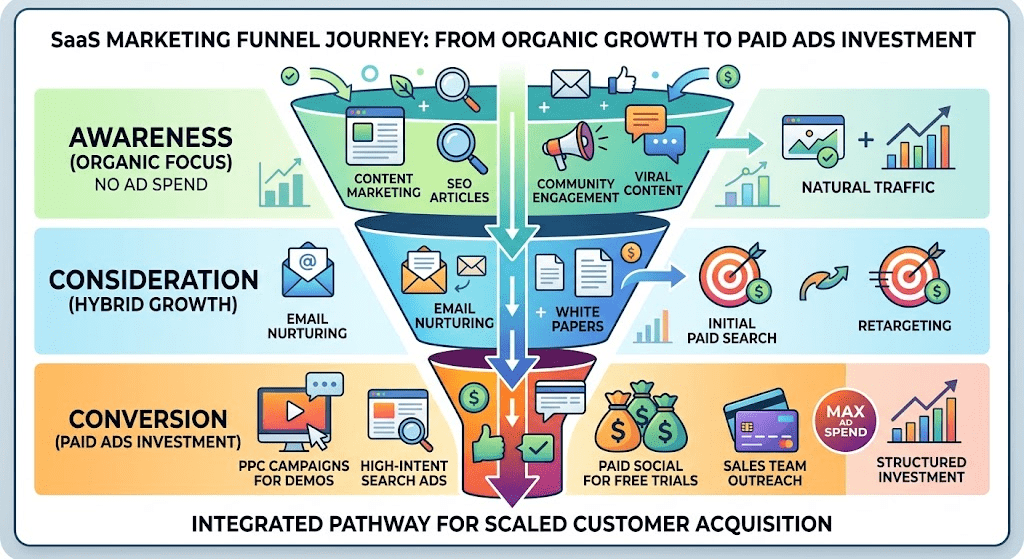
A strong signal that it’s time to invest in paid ads is when your organic channels — SEO, content marketing, word of mouth — are no longer growing at the rate you need. Paid ads are the accelerant that can reignite growth when organic momentum slows. They’re not a replacement for organic — they’re a multiplier.
7. You Understand Your LTV:CAC Ratio Target
The industry-standard LTV to CAC ratio for healthy SaaS growth is 3:1 to 4:1 — meaning for every $1 spent acquiring a customer, you should generate $3–$4 in lifetime value. Before running paid ads, calculate your current LTV and set a maximum CAC you can afford. This ratio is your north star for every paid campaign.
Types of Paid Ads SaaS Companies Should Consider
Not all paid channels work equally well for every SaaS business. The right mix depends on your audience, budget, and growth stage.
- Google Search Ads are intent-driven and best for bottom-of-funnel conversion — capturing users actively searching for solutions. Average CPCs range from $3–$10. These work best when your category has strong search volume (500+ monthly searches at minimum).
- LinkedIn Ads excel for B2B SaaS targeting enterprise buyers. You can target by job title, seniority, company size, and industry. CPCs are higher ($6–$15), but lead quality is significantly better. LinkedIn drives 80% of B2B social media leads according to LinkedIn’s own data.
- Meta Ads (Facebook & Instagram) work well for product-led growth (PLG) SaaS companies with broader audiences or freemium models. They’re effective for retargeting and top-of-funnel awareness at lower CPCs.
- YouTube Ads are powerful for product demos, explainer content, and brand awareness. Particularly useful when your product requires some education before a prospect converts.
- Display & Retargeting Ads keep your brand visible across the web to prospects who already visited your site. Retargeting converts users 70% more efficiently than top-of-funnel traffic, making it an essential layer for any SaaS paid strategy.
- Account-Based Advertising (ABM) is the premium option for enterprise SaaS — delivering hyper-personalized ads to specific target accounts. ABM drives 97% higher ROI than traditional marketing for high-ticket B2B deals.
Benefits of Investing in Paid Ads at the Right Time
When SaaS companies invest in paid ads at the right stage with the right strategy, the results can be transformative.
Immediate, Scalable Traffic is the most obvious advantage. Unlike SEO, which takes months to gain traction, paid ads deliver qualified traffic the moment campaigns go live. This makes them invaluable when you need to hit a revenue milestone quickly.
Precise Audience Targeting allows you to reach your exact buyer persona — by job title, industry, behavior, or search intent — eliminating the spray-and-pray approach that wastes budget. This precision dramatically reduces wasted impressions.
Faster Feedback Loops are another major benefit. Paid ads generate data quickly — click-through rates, conversion rates, and cost-per-acquisition data come back within days, not months. This allows rapid iteration on messaging, landing pages, and offers.
Competitive Positioning is critical in crowded SaaS markets. Running competitor keyword campaigns — bidding on terms like “[Competitor] alternative” or “[Competitor] pricing” — captures high-intent prospects actively evaluating options. This strategy can reduce cost-per-acquisition by up to 40% compared to broad campaigns.
Accelerated Revenue Growth is the ultimate payoff. One case study by Lever Digital showed a SaaS client (Uplisting) growing revenue 30x after integrating paid ads into their overall growth strategy.
AI-Powered Optimization is now a standard advantage of paid platforms. Google’s Smart Bidding, for example, can increase conversions by an average of 20% at the same CPA (Google, 2025). AI-driven dynamic creative optimization (DCO) tests thousands of ad variations automatically, finding the best-performing combinations faster than any human team.
Full-Funnel Coverage is achievable through multi-platform strategies — using Google for bottom-of-funnel intent capture and LinkedIn for top-of-funnel awareness and ABM targeting. Companies doing $10M+ ARR consistently benefit from this multi-channel orchestration.
Common Mistakes SaaS Companies Make With Paid Ads
Understanding what not to do is just as important as knowing the right strategy.
Launching Before Product-Market Fit is the most expensive mistake in SaaS paid advertising. Without PMF, even perfectly targeted ads drive users who don’t stick around, creating a leaky bucket where acquisition spend never builds lasting ARR.
Skipping Conversion Tracking Setup means you’ll have no idea which campaigns, keywords, or ad creatives are actually driving revenue. Many SaaS teams launch campaigns without proper GA4 or CRM integration, making optimization impossible.
Ignoring Landing Page Quality is another critical error. Even the most sophisticated targeting fails if the landing page doesn’t convert. SaaS landing pages average 4.3% conversion rates industry-wide, but optimized pages with a single CTA, clear value proposition, and social proof can reach 10%+.
Bidding on Broad Competitor Brand Names without intent-based qualifiers wastes budget on existing customers trying to log in — not switchers. Always add modifiers like “alternative,” “pricing,” or “vs [your brand]” to competitor campaigns.
Neglecting Retargeting leaves significant revenue on the table. Most SaaS prospects don’t convert on their first visit. Retargeting campaigns bring back 26% of lost users and convert them far more efficiently than cold traffic campaigns.
Setting an Unrealistic Budget for the niche’s competitive landscape is common among early-stage founders. If your category has CPCs above $10 and you’re running $500/month, you won’t generate enough data to optimize — and results will look poor.
Best Practices & Expert Tips for SaaS Paid Ads
These are the strategies that consistently deliver results for SaaS companies in today’s paid landscape.
Build First-Party Data Infrastructure Before You Scale. With third-party cookies being phased out, first-party data — collected directly from your website visitors, email subscribers, and CRM — is your most valuable targeting asset. Businesses using first-party data for ad targeting see 2.9x higher revenue lift (Google & Boston Consulting Group research).
Use a Sequential Campaign Strategy Across Platforms. The winning playbook: use Google Search Ads to capture high-intent prospects, retarget those visitors on LinkedIn with educational content, then re-engage LinkedIn-touched prospects with Google search ads again. This multi-platform loop covers the full SaaS buying cycle.
Prioritize a Single Conversion Goal Per Campaign. Whether it’s a free trial, demo booking, or webinar registration — pick one CTA per campaign. Multiple CTAs create decision fatigue and drop conversion rates significantly.
Leverage AI-Powered Campaign Automation. Use Google’s Performance Max, Smart Bidding, and responsive search ads. Marketers using AI-powered tools report 30% higher conversion rates and 25% lower CAC compared to manually managed campaigns (Boston Consulting Group).
Test and Learn Before Scaling. Start with a smaller budget to test messaging, keywords, and landing pages. Scale only what the data proves is working. This test-and-learn approach prevents large-scale budget waste.
Calculate Your Magic Number Before Launching. Your Magic Number tells you how efficient your paid growth engine is. A Magic Number above 0.75 generally signals you’re ready to scale paid acquisition aggressively.Magic Number=Prior Quarter Sales & Marketing Spend(Current Quarter ARR−Prior Quarter ARR)×4
SaaS Paid Ads vs. Organic Marketing — Key Comparison
| Factor | Paid Ads | Organic (SEO/Content) |
|---|---|---|
| Speed to Traffic | Immediate (days) | Slow (3–12 months) |
| Cost | Ongoing (pay per click) | Lower long-term |
| Scalability | Highly scalable with budget | Limited by content output |
| Targeting Precision | Very high (audience, intent) | Moderate |
| Data Feedback | Fast (days/weeks) | Slow (months) |
| Traffic Sustainability | Stops when budget stops | Evergreen once established |
| Best For | Hitting revenue milestones fast | Building long-term authority |
| Ideal Stage | Post-PMF, scaling phase | Early to mid-stage |
| ROI Timeline | Short-term | Long-term |
| Competitive Advantage | Immediate positioning | Compound interest effect |
The most effective SaaS companies don’t choose between paid and organic — they run both in parallel. According to Position Digital (2026), investing in SEO saves approximately 39.9% in marketing costs compared to relying on paid channels alone. The smart play is using organic to build your foundation and paid ads to accelerate growth.
IMPORTANT FACTS & STATISTICS
The following data points reinforce the strategic importance of timing and precision when SaaS companies invest in paid ads.
1. CAC Has Risen 60% in Five Years. Customer acquisition costs for SaaS businesses have increased by 60% over the past five years (Genesys Growth, 2026). This makes strategic, data-driven paid ad investment more critical — and more expensive to get wrong — than at any previous point in the industry’s history.
2. The Average B2B SaaS CAC Is Approximately $702. According to GTM80/20 (2026), the average customer acquisition cost for a B2B SaaS company sits around $702, though this varies significantly by niche, deal size, and acquisition channel used.
3. The Ideal LTV:CAC Ratio Is 3:1 to 4:1. Industry-standard benchmarks across sources including Kissmetrics, Wall Street Prep, and Usermaven agree that SaaS companies should aim to generate $3–$4 in lifetime customer value for every $1 spent on acquisition. A ratio below 3:1 signals the paid engine is inefficient.
4. Paid Ads Should Represent 20–35% of a SaaS Marketing Budget. According to Pipeline Road’s 2026 analysis of SaaS marketing budget allocation, paid advertising across LinkedIn, Google, and Meta should account for 20–35% of the total marketing budget for growing SaaS businesses. The median overall marketing spend for private B2B SaaS companies is 8% of ARR (SaaS Capital, 2025).
5. B2B SaaS Deals Now Require 266 Touchpoints. According to Wall of Marketing’s 2025 research, the average B2B SaaS deal requires 266 touchpoints before closing — a 19.8% increase from 2023. This underscores why multi-channel, full-funnel paid strategies that cover awareness, consideration, and conversion stages are no longer optional — they’re essential.
FAQ SECTION (People Also Ask)
Q1: How much should a SaaS company spend on paid ads?
The right budget depends on your ARR and growth goals, but most industry benchmarks suggest allocating 20–35% of your total marketing budget to paid channels. For early-stage SaaS, a minimum of $5,000/month is needed to generate meaningful campaign data. Some growth-stage companies invest 15–20% of their ARR in total marketing, with a significant portion directed to paid acquisition. Always tie your budget to your LTV:CAC ratio — ensure every dollar spent on acquisition can be justified by the projected customer lifetime value.
Q2: Is Google Ads or LinkedIn Ads better for SaaS companies?
Both platforms serve different purposes. Google Ads are best for bottom-of-funnel, intent-driven conversion — capturing users actively searching for solutions with CPCs averaging $3–$10. LinkedIn Ads are better for B2B SaaS targeting enterprise decision-makers by job title, seniority, and company — with higher CPCs ($6–$15) but superior lead quality. The most effective SaaS paid strategies use both: Google to capture demand and LinkedIn to build awareness and execute ABM campaigns. The choice isn’t either/or — it’s about how to sequence them for full-funnel coverage.
Q3: Can a SaaS startup run paid ads with a small budget?
Technically yes — you can start Google Ads campaigns with as little as $500/month. However, a budget that small in a competitive SaaS niche will not generate enough data for meaningful optimization. The practical minimum to see actionable results is $5,000/month. If your budget is limited, prioritize highly specific, long-tail keywords with lower competition and higher intent. Alternatively, focus on retargeting first — since you’re reaching people who already know your brand, conversion rates are higher and CPCs are generally lower.
Q4: What is the biggest mistake SaaS companies make with paid ads?
The single biggest mistake is launching paid ads before achieving product-market fit. Without PMF, even perfectly targeted campaigns drive users who churn quickly, creating a leaky acquisition bucket where every marketing dollar evaporates. The second most costly mistake is running ads without proper conversion tracking — without GA4, UTM parameters, and CRM integration in place, you have no way to measure what’s working and optimize campaigns effectively. Always validate your product with paying customers before scaling with paid budget.
Q5: How long does it take for SaaS paid ads to show results?
Unlike SEO which takes months, paid ads can drive traffic within 24–48 hours of launch. However, meaningful results — enough data to optimize campaigns — typically take 4–8 weeks of consistent running. The initial weeks are a “test-and-learn” phase where you refine keywords, ad copy, audience targeting, and landing pages. Expect the first month to focus on learning, month 2 on optimization, and month 3+ on scaling what works. Setting realistic expectations with stakeholders about this ramp-up period is critical for long-term success.
CONCLUSION
Knowing when SaaS companies should invest in paid ads is not a question of calendar date or ARR milestone alone — it’s about strategic readiness. The clearest answer is this: invest in paid ads after you’ve achieved product-market fit, defined your user personas, set up your tracking infrastructure, and established a budget that reflects your niche’s competitive reality.
Get the timing right, and paid ads become the most powerful growth lever in your SaaS arsenal — delivering immediate traffic, fast feedback loops, and scalable revenue. Get it wrong, and you’ll burn budget on a product or audience that isn’t ready.
The key takeaways are simple: validate before you accelerate, track before you spend, and always tie every dollar back to your LTV:CAC ratio.
Ready to make paid ads work for your SaaS? Share this guide with your marketing team, drop your biggest paid ads question in the comments below, or explore our related resources on SaaS marketing strategy. The right investment at the right time could be the decision that changes your growth trajectory forever.