PPC ad copy examples are real-world Google Ads (and other paid ads) that demonstrate proven copywriting techniques. These include writing headlines with urgency, using social proof, addressing pain points, and adding strong calls to action. Great PPC ad copy grabs attention fast, matches the searcher’s intent, and convinces them to click. Whether you’re advertising a product, service, or brand, studying high-performing ad copy examples teaches you exactly what phrases, structures, and emotional triggers work — so you can replicate that success in your own campaigns.
Introduction
Your ad budget means nothing if your words don’t convert. You could be spending thousands of dollars on Google Ads, but if your copy is flat, generic, or misaligned with what users want — you’re simply burning cash.
PPC ad copy is the art and science of writing paid ad text that stops scrollers, earns clicks, and drives sales. It’s one of the most high-leverage skills in digital marketing today. According to WordStream’s 2025 Google Ads Benchmarks report (analyzing over 16,000 campaigns), the average click-through rate on Google Ads is 6.66% — and the gap between mediocre and excellent ad copy is often the entire difference between being above or below that benchmark.
In this guide, you’ll discover 13 real PPC ad copy examples across multiple industries and ad types. Each example comes with a breakdown of why it works and what you can steal for your own campaigns. Whether you’re a beginner or a seasoned PPC marketer, these examples will sharpen your copywriting instincts instantly.
What Is PPC Ad Copy? (Full Explanation)
Pay-per-click (PPC) ad copy refers to the written content within a paid advertisement — typically on Google Ads, Microsoft Ads, Facebook Ads, or LinkedIn Ads — where the advertiser pays each time a user clicks on the ad.
Unlike organic content or SEO writing, PPC copy must do a very specific job within an extremely tight space. A standard Google Search Ad gives you roughly 30 characters per headline and 90 characters per description line. That’s less space than a tweet. Every word must earn its place.
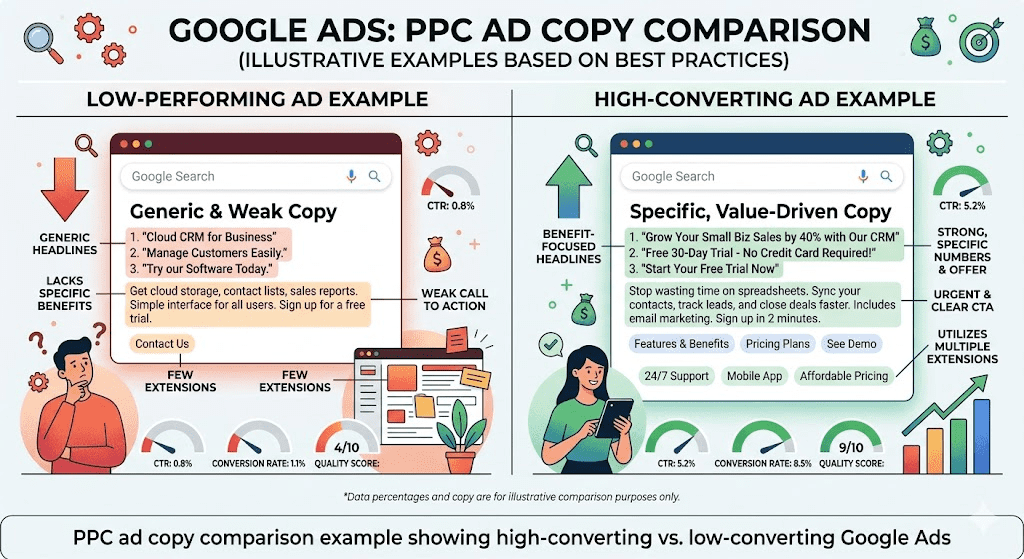
PPC ad copy has three core components that work together to drive results: the headline (the first thing people see), the description (the supporting message), and the call to action (the directive that tells people what to do next). When these three elements align with a user’s search intent, the results can be remarkable.
The importance of PPC advertising cannot be overstated. Search ad spending in the U.S. alone is projected to reach $140.06 billion in 2025 (Digital Silk, 2026), and global digital ad spending is forecasted to surpass $740 billion the same year. With competition this fierce, excellent ad copy is no longer optional — it’s the primary weapon in your marketing arsenal.
How Does PPC Ad Copy Work?
Writing effective PPC ad copy is a process, not a guessing game. Here is a clear step-by-step breakdown of how it works from start to finish.
Step 1 — Understand Search Intent. Before writing a single word, identify why someone is searching. Are they looking to buy (transactional), compare options (commercial), or just learn (informational)? Your ad copy must mirror that intent perfectly.
Step 2 — Identify Your Unique Selling Proposition (USP). What makes your offer different? It could be a price guarantee, speed of service, number of customers served, or a specific feature competitors lack. Your USP is the core message your ad should communicate.
Step 3 — Write Keyword-Rich Headlines. Use the focus keyword naturally in at least one headline. Google’s algorithm rewards relevance, and users are visually drawn to headlines that match what they just typed.
Step 4 — Address a Pain Point or Desire. The best ads speak directly to a problem the user has or a goal they want to achieve. Phrases like “Tired of slow internet?” or “Get debt-free in 12 months” immediately connect emotionally.
Step 5 — Add a Clear Call to Action (CTA). Every ad must tell the reader what to do next. “Get a Free Quote,” “Shop Now,” “Book a Consultation,” and “Download Free Guide” are all proven CTAs that drive action.
Step 6 — Test Multiple Variations. PPC pros recommend creating 3-5 ad variations per ad group. Small changes in wording, CTA, or headline order can dramatically shift performance. A/B testing is the only way to know what truly converts for your specific audience.
Step 7 — Align with Your Landing Page. The best ad copy in the world will fail if it leads to a mismatched landing page. The promise made in your ad must be fulfilled immediately when the user lands on your site.
13 PPC Ad Copy Examples You Can Learn From
These 13 examples are drawn from across industries and platforms. Each illustrates a distinct copywriting strategy that you can adapt for your own campaigns.
Example 1 — Competitive Ad Copy (Monday.com vs. Rivals)
“monday.com — So Much Better. Objective comparison says it all. Flexible platform for teams to manage projects, their way, wherever!”
Why it works: This ad attacks competitors without naming them directly, which is both bold and legally smart. It uses the phrase “objective comparison” to plant doubt about rival tools, then pivots immediately to a customer-centric benefit: flexibility. Competitive copy thrives on differentiation. What to steal: Lead with a comparison hook. Position your product as the superior alternative without being petty.
Example 2 — Authority Ad Copy (Legal Services)
“We’ve Helped Over 1,000,000 People. Over $10B Won For Clients. Experienced Trial Lawyers Available 24/7. Pay Nothing Unless We Win.”
Why it works: This ad stacks trust signals in rapid succession — a massive number, a financial proof point, availability, and zero-risk guarantee. For high-stakes industries like legal services (where the average CPC is $8.58), users need to feel safe before clicking. What to steal: In high-trust industries, lead with credibility numbers and risk-reversal phrases like “no fee unless you win.”
Example 3 — Pain Point Ad Copy (Project Management Tools)
“Finally, a social media calendar tool that your team will ACTUALLY love. Sign up for free today.”
Why it works: The word “actually” carries enormous emotional weight. It implies that other tools have failed this user before — and that this one is different. It speaks directly to the frustration of teams forced to use clunky software. What to steal: Use the word “actually” when you want to acknowledge a user’s past disappointment and position your offer as the real solution.
Example 4 — Conversational Ad Copy (SpyFu)
“Are You Kidding? Unlimited Data, Projects & Keywords at Half the Price? Try SpyFu Free.”
Why it works: This ad uses informal, punchy language that sounds like something a real person would say out loud. It leads with shock (“Are You Kidding?”), backs it up with a compelling value statement, and ends with a low-risk CTA (free trial). What to steal: Use a question or exclamation that mirrors your customer’s inner voice. Conversational copy feels more human and less like an ad.
Example 5 — Urgency Ad Copy (E-commerce)
“Flash Sale Ends Tonight — 40% Off Sitewide. Limited Stock Available. Shop Before It’s Gone.”
Why it works: This ad fires three urgency triggers in sequence: time scarcity (“Ends Tonight”), discount motivation (“40% Off”), and stock scarcity (“Limited Stock”). Research consistently shows that urgency and scarcity increase click-through rates by triggering the psychological principle of loss aversion. What to steal: Layer multiple urgency signals in your ad copy. Time limits and stock limits together create irresistible pressure to act now.
Example 6 — Social Proof Ad Copy (SaaS Product)
“Trusted by 50,000+ Businesses Worldwide. Rated #1 in Customer Satisfaction. Start Your Free 14-Day Trial.”
Why it works: Social proof is one of the most powerful forces in human decision-making. When people see that thousands of others have already made a choice, they feel safer making that same choice. Numbers create instant credibility. What to steal: Always include a real number — customers, reviews, star ratings, or years in business. Vague claims (“trusted by thousands”) are weaker than specific ones (“trusted by 52,481 businesses”).
Example 7 — Benefit-Led Ad Copy (Health & Fitness)
“Lose 10 lbs in 30 Days — Without Giving Up Your Favorite Foods. Science-Backed Plan. Get Started Free.”
Why it works: This ad leads with a specific, desirable outcome (10 lbs in 30 days), then immediately removes the biggest objection (“without giving up your favorite foods”). Benefit-led copy always outperforms feature-led copy because it answers the user’s core question: “What’s in it for me?” What to steal: State your #1 benefit in the headline, then eliminate the top objection in the description. This formula works in virtually every industry.
Example 8 — Question-Based Ad Copy (Finance)
“Still Paying Too Much in Taxes? Our CPAs Have Saved Clients Over $2.3M. Book a Free Consultation.”
Why it works: Opening with a question immediately engages the reader because the brain instinctively tries to answer it. If the question resonates, the reader self-qualifies and continues reading. The social proof stat (“$2.3M saved”) then anchors the value before the CTA closes the deal. What to steal: Open with a question your ideal customer is already asking themselves. Make it specific enough to qualify leads, but broad enough to capture a significant audience
Example 9 — Rhyming/Memorable Ad Copy (Display Ad)
“Keep Work Flowing and Games Going.”
Why it works: This display ad from a gaming/productivity brand uses rhyming to create a memorable, sticky phrase. It says very little but invites curiosity — the reader wants to click just to understand what’s being advertised. Rhyming creates rhythm, and rhythm aids memory. What to steal: For display and awareness campaigns, a short, clever, rhyming tagline can outperform lengthy benefit-heavy copy because it lodges itself in the user’s memory.
Example 10 — Storytelling Ad Copy (Facebook/Display)
“Over 200,000 small businesses permanently closed during the pandemic. 70% of all US online spending goes to just 15 mega-retailers. Say hello to conscious shopping. Add [brand] — it’s free!”
Why it works: This ad tells a mini-story using real data points that provoke emotion. It creates a problem (the plight of small businesses), builds empathy, and presents the brand as a heroic solution. Storytelling in PPC copy works because humans are wired to respond to narrative. What to steal: Use a shocking fact or statistic to open your ad, especially on social platforms where you have more space. Then bridge from the problem to your solution in 2-3 lines.
Example 11 — “Yet” Ad Copy (Mailchimp Display)
“Advanced, Yet Easy Tools.”
Why it works: The single word “yet” bridges two things customers want but fear are mutually exclusive: power and simplicity. This is a classic copywriting device — acknowledging the tension between two competing desires and resolving it in one short phrase. What to steal: Think about what two things your customers want that seem contradictory. Then use “yet,” “without,” or “but” to connect them. Examples: “Professional Results, Yet Beginner Friendly” or “Premium Quality Without the Premium Price.”
Example 12 — Open Loop / Curiosity Ad Copy (LinkedIn)
“Why did HubSpot list [Brand] as one of the 16 top apps for CRM customization? Read our blog to find out.”
Why it works: This is a textbook open-loop technique. The ad reveals just enough information to create a compelling question in the reader’s mind — but not enough to satisfy their curiosity. The brain is wired to close open loops, which makes clicking feel almost involuntary. What to steal: Ask a “why” or “how” question in your ad that references a third-party validation (awards, rankings, media mentions). It creates curiosity and borrows authority simultaneously.
Example 13 — Compassionate Ad Copy (B2B/Utility Services)
“As temperatures drop, energy costs are rising. [Brand] is here to help customers manage their bills.”
Why it works: This ad doesn’t sell at all — it empathizes. It acknowledges a real problem the audience is facing and positions the brand as a helpful ally, not a salesperson. This approach is especially effective in regulated industries or when re-engaging existing customers. What to steal: Don’t always lead with your product. Sometimes leading with empathy and situational awareness builds more trust — especially with audiences who are skeptical of traditional sales messaging.
Types of PPC Ad Copy Strategies
Understanding the different categories of PPC ad copy helps you select the right approach for each campaign goal.
| Strategy | Best For | Key Trigger | Example Phrase |
|---|---|---|---|
| Competitive Copy | High-competition markets | Differentiation | “Better than [Tool X]” |
| Authority Copy | Trust-sensitive industries | Credibility | “1M+ customers served” |
| Urgency Copy | E-commerce, promotions | FOMO | “Offer ends midnight” |
| Social Proof Copy | New brands building trust | Herd mentality | “Rated #1 by Forbes” |
| Benefit-Led Copy | Product/service ads | Desire | “Lose 10 lbs in 30 days” |
| Empathy/Pain Point Copy | Service industries | Emotional connection | “Tired of paying too much?” |
| Curiosity/Open Loop Copy | Content, lead gen | Intrigue | “Why do 9/10 experts say…?” |
| Conversational Copy | Younger audiences | Relatability | “Are you kidding? Half price!” |
Benefits of Studying PPC Ad Copy Examples
Learning from real-world PPC ad copy examples delivers concrete, measurable advantages for your campaigns.
- Faster learning curve: Instead of spending thousands of dollars on failed experiments, studying proven examples lets you skip straight to what works. You learn the underlying principles through real-world application.
- Improved CTR: Applying tested copywriting techniques — like urgency, social proof, and benefit-led headlines — directly improves your click-through rates. WordStream data shows that better-optimized ads see significantly higher CTRs compared to generic equivalents.
- Higher Quality Score: Google rewards ads that are highly relevant to the user’s search intent. Well-crafted copy aligned with search intent leads to higher Quality Scores, which in turn lowers your cost per click and improves ad placement.
- Better conversion rates: The average Google Ads conversion rate in 2025 is 7.52% (WordStream). Brands that use emotionally intelligent, benefit-driven copy consistently outperform this benchmark.
- Stronger ROI: Every improvement in your ad copy’s performance means you’re extracting more value from the same budget. A 2% improvement in CTR can have a compounding effect on your cost per lead over time.
- Competitive intelligence: Analyzing competitor ad copy tells you how the market is positioning itself — and where the gaps are that you can exploit.
- Transferable skills: Great PPC copywriting skills apply across Google Ads, Facebook Ads, LinkedIn Ads, email subject lines, and landing page headlines. Mastering this one craft elevates your entire marketing operation.
Common PPC Ad Copy Mistakes to Avoid
Even experienced marketers fall into predictable traps that kill ad performance. Here’s what to watch out for.
Mistake 1 — Keyword stuffing your headlines. Forcing your focus keyword into every headline makes ads sound robotic and unnatural. Google’s Responsive Search Ads algorithm is smart enough to mix and match. Focus on relevance, not repetition.
Mistake 2 — Ignoring search intent. Using urgency copy for a user doing research-phase searches confuses and repels them. Always match your copy’s tone and message to where the user is in the buyer’s journey.
Mistake 3 — Weak or missing CTAs. “Learn More” is the least effective CTA in existence. Be specific: “Get Your Free Quote,” “Download the Free Guide,” or “Book Your Spot Today” all outperform generic alternatives.
Mistake 4 — Vague benefit claims. “High quality service” and “great results” mean nothing. Replace vague language with specific outcomes: “Delivered in 24 Hours,” “Save Up to $500,” or “Join 30,000 Satisfied Customers.”
Mistake 5 — Forgetting mobile users. Over 60% of Google searches happen on mobile. Write copy that’s punchy enough to read on a small screen, with CTAs that are easy to tap.
Mistake 6 — Not testing enough variations. Running one ad per ad group and calling it a day is one of the most expensive mistakes in PPC. Always test at least 3 variations to let data (not assumptions) determine the winner.
Best Practices for Writing High-Converting PPC Ad Copy
These are the actionable, expert-backed principles that separate good PPC copy from great PPC copy.
1. Lead with the strongest benefit, not a feature. Users don’t care about what your product is — they care about what it does for them. Translate every feature into a tangible outcome.
2. Use power words and emotional triggers. Words like free, exclusive, guaranteed, proven, instant, limited, and secret have been shown to increase engagement. Use them strategically, not carelessly.
3. Match your ad copy to your landing page. The headline of your landing page should mirror the promise made in your ad. Message mismatch is one of the leading causes of high bounce rates from paid traffic.
4. Write to one person, not a crowd. The best PPC copy sounds like it was written specifically for the reader. Use “you” and “your” frequently to create a personal connection.
5. Use numbers whenever possible. Numbers are concrete, credible, and scannable. “Save 40%” is stronger than “Save a lot.” “Over 10,000 5-star reviews” is stronger than “highly rated.”
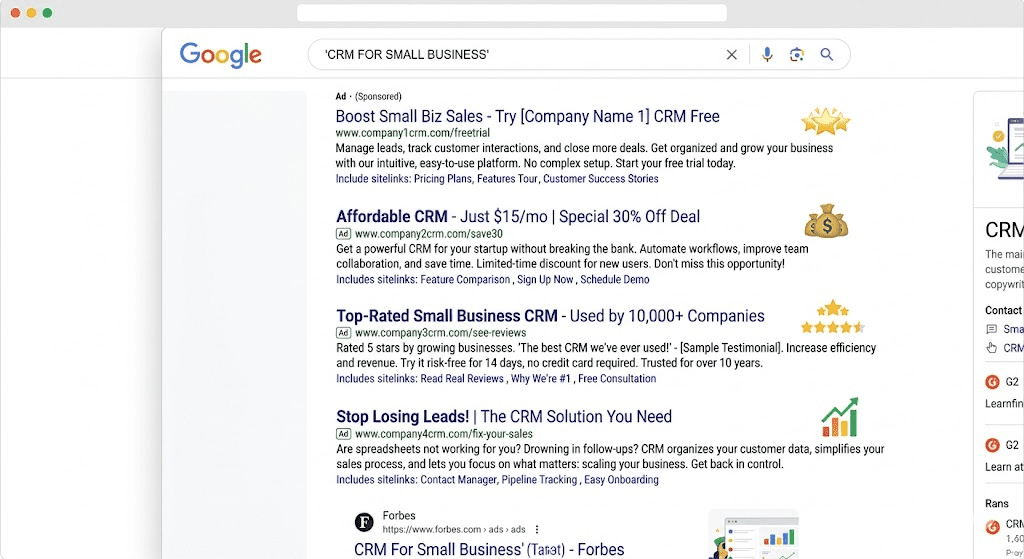
6. Leverage ad extensions (assets). Sitelinks, callouts, structured snippets, and price extensions give your ad more real estate and more information — all at no extra cost. They consistently improve CTR.
7. Revisit and refresh copy regularly. Ad fatigue is real. Even high-performing copy eventually loses its impact. Refresh your ad variations every 60-90 days to maintain performance.
Important Facts & Statistics
These verified data points underscore why mastering PPC ad copy is so critical for digital marketers in 2025 and beyond.
Stat 1: The average click-through rate on Google Ads in 2025 is 6.66%, based on analysis of over 16,000 campaigns (WordStream, 2025 Google Ads Benchmarks). The highest-performing industry — Arts & Entertainment — achieves a CTR of 13.10%.
Stat 2: The average cost per click (CPC) across Google Ads is $5.26 in 2025, up 12.88% year-over-year. In high-competition industries like Legal Services, average CPC reaches $8.58 (WordStream, 2025).
Stat 3: U.S. search ad spending is projected to reach $140.06 billion in 2025 (Digital Silk, 2026), underscoring the massive scale of the PPC ecosystem and how critical effective ad copy is to standing out.
Stat 4: The average conversion rate on Google Ads is 7.52% in 2025 — up 6.84% year-over-year. Industries like Automotive Repair (14.67%) and Physicians & Surgeons (11.62%) lead the pack (WordStream, 2025).
Stat 5: According to Cliff Sizemore, Senior Marketing Manager at LocaliQ: “Costs are rising, but so is performance — 65% of industries saw better conversion rates in 2025. The main takeaway here is that a smart strategy beats cheap clicks.” This confirms that excellent ad copy, not just budget, is the real performance driver.
FAQ Section — People Also Ask
Q1: What makes good PPC ad copy?
Good PPC ad copy is clear, relevant to the user’s search intent, and action-oriented. It should include a keyword-rich headline, a benefit-focused description, and a specific call to action. The best copy speaks directly to a pain point or desire, uses specific numbers or claims to build credibility, and creates enough curiosity or urgency to compel the click. Readability matters too — simple, short sentences consistently outperform complex, jargon-heavy copy in paid ads.
Q2: How many characters can you use in a Google Ad?
Google Responsive Search Ads allow up to 30 characters per headline (up to 15 headlines) and 90 characters per description line (up to 4 descriptions). Google’s system automatically tests different combinations to find which performs best. You should always fill out all available headline and description slots to maximize your ad’s exposure and give Google’s algorithm the most options to work with.
Q3: How often should I update my PPC ad copy?
Industry experts recommend reviewing and refreshing your PPC ad copy every 60 to 90 days — or sooner if you notice performance declining. Ad fatigue occurs when the same audience sees the same message repeatedly, causing CTRs and conversion rates to drop. Running continuous A/B tests on 3-5 ad variations within each ad group is the most effective way to identify winning copy before fatigue sets in.
Q4: What is the best call to action for PPC ads?
The most effective PPC CTAs are specific, action-oriented, and tied to a benefit. High-performing examples include “Get Your Free Quote,” “Start Your Free Trial,” “Book a Free Consultation,” “Download the Free Guide,” and “Shop the Sale.” Avoid generic CTAs like “Click Here” or “Learn More” — they provide no motivation and set no expectations for what happens after the click.
Q5: Can PPC ad copy affect my Quality Score?
Absolutely. Google’s Quality Score (rated 1-10) is directly influenced by your ad’s expected CTR, ad relevance, and landing page experience. Well-written ad copy that closely matches the user’s search query and clearly communicates relevance earns higher Quality Scores. A higher Quality Score means Google charges you less per click and positions your ad higher on the page — making excellent ad copy one of the most cost-effective investments in your entire PPC strategy.
Conclusion
Writing powerful PPC ad copy is one of the highest-ROI skills you can develop as a digital marketer. As we’ve seen from these 13 real-world examples, the difference between an ad that gets ignored and one that earns the click often comes down to a single word, a well-placed number, or the right emotional trigger.
From competitive copy and authority-building to open-loop curiosity and compassionate empathy — every style has its place, and the best advertisers know when to deploy each one. The key takeaway is simple: study what works, understand why it works, and then adapt it to your own brand voice and audience.
With U.S. PPC spend approaching $140 billion and average CPCs rising each year, the cost of lazy ad copy is higher than ever. Don’t let your budget work harder than your words.
Ready to transform your PPC results? Start by picking 2-3 examples from this list and testing them in your next campaign. Drop a comment below sharing which example inspired you most — and don’t forget to share this guide with your team!